
Viruses: no specific cure
| Disease | Species, size | Signs, conditions | Prevention |
|---|---|---|---|
| Nervous necrosis (VNN) | Over 50 species. SEAFDEC 2004: up to 70% in fry, up to 100% at 2.5–7.5 cm, under 20% above 15 cm. WOAH reports often 100% in larvae, lower in older fish | Spiral swimming, lethargy, off feed, sinking then floating. Outbreaks at 24.5–30 °C | Buy tested lots, rear lots apart, UV or ozone on water, no raw fish, less stress |
| Iridovirus | Over 30 marine species, juveniles more susceptible. Grouper of 5–8 cm have lost up to 60% | Mostly in summer at 25 °C and up. Transport stress triggers outbreaks in exposed fish | Quarantine, early screening, less transport stress and lower density |
WOAH notes no chemotherapy is available for these diseases, and commercial vaccines exist in Japan. No marine fish vaccine in Vietnam could be verified. PCR confirms only the presence of virus; diagnosis also needs histology.
Parasites: one bath does not clear them
The stage off the fish is the one to deal with.
| Parasite | Life cycle | What a bath misses | What to do |
|---|---|---|---|
| White spot (Cryptocaryon) | 1–2 weeks on average, 6 days to 11 weeks in all | Cysts on bottom and nets; trophonts under the skin | Move fish to clean tanks, siphon, quarantine new lots |
| Amyloodinium | 12 days or less in good conditions | Cysts on the bottom, spores in the water | Filter or UV intake, quarantine new lots for 3 weeks or more, move fish out of infected tanks |
| Skin flukes (Neobenedenia, Benedenia) | At 24 °C, 35‰: mature at day 10, eggs hatch from day 5 | Eggs on nets and tank walls | Clean or change nets, repeat on the life cycle before flukes lay |
| Gill flukes | Eggs hatch in 5 days, cycle 14–21 days | Eggs | As above, check gills regularly |
Cage surveys in Vietnam: very high Amyloodinium and white spot prevalence in cobia in Kien Giang, and Trichodina year-round in pompano in Hai Phong.
How far a freshwater bath goes
The only controlled trial read: gill flukes on orange-spotted grouper of 2–19 g at 27.5–28.5 °C. Results may not carry over to other species or sizes.
| Freshwater bath | Flukes removed | 24-hour survival |
|---|---|---|
| 30 minutes | 51.0% | 96.5% |
| 60 minutes | 84.5% | 88.5% |
| 120 minutes | 92.5% | 92.0% |
The authors rated 30 minutes as not effective, and 60–120 minutes as stressful with an effect on survival. Water at 60‰ killed all fish. Tolerance differs by species: tiger grouper handle fresh water less well than orange-spotted grouper.
Bacteria: usually follow stress
| Disease | Signs | Triggers |
|---|---|---|
| Vibrio | Off feed, dark colour, ulcers, fin rot, bulging eyes | Parasites, injury in transport and grading; high salinity of 30–35‰ |
| Tenacibaculum | Grey fin tips, fin erosion, tail rot | Injury, poor water, crowding, overfeeding. Worst at 2–80 g (data from sea bream, sole, salmonids and turbot, not these six species) |
| Streptococcus iniae | Whirling, bulging and cloudy eyes, dark colour | Handling stress, parasites, poor water. Seabass can carry it with no signs |
SEAFDEC notes bacteria usually cause disease only when fish are stressed by poor conditions, diet and handling.
Disease photos by species
Photos from open-access papers, with author, journal and licence under each one. Each gives the fish size from the paper. Seed fish here means fish not yet past the grow-out stocking size of that species, as listed on the Moving seed to the cage page. Many show fish larger than seed size, so signs in small fish may differ. They help recognition but do not replace diagnosis.
Asian seabass
Seed fishExperimental infection
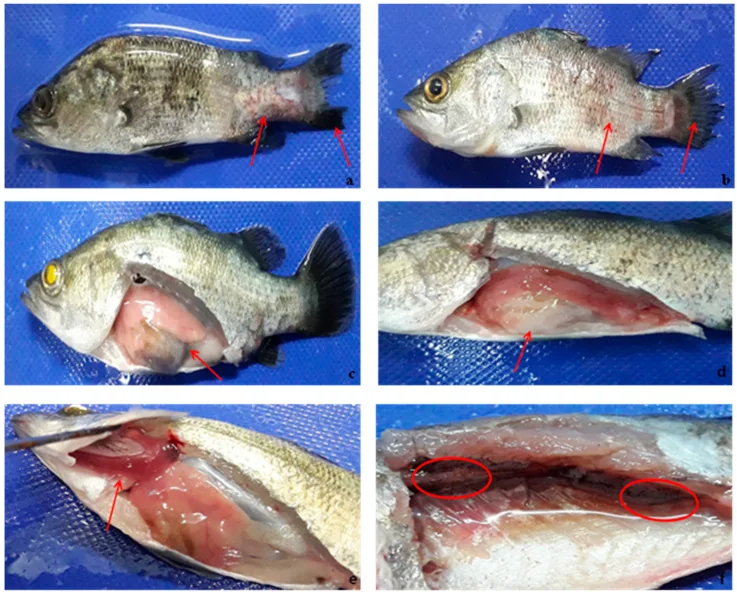
Fish size: about 5 cm, 10–20 gHaemorrhagic skin, eye opacity, tail and fin rot (a, b), swollen gonad (c), swollen intestine (d), pale gill (e), black spots (f).Source: Silvaraj et al. (2020), Vaccines 8(4), CC BY 4.0. Resized.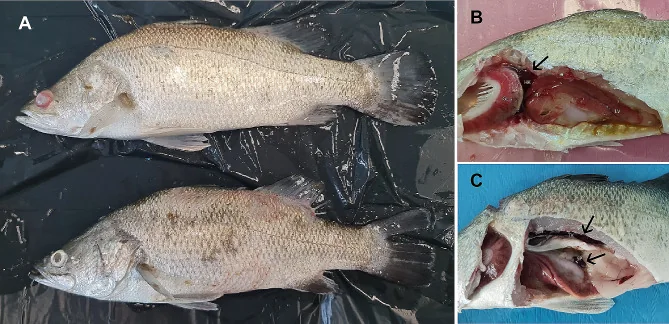
Seed fishExperimental infection
Fish size: 15 g at the start, challenged after 6 and 10 weeksOutside: cloudy eye, fin and tail erosion, skin haemorrhage, detached and lost scales (A). Inside: severe liver haemorrhage, enlarged spleen and kidneys (B, C).Source: Chokmangmeepisarn et al. (2024), BMC Veterinary Research 20, CC BY 4.0. Resized.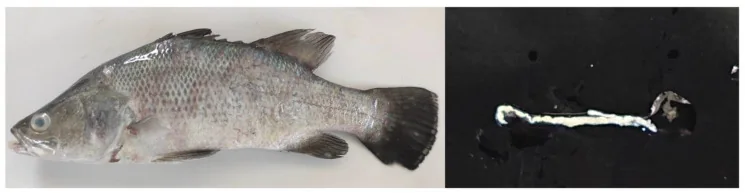
Mixed sizesExperimental infection
Fish size: called juvenile, 10 g at the start and 130 g at the last round; the photo does not say which roundLens opacity in both eyes and scale loss (left). Whitish faeces from sick fish in the trial tank (right).Source: Tanpichai et al. (2023), Vaccines 11(2), CC BY 4.0. Resized.Grouper
Seed fishExperimental infection
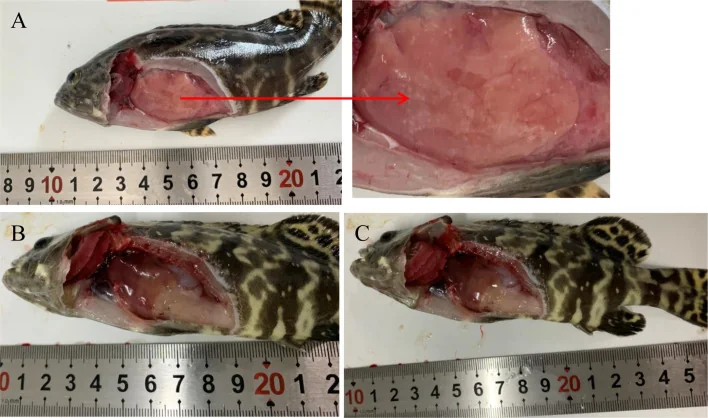
Fish size: about 50 gLesions with a high-virulence strain (A) and a low-virulence strain (B), against a saline control (C).Source: Deng et al. (2020), Frontiers in Immunology 11, CC BY 4.0. Resized.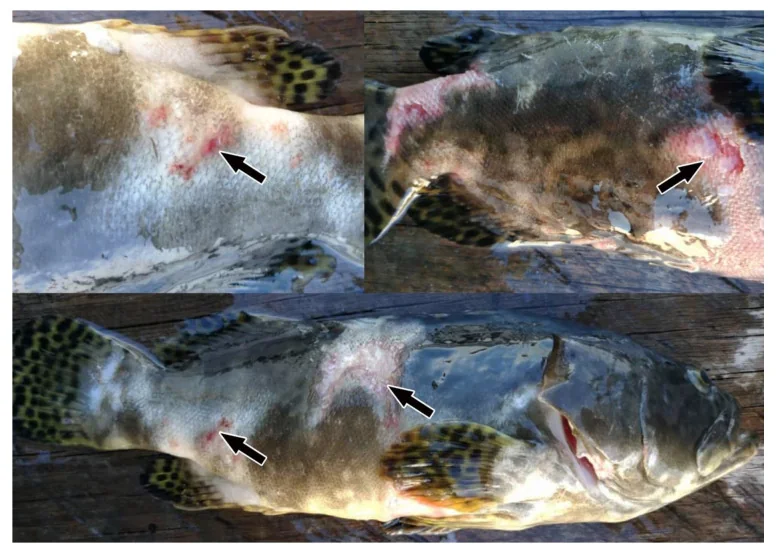
Mixed sizesNatural infection
Fish size: the stock grew from 31 g to 208–248 g in 4 months; the photo does not give its sizeFarmed fish in Malaysia: severe scale loss, skin ulcers and muscle necrosis. Arrows mark infected areas.Source: Mohamad et al. (2022), Animals 12(2), CC BY 4.0. Resized.Cobia
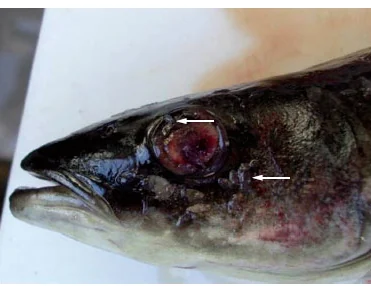
In grow-outNatural infection
Fish size: 317 g on average, in sea cagesSea-caged fish in Brazil: many flukes around the eye (arrows), skin haemorrhage and keratitis.Source: Kerber et al. (2011), Rev. Bras. Parasitol. Vet. 20(4), CC BY 4.0. Cropped and resized.Golden pompano
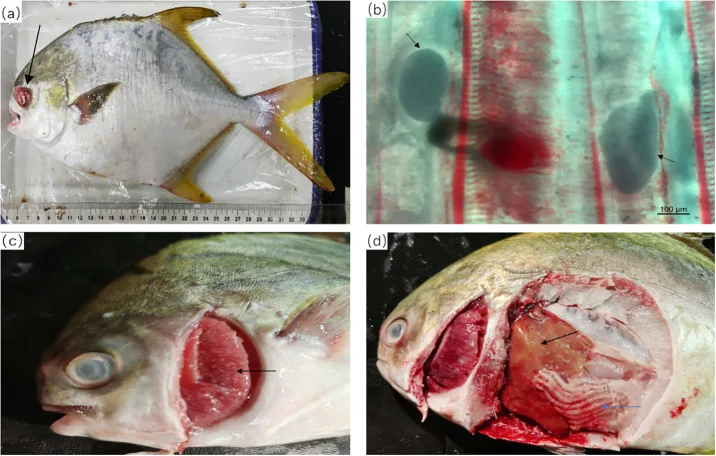
In grow-outNatural infection
Fish size: about 500 g, 31.5 cm, in sea cagesFarmed fish with a mixed infection: eye inflammation (a), white spot parasites on gill filaments (b), many white spots on the gills (c), uneven liver and inflamed gut (d).Source: Huang et al. (2024), PLOS ONE 19(7), CC BY 4.0. Resized.Red drum
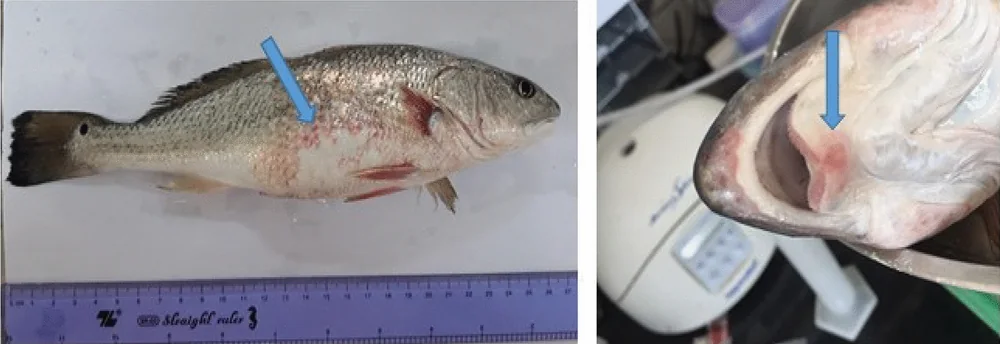
Size not statedNatural infection
Fish size: not stated in the paperA sample with haemorrhagic signs (arrows) in a Hue University study.Source: Yen et al. (2021), AMB Express 11, CC BY 4.0. Resized.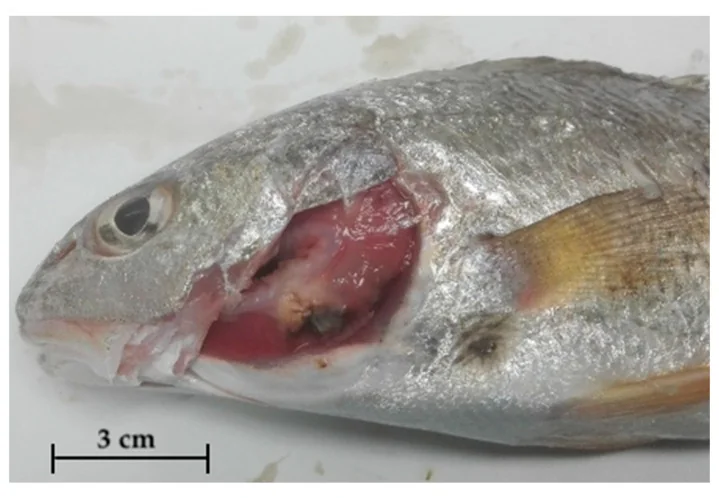
In grow-outNatural infection
Fish size: about 200 gFish farmed in the Mediterranean with Mycobacterium pseudoshottsii.Source: Mugetti et al. (2020), Pathogens 9(8), CC BY 4.0. Resized.Rabbitfish
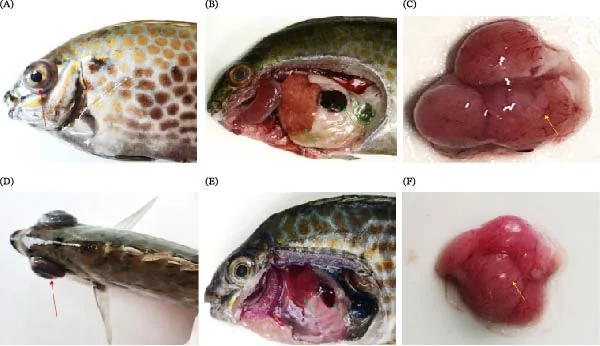
Mixed sizesNatural infection (A–C), experimental infection (D–F)
Fish size: outbreaks in fish of 15–260 g, challenged fish about 35 gCage-farmed fish in Vietnam. Bulging eyes, haemorrhage in the organs and brain. Challenged fish showed similar signs.Source: Hoai et al. (2026), Transboundary and Emerging Diseases, CC BY 4.0. Resized.Parasites: photos from other fish
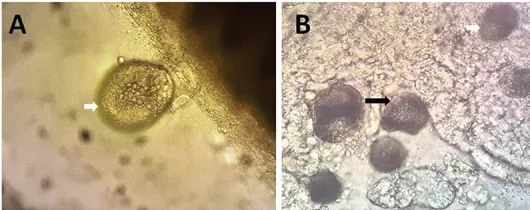
Seed fishNatural infection
Fish size: about 1 g, in a hatcheryFresh gill smears: dark brown trophonts (A, B). This stock lost 70%. A different fish, shown to illustrate the parasite under the microscope.Source: Ragab et al. (2022), Int. J. Vet. Sci. Med. 10(1), CC BY 4.0. Cropped and resized.
In grow-outNatural infection
Fish size: 102 g on averageHealthy (a) and infected fish (b); healthy (c) and infected gills (d). A different fish, shown to illustrate the lesions.Source: Cervera et al. (2022), Int. J. Mol. Sci. 23(2), CC BY 4.0. Cropped and resized.Daily biosecurity
Drugs and chemicals
Malachite green, nitrofurans, chloramphenicol, trichlorfon and other banned substances must not be used. Older manuals may still list them, so do not copy those. Use only drugs on the permitted list, for the right species and label, once the disease is identified. This page gives no chemical bath doses. Unusual deaths must be reported to the commune vet or nearest aquatic veterinary office; VNN is a reportable disease.