
Free tool · Mineral calculator
Mineral calculator by salinity for shrimp ponds
Enter salinity and your Ca, Mg, K and alkalinity test results. The calculator compares them with diluted seawater at the same salinity, sets targets from published trials, and works out how many kilograms of chemical the whole pond needs — split into doses.
Yellow cells — fill inArea, depth, salinity and your Ca, Mg, K, alkalinity test results
White cells — defaultsChemicals, % content, number of doses — change if needed
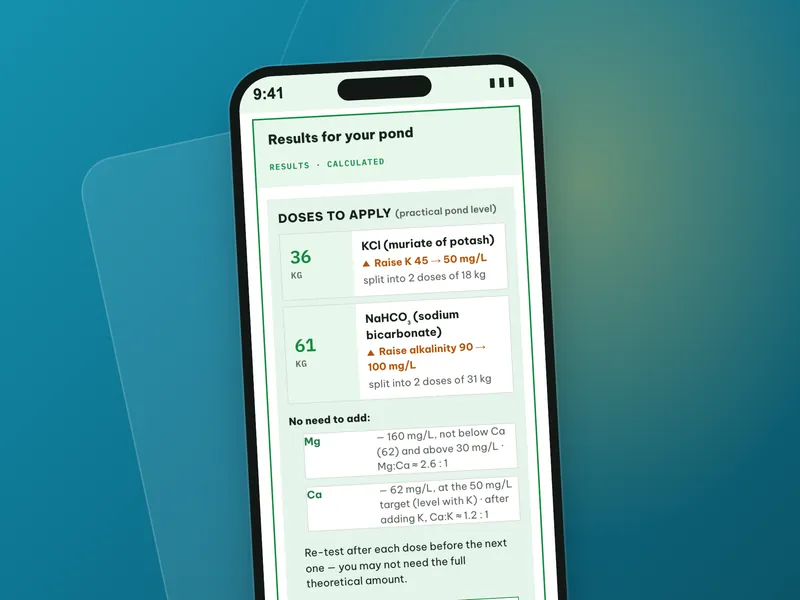
Green panel — resultsKilograms to apply, calculated as you type
Results for your pondResults · calculated
Target levels at 5‰
- K ≈ 50 mg/L (practical: seawater level but max 50) · 54 mg/L diluted seawater
- Mg ≥ 30 mg/L (minimum) · 196 mg/L diluted seawater
- Ca ≈ 50 mg/L (level with K, min 30) · 58 mg/L diluted seawater
- Alkalinity: minimum 80, best 100–120; below 80, first raise to 80 — target 100 mg/L
Enter your Ca, Mg, K or alkalinity readings (step 2) to get the kilograms to add — or tap “Try sample values”.
What is it based on?
- Diluted-seawater levels (reference): Ca = 11.6 × salinity, Mg = 39.1 × salinity, K = 10.7 × salinity (mg/L per ppt; Davis, Samocha & Boyd, SRAC 2601).
- Potassium (K) — Practical pond level (default): target K = pond Na ÷ 28.5 (the seawater Na:K ratio), capped at 50 mg/L. Without a Na reading, Na is estimated from salinity, so the target equals the diluted-seawater level (10.7 × salinity) capped at 50. Basis: in 4 ppt well water with added KCl, Na:K 23–33:1 improved survival and growth (Liu et al., 2014); at 4 ppt growth rose with K up to 40 mg/L, the highest level tested (Roy et al., 2007). Full mode has no cap — 75 mg/L at 7 ppt, which takes more KCl.
- Why K matters: K is usually the most critical deficiency in low-salinity ponds (Boyd); at 4 ppt, growth improved as K rose from 5 to 40 mg/L (Roy et al., 2007).
- Magnesium (Mg): default minimum 30 mg/L and not below Ca. At 4 ppt, 10 mg/L Mg gave 60% survival vs 90–97% at 20 mg/L and above (Roy et al., 2007); Mg reduced to 30 mg/L with Mg:Ca 1:1 did not reduce growth at 5 ppt (Aquaculture, 2023). The full 39.1 × salinity level is optional and usually needs a lot of chemical.
- Calcium (Ca) — practical mode: level with the practical K target so Ca:K stays near seawater's 1:1 (SRAC 2601), minimum 30 mg/L — 50 mg/L from 5 ppt up. After molting, shrimp take Ca from the water to harden the shell. If raising Ca leaves Mg below Ca, the calculator shows how much Mg to add to keep Mg:Ca at 1:1 or more. Full mode uses the diluted-seawater level (11.6 × salinity).
- Alkalinity: minimum 70–80 mg/L CaCO₃, 100–120 is better (Boyd); not below 75 (SRAC 2601). Default target 100 mg/L, adjust to your own protocol. Practical mode: below 80, step 1 only raises it to 80; re-test before raising further, so the water does not change too fast. Sodium bicarbonate dissolves at once; limestone/dolomite dissolves poorly in brackish water (Boyd).
- Dose formula: chemical (kg) = increase (mg/L) × volume (m³) ÷ 1,000 ÷ (% element ÷ 100). Default contents come from the chemical formula or SRAC — enter your batch COA values.
Article: El Niño 2026–2027 — How much mineral is enough? (Part 5)
A reference tool giving theoretical amounts for pure chemicals. Always split doses, re-test after each one, and consult a technician if shrimp show problems.