
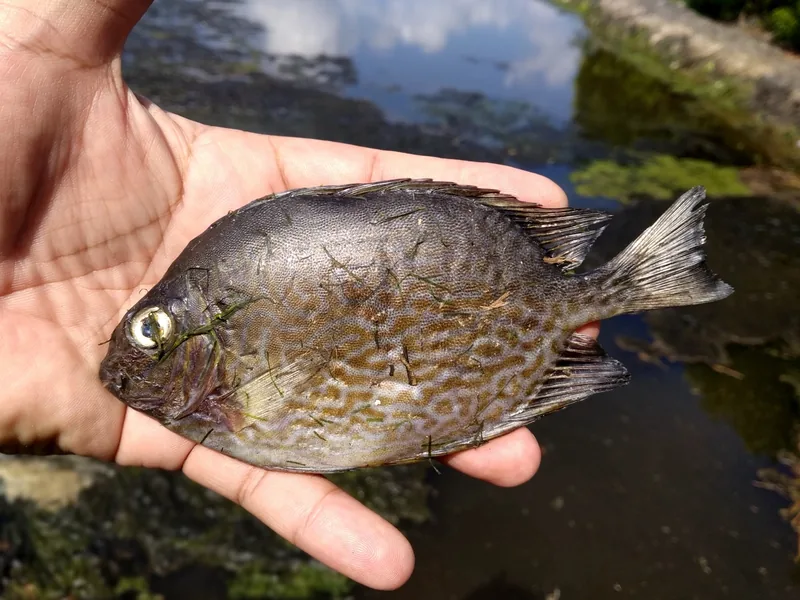
- Small fingerling to fingerling, Hue
- 72.86% survival
- Net cages in ponds
- 150 fish/m³ for 1-inch fish
- Harvest size
- 30–50 g
- Feed protein
- 35–37%
Rations in net cages
SEAFDEC AEM 70: 3 meals at 9:00, 12:00 and 17:00, feed with 35–37% protein and 7–8% fat. Where Gracilaria or filamentous algae are plentiful, they can make up 50%.
| Weight | Daily ration |
|---|---|
| 0.5–10 g | 12% |
| 11–20 g | 10% |
| 21–30 g | 7% |
| 31–60 g | 6% |
Hapa density
1 × 1 × 1 m hapas in a pond, 30-day fish of 1.6 cm, 60 days. The authors favoured 500 fish/m³ on profit.
| Density | Survival |
|---|---|
| 250 fish/m³ | 68.83% |
| 500 fish/m³ | 64.33% |
| 1,000 fish/m³ | 43.29% |
AEM 70 gives 150 fish/m³ for 1-inch fish; the manual's economic model uses 100 fish/m³ for 2.5-inch fish. It gives 60 days to about 3 months, and 30–50 g (40–50 g in one place).
Water and care
Pond water
Salinity 20–32‰, 25–32 °C, pH 6.5–8.5, oxygen 4–6.8 mg/L with aeration below 4 mg/L, NO2-N 0–0.05 mg/L, water at least 1 m deep.
Shade
Fry are sensitive to ultraviolet light, so shade the nursery with old nets. Cage mesh is 5 mm.
Safe handling
Fin spines carry venom glands, so wear gloves. A prick causes burning pain and a severe headache.
Transport
2.3 cm fish
Road test at 22–23 °C in bags with 4 L of water: 300 fish per bag had 99.44% survival after 15 hours; 400 per bag suited 10 hours; 500 per bag fell to 61.67% after 10 hours.
30–50 g fish
5–6 fish/L, 4–5 L of water per bag, oxygen 1:1, 150–200 g of ice per box, moved early morning or late afternoon.
Not yet known
No grading interval or size rule for rabbitfish was found. TCVN 14143-1:2024 exists but its full text was not read.
Disease photos: rabbitfish
Photos from open-access papers, with the source and fish size under each one. They help recognition but do not replace diagnosis.
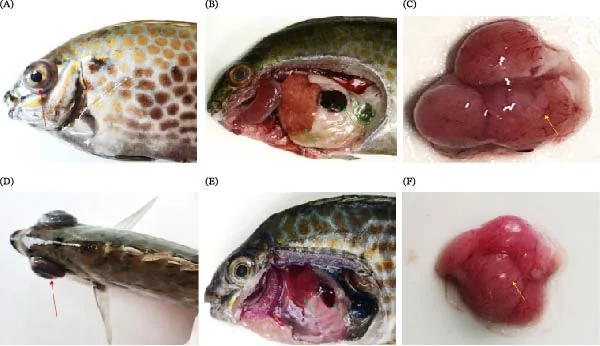
Mixed sizesNatural infection (A–C), experimental infection (D–F)
Fish size: outbreaks in fish of 15–260 g, challenged fish about 35 gCage-farmed fish in Vietnam. Bulging eyes, haemorrhage in the organs and brain. Challenged fish showed similar signs.Source: Hoai et al. (2026), Transboundary and Emerging Diseases, CC BY 4.0. Resized.