
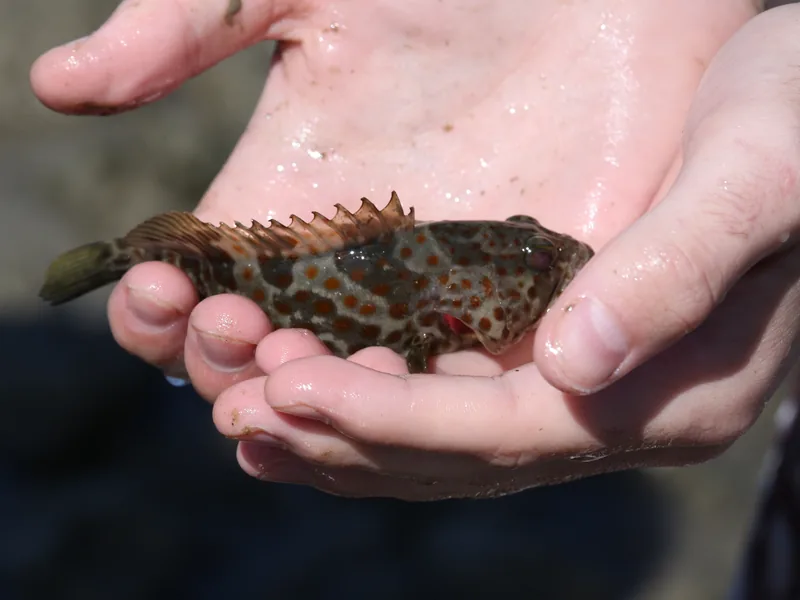
- Brown-spotted grouper, small fingerling (QCVN)
- 1.5 to under 7 cm
- Brown-spotted grouper, fingerling (QCVN)
- from 7 cm, 6 g
- Usual hatchery size
- 2–3 cm
- 30–50 days in nursery
- reaches 7–10 cm
Tiger grouper density by size
Table 2 of ACIAR Monograph 150, for tiger grouper. Density can rise with added oxygen, but disease outbreaks become more likely.
| Length (cm) | Tanks (fish/m³) | Cages in ponds (fish/m³) |
|---|---|---|
| 2.5–4 | 1,000–1,500 | 1,500–2,000 |
| 4–5 | 750–1,000 | 1,000–1,500 |
| 5–7 | 500–750 | 750–1,000 |
| 7–9 | 400–500 | 500–750 |
| 9–11 | 300–400 | 300–500 |
| 11–13 | 250–300 | 250–300 |
| 13–15 | 150–200 | 150–200 |
Flow-through tanks exchange at least 300% a day. For tanks without flow-through and with at least 50% daily exchange, SEAFDEC (2001) gives 50–200 fish/m³ under 2.5 cm, and one Philippine farm settled at about 100 fish/m³ for 1.5–3 cm fish.
Pellet feeding
ACIAR calls this a guide only. Fish going to a pellet farm should be weaned at the hatchery and stay on pellets through the nursery.
| Weight | Daily ration | Meals |
|---|---|---|
| 1–5 g | 4–10% | 3–5 |
| 5–20 g | 2–4% | 2–3 |
| 20–100 g | 1.5–2% | 2 |
Grouper under 20 g need about 50–52% protein and under 12–13% lipid. Starting at dawn clearly cuts cannibalism in tiger grouper.
Grading grouper
Under 30% spread
A lot should differ by under 30% in length, for example a 50 mm grade is 45–59 mm. Trials on giant grouper also point to a threshold of about 30%.
How often
Pond nets in Aceh: every 3 days. Other nurseries go from 3–4 days to over a week, because grading stresses and scratches fish and can open the way to disease.
Tools
Above 1 cm use bar graders rather than mesh. A 1 mm gap matches about 8 mm of body length in orange-spotted grouper and 7.5 mm in tiger grouper.
Water, light and shelter
Water
25–32 °C, salinity 20–32‰, oxygen 4–8 mg/L, pH 7.5–8.3, NH3-N under 0.02 mg/L (tiger, orange-spotted, giant grouper).
Light
Roofed tanks with light up to about 600 lux give the best survival.
Shelter
Pipes or bamboo in ponds raise fry survival and cut cannibalism and disease. No number per m² is given.
Grouper in Vietnam
A two-step nursery
Manuals give 5–10 cm for cages, but a 2013 survey at Hon Ngang, Kien Giang found farmers stocking 12–20 cm. Quang Ninh's guide says 12 cm and up for hybrid grouper.
Pearl grouper
RIA3 grew 7–8 cm fish to 15–20 cm in pond hapas at 20 fish/m² on 46–48% protein feed at 5–7% of body weight in 3 meals, reaching 128.8 g in 3 months with 94% average survival in 3 model ponds. The density trial at the same rate gave 79.6%.
Freshwater baths
Orange-spotted and giant grouper tolerate fresh water well, tiger grouper less so. Bath small batches for under 15 minutes.
Disease photos: grouper
Photos from open-access papers, with the source and fish size under each one. They help recognition but do not replace diagnosis.
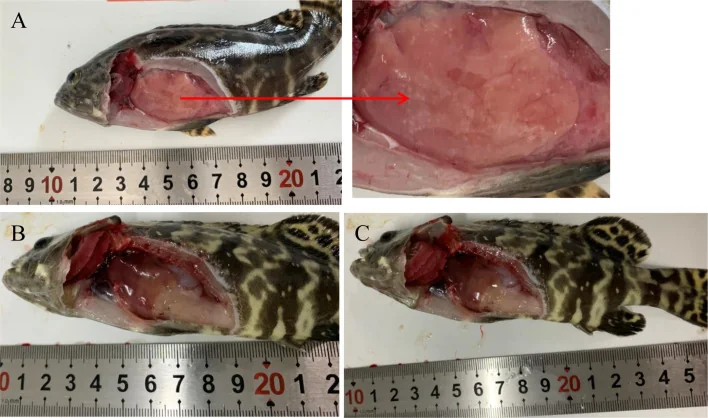
Seed fishExperimental infection
Fish size: about 50 gLesions with a high-virulence strain (A) and a low-virulence strain (B), against a saline control (C).Source: Deng et al. (2020), Frontiers in Immunology 11, CC BY 4.0. Resized.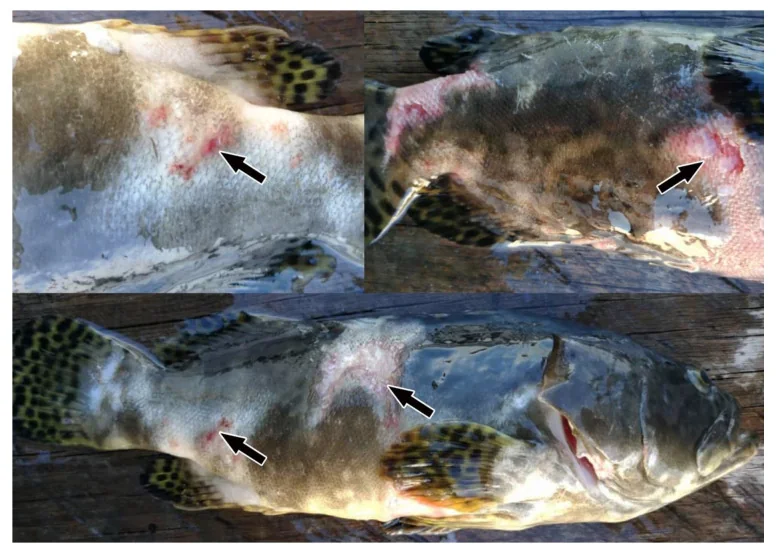
Mixed sizesNatural infection
Fish size: the stock grew from 31 g to 208–248 g in 4 months; the photo does not give its sizeFarmed fish in Malaysia: severe scale loss, skin ulcers and muscle necrosis. Arrows mark infected areas.Source: Mohamad et al. (2022), Animals 12(2), CC BY 4.0. Resized.