
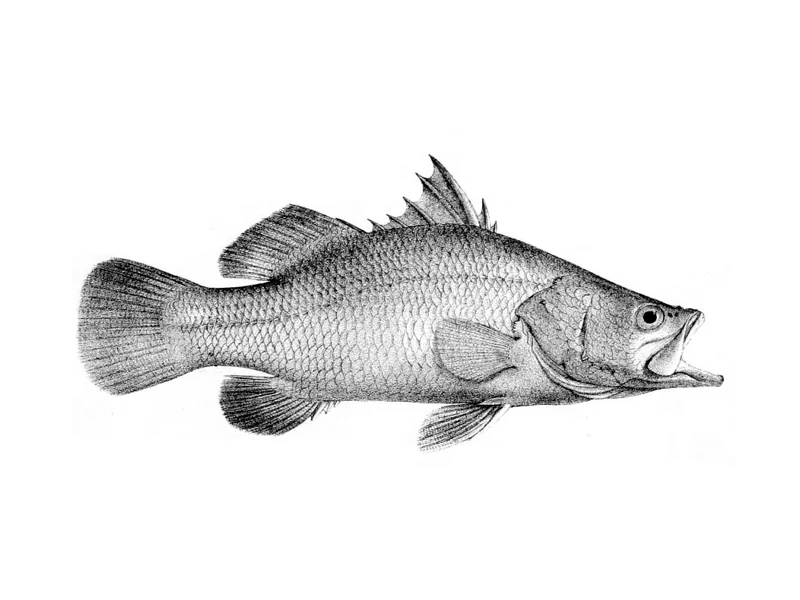
- Usual hatchery size
- 1–1.5 cm, 25–30 days old
- 4–5 weeks in tanks
- reaches 4–6 cm, 1.5–3 g
- Safe weaning size
- from about 16 mm
- Length gap to separate
- from 30–33%
Do not wean too early
An Australian trial in 130 L tanks at 28 °C in fresh water: survival through 10 days of weaning was 38.9% at 12.8 mm, 57.6% at 13.6 mm, 97.0% at 16.7 mm and 92.3% at 19.6 mm. Fish of 1 cm from a hatchery are usually not yet on pellets, so they still need live or natural food at first.
Densities on record
These come from different systems and cannot be compared directly.
| System | Fish size | Density | Result |
|---|---|---|---|
| 5–10 t tank with Artemia biomass grown in it, 70% daily exchange | Stocked at 1–1.5 cm | 800–1,000 fish/m³ | 60–70% survival after 4–5 weeks |
| 2 × 1 × 1 m hapa | to 2.5–3 cm | 150–200 fish/m³ | Given as optimum by SEAFDEC |
| 2 × 1 × 1 m hapa, a farm in India | 1.76 cm | 1,500 fish/hapa | Only 25% survival after 45 days |
| Estuary hapa, India | 4.8 cm | 463 fish/m³ | 77% survival over 38 days, to 8.4 cm |
| 10 m³ tank, Hue | 5 cm, 2.7 g | 500 / 700 / 900 fish/m³ | 99 / 86 / 73% survival after 60 days |
Feeding
| Feed | Daily ration | Meals | Stage |
|---|---|---|---|
| Artemia biomass in the tank, plus minced fish, 3–5 mm | 100, 80, 60, 40, 20% of body weight in weeks 1–5 | 3–4 | From 1–1.5 cm, in tanks |
| Moist balls, 40% protein | 10% then 8% | 2 | From 1.8 cm, in hapas |
| 3 mm pellets, 52% protein | 10% | 2 | 2.7–11.7 g, in tanks |
Minced fish is counted wet, so its percentage is far higher than for pellets. Trash fish can carry pathogens: see the Feeding page.
Grading seabass
Size rule
Fish can swallow prey about 60–67% of their own length, so separate fish that differ by 33% or more. SEAFDEC says no more than 30% difference in one tank.
How often
Hatchery larval tanks: every 3 days from day 15 after hatching (CMFRI). Nursery tanks and hapas: every 5–7 days (SEAFDEC). A Tahiti study saw cannibalism appear once fish moved to artificial feed.
How much it costs
Indian data put cannibalism at 11–51% of all deaths in hapas. Indian hatcheries use graders with 2, 4, 6, 8, 10 mm openings at the larval stage.
Water and transfer
Salinity
Seabass tolerate fresh water to full seawater and grow better at 10–20‰ (SEAFDEC). No source read gives safe oxygen or ammonia limits for seabass fry, so use the general figures on the Water page.
Transfer size
SEAFDEC gives 20–50 g as ideal. Quang Ninh's guide says 12 cm and up at 25 fish/m³. Indian work stocks cages from 10–15 g at 25–30 fish/m³.
Standard
TCVN 12242:2018 on seabass seed is active on the VSQI portal. Its table values are not quoted here because the full text was not read.
Disease photos: asian seabass
Photos from open-access papers, with the source and fish size under each one. They help recognition but do not replace diagnosis.
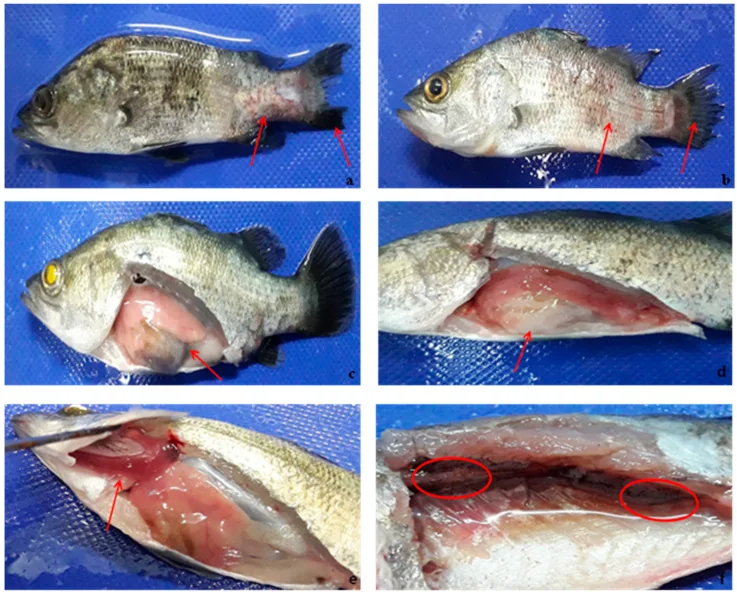
Seed fishExperimental infection
Fish size: about 5 cm, 10–20 gHaemorrhagic skin, eye opacity, tail and fin rot (a, b), swollen gonad (c), swollen intestine (d), pale gill (e), black spots (f).Source: Silvaraj et al. (2020), Vaccines 8(4), CC BY 4.0. Resized.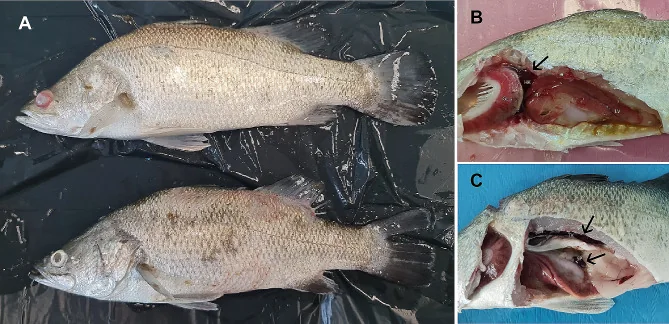
Seed fishExperimental infection
Fish size: 15 g at the start, challenged after 6 and 10 weeksOutside: cloudy eye, fin and tail erosion, skin haemorrhage, detached and lost scales (A). Inside: severe liver haemorrhage, enlarged spleen and kidneys (B, C).Source: Chokmangmeepisarn et al. (2024), BMC Veterinary Research 20, CC BY 4.0. Resized.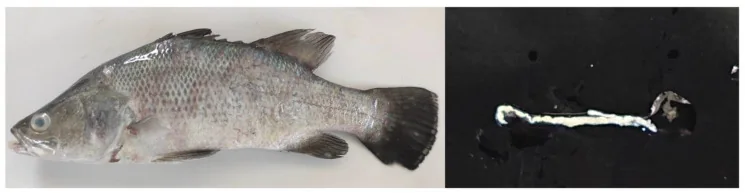
Mixed sizesExperimental infection
Fish size: called juvenile, 10 g at the start and 130 g at the last round; the photo does not say which roundLens opacity in both eyes and scale loss (left). Whitish faeces from sick fish in the trial tank (right).Source: Tanpichai et al. (2023), Vaccines 11(2), CC BY 4.0. Resized.