
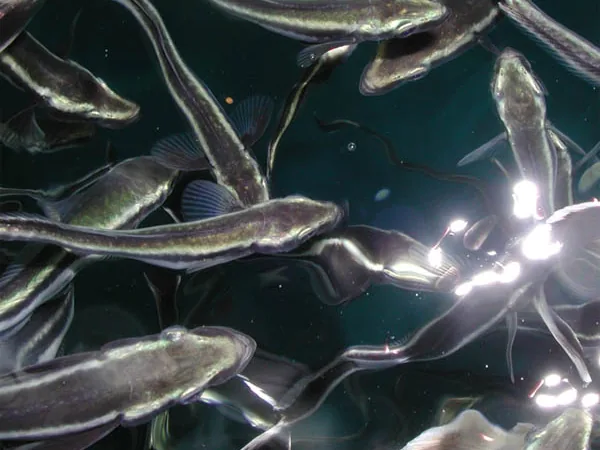
- Small fingerling (QCVN)
- 4 to under 10 cm
- Fingerling (QCVN)
- from 10 cm, 8 g
- 5–6 cm to 11.5 cm
- 28–30 days
- Survival in this step
- 87.3% (16,000-fish trial)
From 5–6 cm to 11.5 cm in tanks
Three batches at Kien Luong, 16,000 fish, 8 m³ cement tanks. The 87.3% survival covers this step only, not from fry.
| Age, size | Feed size | Meals |
|---|---|---|
| 35–45 days, 5–8 cm | 400–600 µm | 4–6 |
| 45–55 days, 8–10 cm | 500–800 µm | 4 |
| 55–65 days, 10–12 cm | 800–1,200 µm | 3 |
Density 0.5–0.8 fish/L, feed over 55% protein and over 8% lipid. Water at 27–31 °C, salinity 27–32‰, pH 7.6–8.2, oxygen over 4 mg/L, TAN under 0.5 mg/L. Siphon and change 50–70% of the water daily. The paper's density differs slightly between sections, from 0.5 to 0.8 fish/L.
Grading cobia
Vietnamese work
Above 3 cm: every 5 or 7 days (RIA1). From 4–5 cm: every 10–20 days depending on size spread (Kien Luong).
Indian work
From 25 to 40 days of age cannibalism is strong, so grade every 3 days.
Not yet known
No grader size or size-difference rule for cobia was found in the sources read.
Disease and transfer
Amyloodinium
Caused high juvenile losses in RIA1 hatcheries in 2005 and 2006. A cage survey in Kien Giang found very high infection rates. Check gills before moving fish.
Transfer size
Vietnam: 10–12 cm, sometimes nursed on in bigger tanks or sea hapas. Quang Ninh's guide says 18 cm and up at 3 fish/m³.
Transport
Very sensitive to density: 48 mm fish at 2.5 fish/L had 100% survival after 48 hours, at 5 fish/L only 12.5%. Over 12 hours, 5 cm fish at 20 / 40 / 60 fish/L had 100 / 80 / 60% survival.
Disease photos: cobia
Photos from open-access papers, with the source and fish size under each one. They help recognition but do not replace diagnosis.
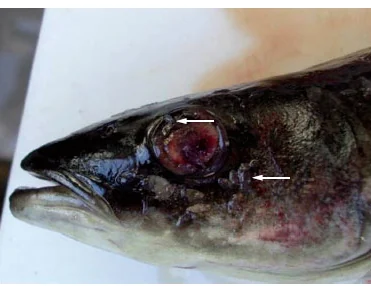
In grow-outNatural infection
Fish size: 317 g on average, in sea cagesSea-caged fish in Brazil: many flukes around the eye (arrows), skin haemorrhage and keratitis.Source: Kerber et al. (2011), Rev. Bras. Parasitol. Vet. 20(4), CC BY 4.0. Cropped and resized.