
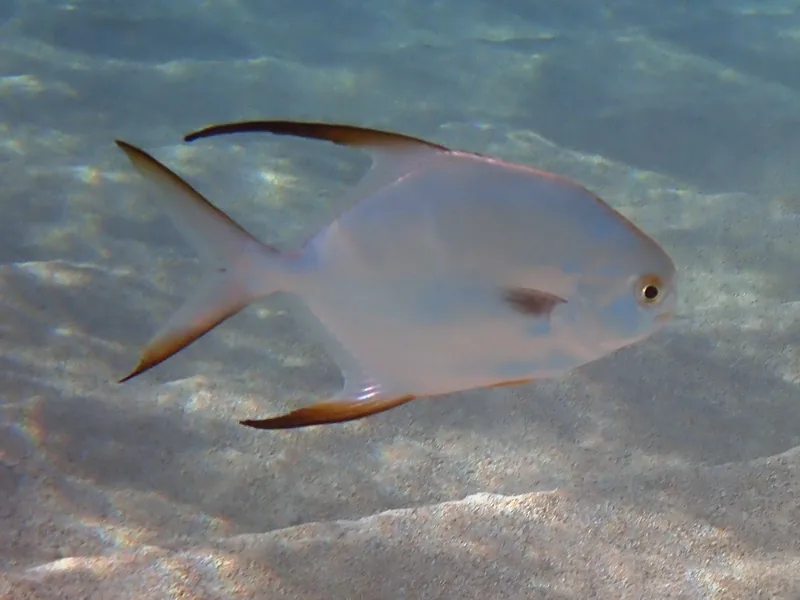
- Small fingerling (QCVN)
- 2 to under 5 cm
- Fingerling (QCVN)
- from 5 cm, 6–7 g
- Best pond salinity
- 25–33‰
- Best pond temperature
- 26–32 °C
Long-finned: density
| System | Fish size | Density | Result |
|---|---|---|---|
| 5 × 5 × 1.5 m net in a pond, Philippines | 1 g, 3.8 cm | 150 fish/m³ | Reared 35 days or until 30 g (manual's protocol) |
| 3 m³ cage at Hon Tre, Kien Giang | 1.88 g | 200 / 300 / 400 / 500 / 600 fish/m³ | 97.6 / 97.2 / 98.6 / 91.1 / 87.1% survival after 30 days. Authors chose 400 |
Short-finned: stepwise cage nursery
A protocol from a farm group in Hainan, 60 m HDPE cages. Fish move up once enough reach the next size. Above these densities survival held but the stock became less even.
| Length | Density | Mesh |
|---|---|---|
| 2.9–3.2 cm | 280–300 fish/m³ | 1.2 cm |
| 4.4 to under 5.8 cm | 150–180 fish/m³ | 2.0 cm |
| 5.8 to under 7.2 cm | 120–150 fish/m³ | 3.0 cm |
Feed over 40% protein, 3–6% of body weight, 3 meals, net change about every 7 days, fish in a lot within about 1 cm.
Feeding long-finned pompano
| Weight | Pellet | Daily ration | Meals |
|---|---|---|---|
| Under 1 g | 0.8–1.0 mm | 20% | 4 |
| 1–10 g | 1.0–1.5 mm | 10% | 4 |
| 10–100 g | 1.8 mm | 5% | 3 |
Indian work for pond fish. SEAFDEC gives 10–8% for 1–30 g fish in 4 meals and warns against feeding to satiation, since the fish do not stop when full. The Hon Tre trial fed to satiation and recorded FCR of 2.61–3.29.
Notes
Low salinity
Long-finned pompano handle low salinity well, and CMFRI reports faster growth at 10–15‰. An Indian trial dropped from 32‰ to 12‰ over 24 hours before packing. Cages at Hon Tre measured 14–16‰ and fish did well.
Check before moving
In Hai Phong (the paper names T. falcatus), tank fish with Amyloodinium were treated in September. Moved to sea cages in late October, they showed 86.7% Amyloodinium and 90% white spot infection 8 days later.
Transfer size
Quang Ninh: 6–8 cm at 25–35 fish/m³. Hainan: 7.2–8.2 cm. The Philippines stocks ponds from 30 g.
Disease photos: golden pompano
Photos from open-access papers, with the source and fish size under each one. They help recognition but do not replace diagnosis.
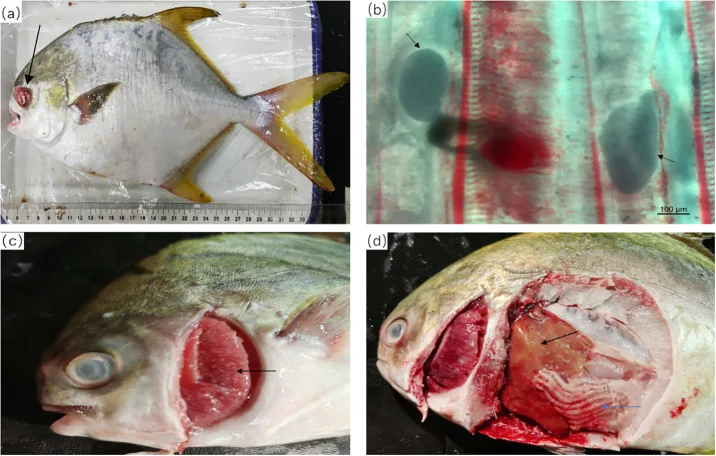
In grow-outNatural infection
Fish size: about 500 g, 31.5 cm, in sea cagesFarmed fish with a mixed infection: eye inflammation (a), white spot parasites on gill filaments (b), many white spots on the gills (c), uneven liver and inflamed gut (d).Source: Huang et al. (2024), PLOS ONE 19(7), CC BY 4.0. Resized.