
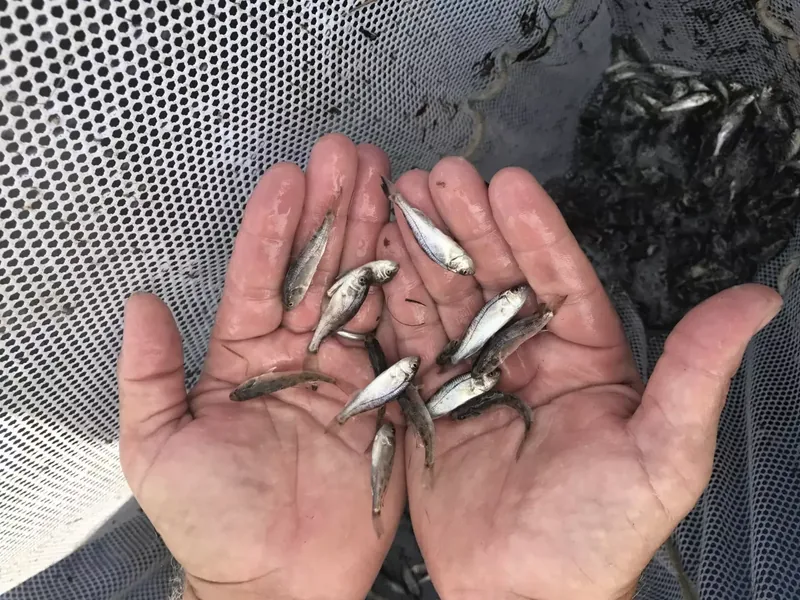
- Small fingerling (QCVN)
- 3 to under 5 cm, 1 to under 4 g
- Fingerling (QCVN)
- from 5 cm, 4 g
- Best salinity
- 25–35‰
- Best temperature
- 24–27 °C
Feed by size
SRAC 0324 table for US ponds. Pond switch from meal to crumble: replace 10% a day from day 25 to day 35.
| Fish size | Feed form | Protein | Lipid | Ration |
|---|---|---|---|---|
| 2.5–7.6 cm | #2 crumble (1.0–1.3 mm) | 45–50% | 15–17% | 5% BW/day |
| 7.6–15 cm | #3 crumble or 2.3–3.2 mm pellet | 45–50% | 15–17% | 5% BW/day |
| 15–20 cm | 2.3–6.4 mm pellet | 40–45% | 13–16% | 4% BW/day |
Water and acclimation
Temperature
Best at 24–27 °C, cultured at 18–31 °C. Growth slows sharply below 20 °C, and survival often falls above 29 °C.
Salinity
Best at 25–35‰, possible down to 10‰ with slow tempering.
Acclimation time
At least 1 hour per 5.6 °C, per pH unit or per 10‰ of salinity difference. Fish tolerate small decreases in temperature or salinity better than increases.
Cannibalism, disease, transport
Cannibalism
The Nha Trang paper reports cannibalism at 10–20 mm. Higher density needs more frequent grading. No fixed interval was found.
Amyloodinium
SRAC lists red drum as high risk: onset is acute and spread very fast. Control needs repeated treatments, or treatment for more than 10–14 days, and lowering salinity may fail.
Transport
Fast at least 1 day, 2 recommended. Haul at about 10‰ and 20–24 °C, avoiding below 15 °C and above 27 °C. Do not use agitators with fish under 7.6 cm, since fish die against them.
Density
A 60 L tank trial at Nha Trang: 21.9 mm fish at 2–4 fish/L had 75–88.75% survival after 28 days, reaching 53.5–55.7 mm. That is a lab tank, not a farm density. Quang Ninh's guide stocks cages from 10 cm at 25 fish/m³.
Disease photos: red drum
Photos from open-access papers, with the source and fish size under each one. They help recognition but do not replace diagnosis.
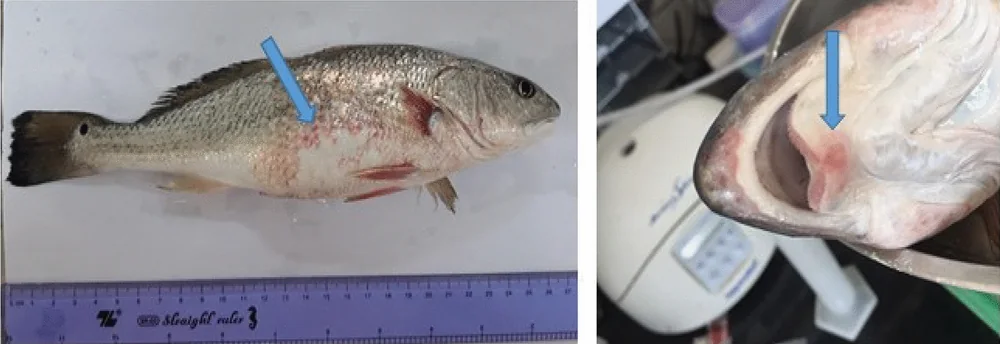
Size not statedNatural infection
Fish size: not stated in the paperA sample with haemorrhagic signs (arrows) in a Hue University study.Source: Yen et al. (2021), AMB Express 11, CC BY 4.0. Resized.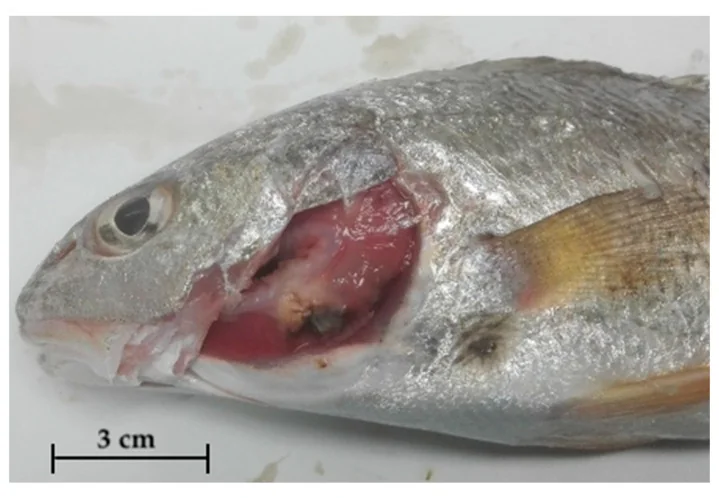
In grow-outNatural infection
Fish size: about 200 gFish farmed in the Mediterranean with Mycobacterium pseudoshottsii.Source: Mugetti et al. (2020), Pathogens 9(8), CC BY 4.0. Resized.