01 / FORECAST
The lowest since 2016
According to data from members of IFFO — The Marine Ingredients Organisation — the supply of raw material for fishmeal and fish oil production improved in August 2026, thanks to higher output in Chile, Spain and the United States. But on a year-to-date basis, fishmeal output in the monitored countries was still 45% lower, and fish oil 26% lower, than in the same period of 2025.
“2026 is expected to deliver a reduction in the supply of marine ingredients, down to less than 4.6 million mt for fishmeal. This would represent the lowest global supply of fishmeal since the year 2016, when global supply was 4.53 million mt.”
Dr Enrico Bachis, Market Research Director, IFFO
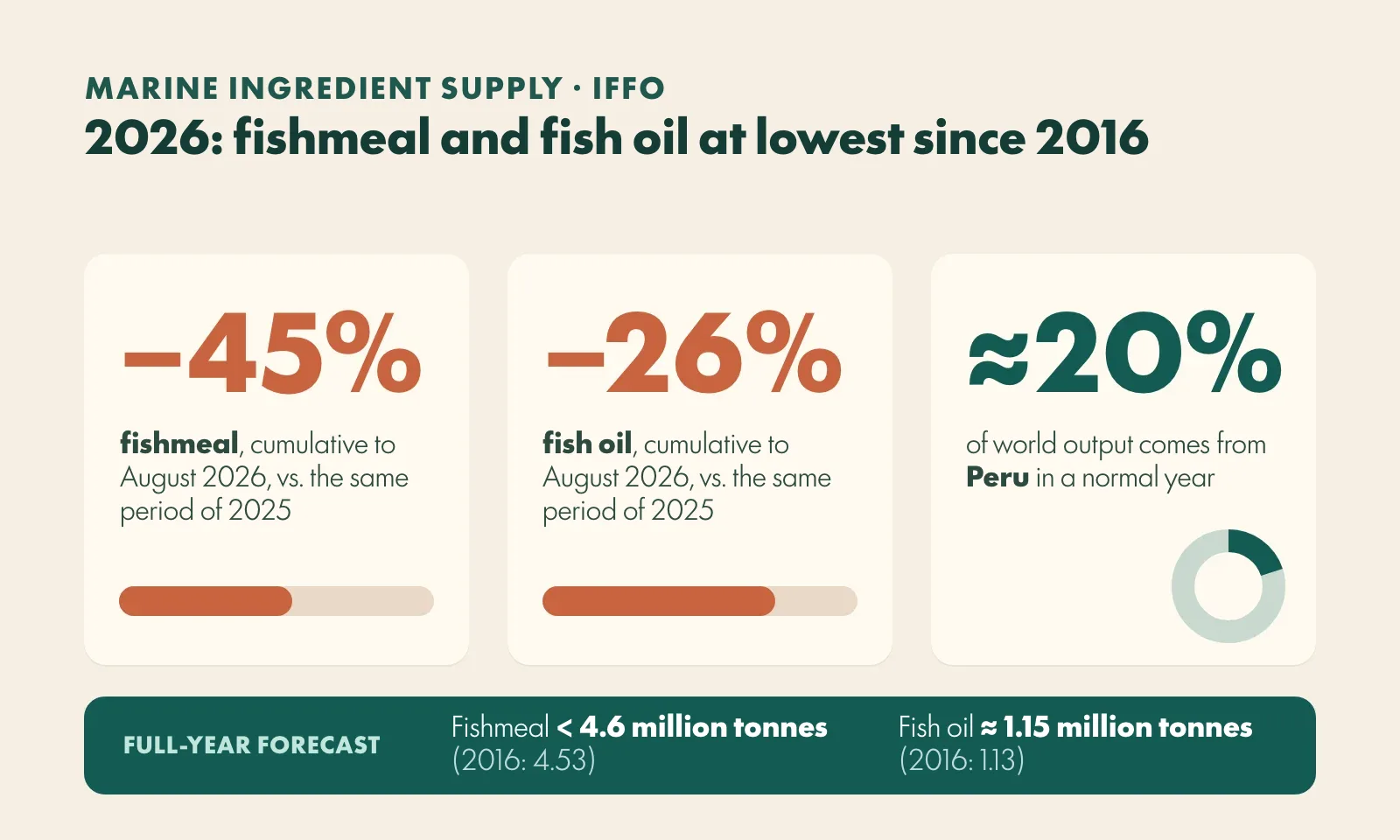
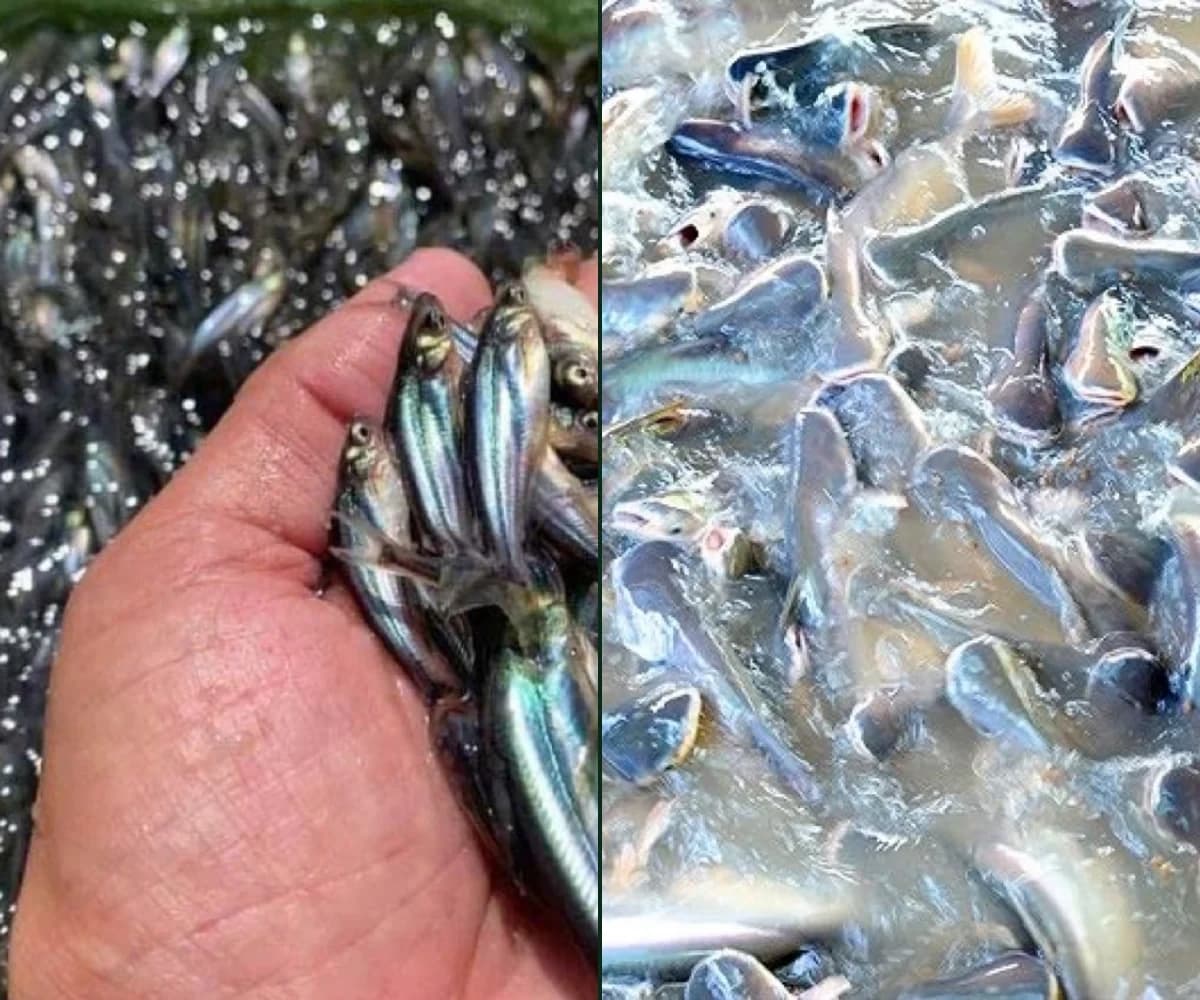
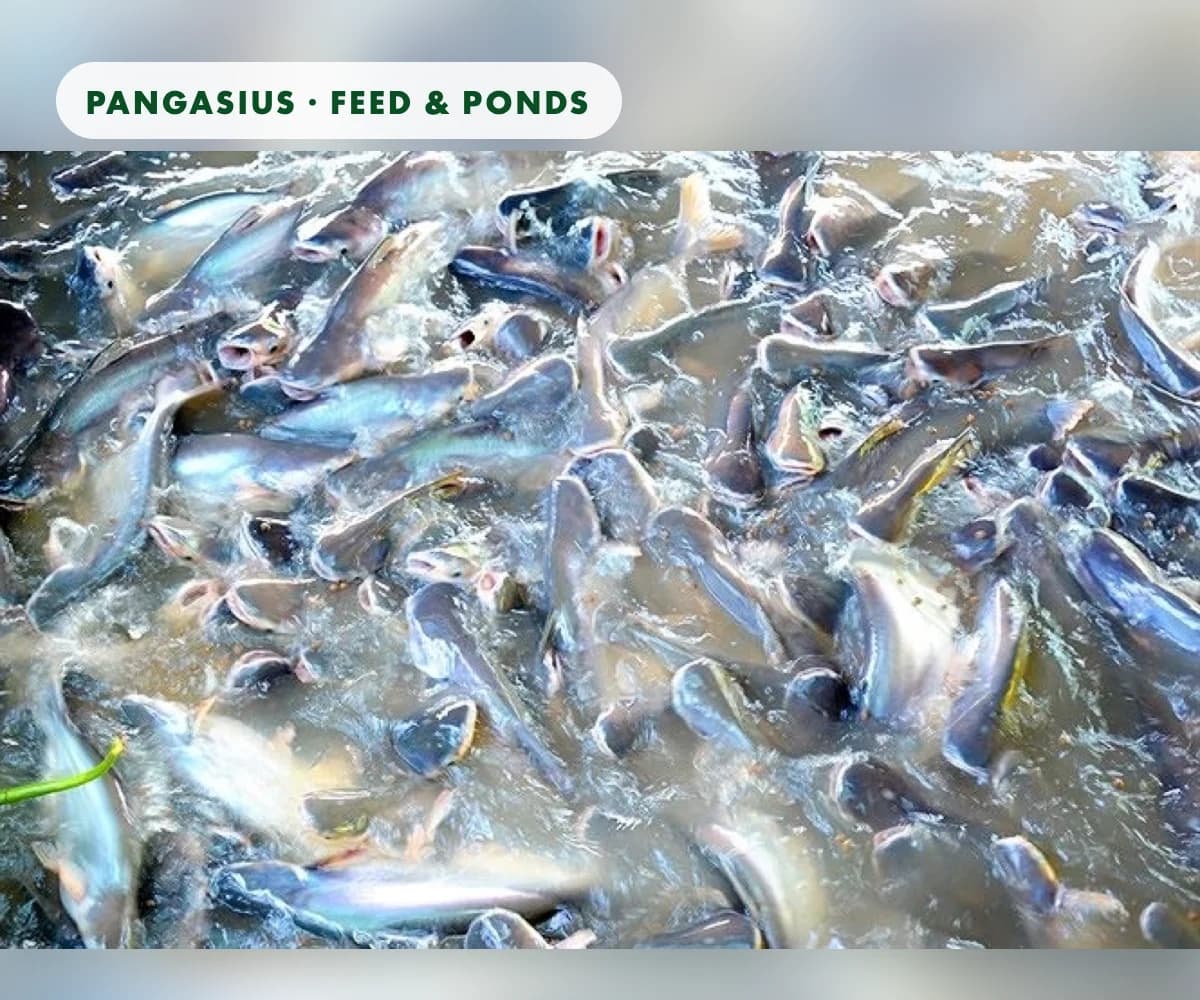
Fish oil could also fall to about 1.15 million tonnes, the lowest since 2016 (about 1.13 million tonnes at that time). The portion made from wild-caught pelagic and demersal fish — the main source — is down to only about 3.6 million tonnes of fishmeal and 605,000 tonnes of fish oil, both declining steadily year after year. By contrast, fishmeal and fish oil from other sources are still growing, notably from salmon and pangasius processing by-products.
IFFO notes that catches in the final weeks of the year could make the actual figures differ slightly from the forecast.
02 / CAUSE
Why supply is short: Peru and anchovy
In a normal year, Peru accounts for about 20% of world fishmeal and fish oil output. In August 2026, raw material volumes in Peru were still very low because the fishery in the central – northern region remained closed. On 15 September, the Peruvian Marine Research Institute (Imarpe) began a new anchovy stock assessment, expected to be completed on 7 October.
Elsewhere, Chile, Spain and the United States increased; producers in Africa and in the Iceland – North Atlantic region declined; Denmark and Norway were almost unchanged. IFFO's data come from members in 12 countries, which account for about 40% of global fishmeal output and 50% of global fish oil output.
Than Vuong has published a series on Peruvian anchovy: the Peruvian anchovy crisis, part 1, part 2 and the failed anchovy season.
03 / FEED INDUSTRY
How the feed industry is responding
At the Global Shrimp Forum 2026 (Utrecht, the Netherlands, 1–3 September), a raw materials market analyst said that during the strong El Niño of 2023, Peru's fishmeal and fish oil output fell by about 50% from normal levels; the official forecast for 2026 is a further decline of about 20%. The current El Niño could last into the first quarter of 2027.
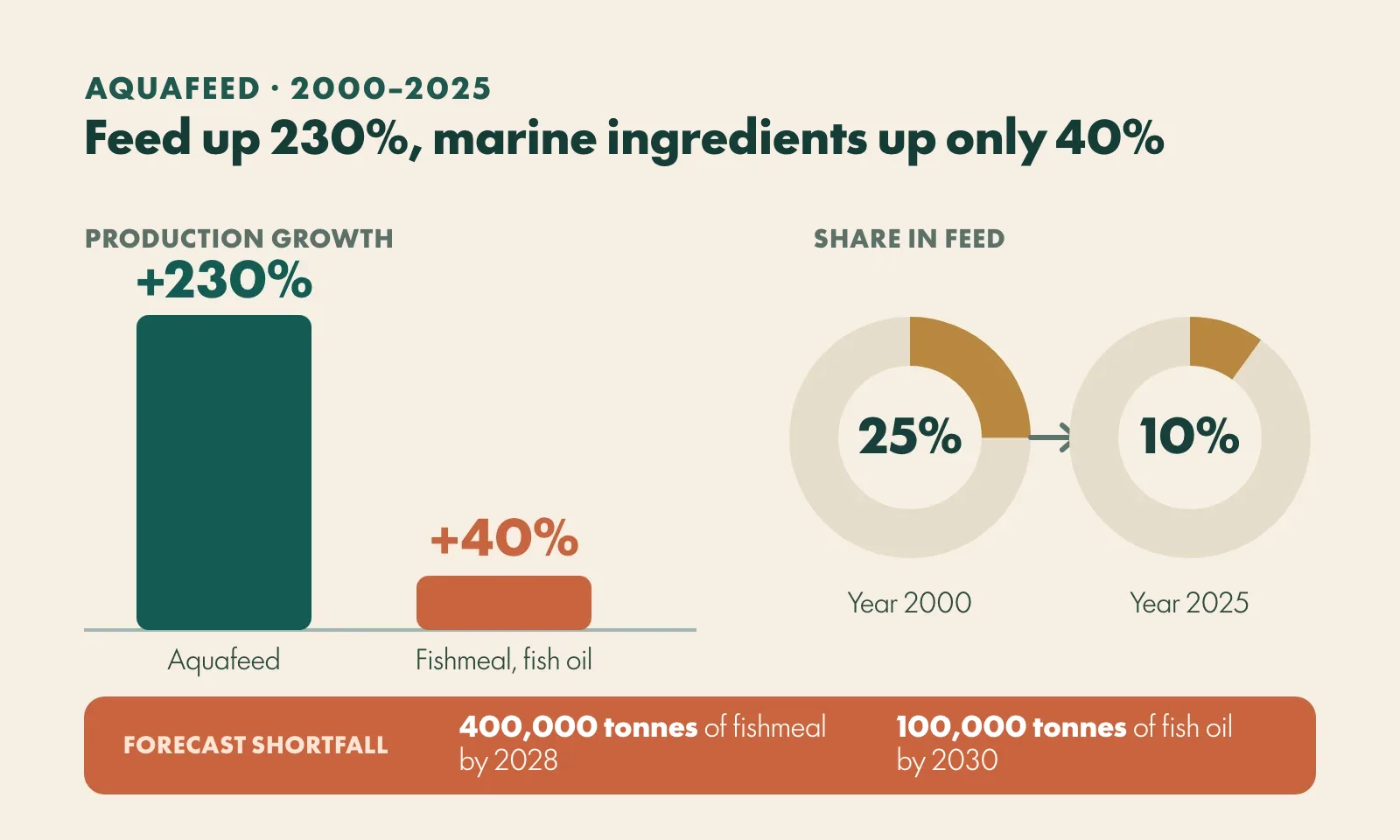
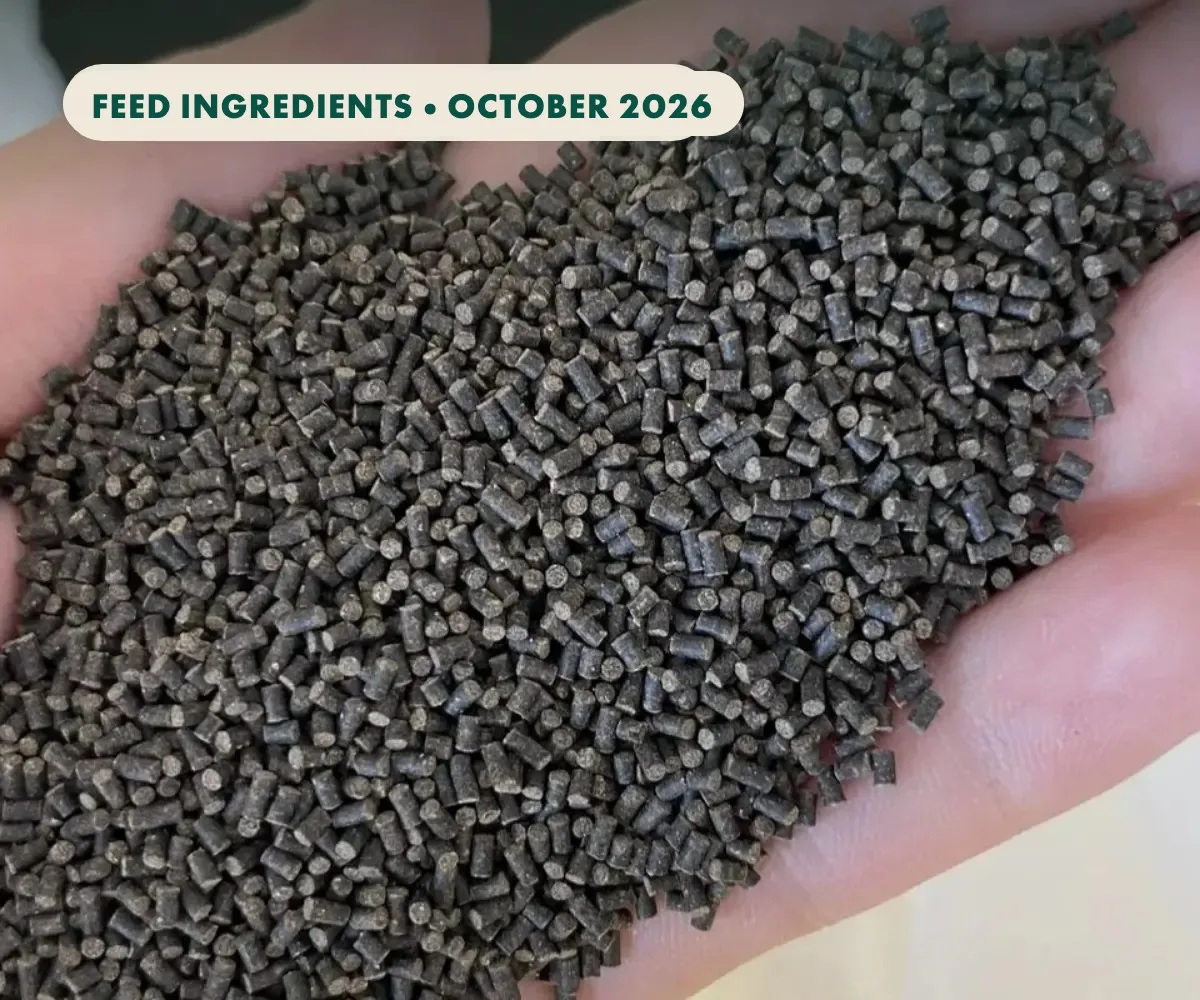
From 2000 to 2025, aquafeed production grew by about 230%, while marine ingredients grew by only about 40%. As a result, the share of fishmeal and fish oil in feed fell from about 25% to 10%. Recent studies warn of a possible shortfall of about 400,000 tonnes of fishmeal by 2028 and 100,000 tonnes of fish oil by 2030.
“In the short-term, fishmeal and fish oil will probably continue to be very volatile, with upside price risk.”
Raw materials analyst at the Global Shrimp Forum 2026
The alternatives mentioned are single-cell protein, insect meal and algal oil, but they need time to reach sufficient scale. In the meantime, functional ingredients such as prebiotics, probiotics and plant extracts are seen as part of the solution — helping animals use feed more efficiently when formulas contain less fishmeal.
04 / THAN VUONG PERSPECTIVE
Applying it to your ponds: every kilo of feed must turn into meat
Farmers cannot control the price of fishmeal, but they can control how much shrimp or fish meat each kilo of feed turns into. With feed likely to become more expensive, the feed conversion ratio (FCR) is the number most worth tracking:
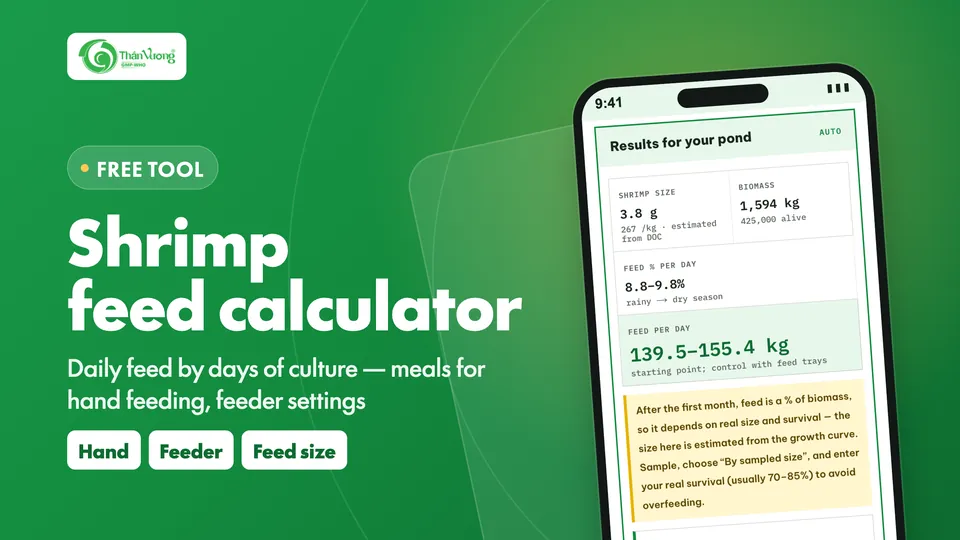
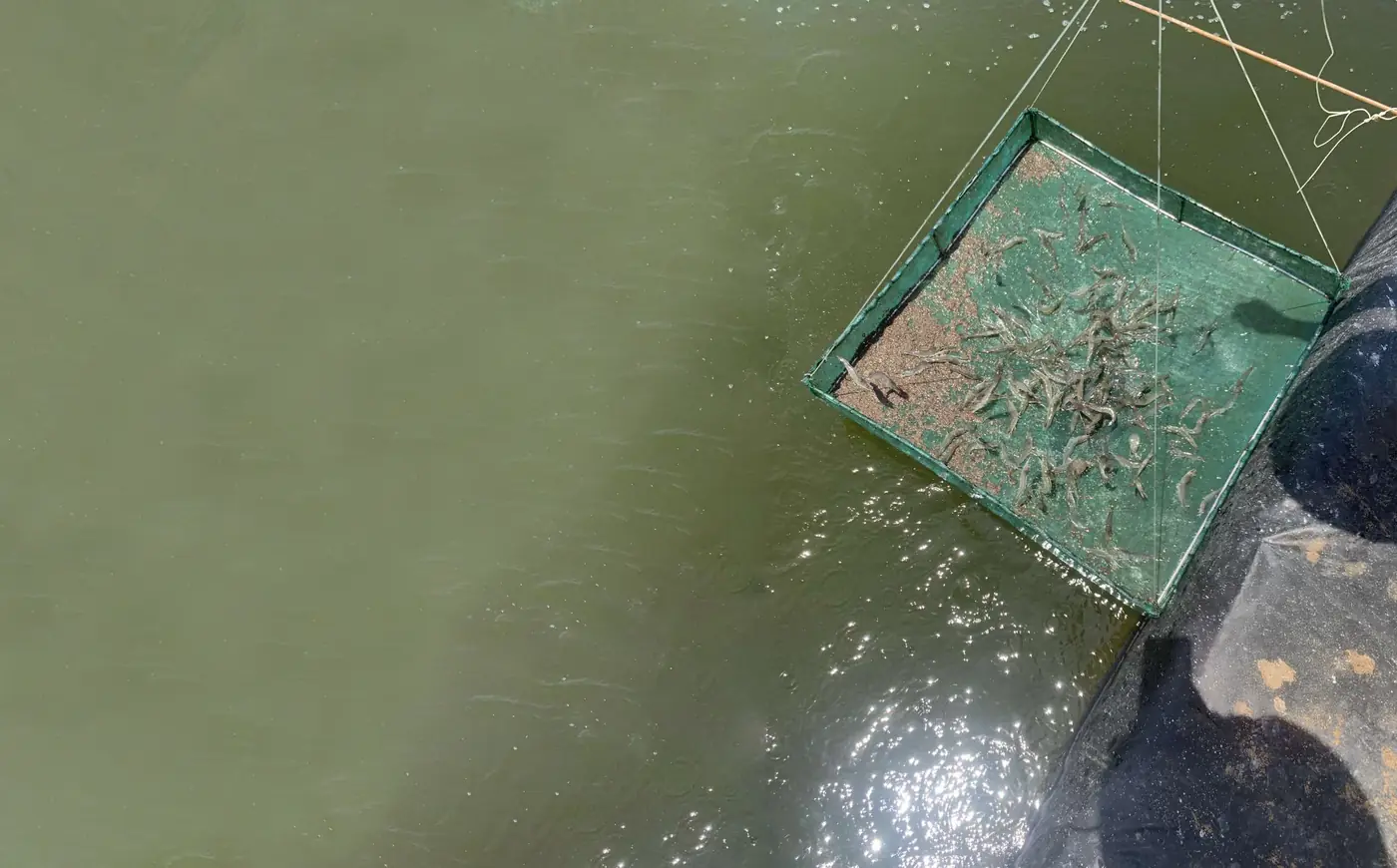
- Feed to real appetite: check the feed trays, and cut back when it is hot, when it rains or when the shrimp are molting; work out the daily ration with the shrimp feed calculator.
- Keep the gut healthy: when shrimp digest and absorb well, less feed is wasted. See also the shrimp gut health survey of 110 farms in Asia.
- Keep the bottom and water clean: leftover feed fouls the pond bottom, produces toxic gases, puts shrimp off their feed and raises FCR. Check with the NH3, NO2 toxic gas calculator.
- Keep records for each pond: feed amounts and regular weight checks, to calculate the real FCR and spot early any pond that is "eating but not growing" — with the Nuôi Lời app, free for 2 years.