
Shrimp feed calculator by days of culture — hand feeding & feeders
Enter the number stocked and the days of culture — or your sampled shrimp size. The calculator gives daily feed for the dry and rainy season, meals for hand feeding, batches and timer settings for feeders, plus the feed size to use and when the next switch is due.
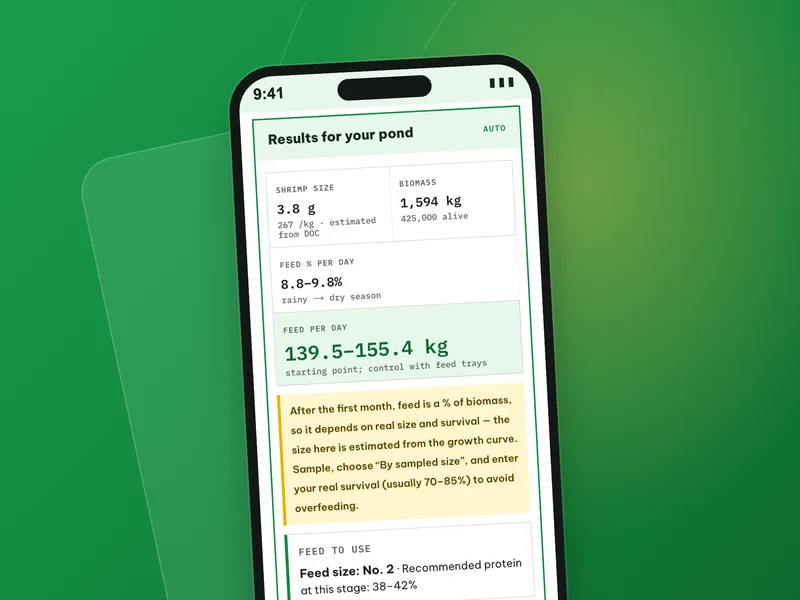
Results for your pondAuto
Enter the number stocked and the days of culture (or sampled size) in the yellow cells — results appear instantly.
Quick table by days of cultureWhiteleg shrimp
Per 100,000 shrimp stocked at the survival entered. Days 1–30: rising evenly to the summary table; from day 40: % of biomass by estimated size. Enter your stocking number to get your pond.
| DOC | Est. size (g) | Count/kg | %/day | kg/day | Feed | Feeding |
|---|---|---|---|---|---|---|
| 10 | — | — | table | 6.69–7.31 | No. 0 → No. 1 (powder, crumble) | Hand |
| 15 | — | — | table | 10.0–11.0 | No. 0 → No. 1 (powder, crumble) | Hand → feeder |
| 20 | — | — | table | 13.3–14.7 | No. 0 → No. 1 (powder, crumble) | Hand → feeder |
| 25 | — | — | table | 16.7–18.3 | No. 0 → No. 1 (powder, crumble) | Hand → feeder |
| 30 | — | — | table | 20.0–22.0 | No. 0 → No. 1 (powder, crumble) | Feeder |
| 40 | 5 | 200 | 7.5–8.5 | 30.0–34.0 | No. 2 | Feeder |
| 50 | 10 | 100 | 5.5–6 | 44.0–48.0 | No. 3 | Feeder |
| 60 | 14.3 | 70 | 4.5–5 | 51.5–57.2 | No. 3 | Feeder |
| 70 | 20 | 50 | 3.5–3.9 | 56.0–62.4 | No. 4 (large pellet) | Feeder |
| 80 | 25 | 40 | 3–3.6 | 60.0–72.0 | No. 4 (large pellet) | Feeder |
| 90 | 28.6 | 35 | 2.7–3.2 | 61.8–73.2 | No. 4 (large pellet) | Feeder |
| 100 | 30.3 | 33 | 2.4–2.7 | 58.2–65.4 | No. 4 (large pellet) | Feeder |
When to switch to a feeder?
- Usually from DOC 15–25, when shrimp are about 1.5–3 g and already eat pellets. Before that the feed is fine and amounts are small — broadcast by hand around the pond. The calculator assumes a switch at DOC 20.
- Switch over a few days: let the feeder spread part of the ration and keep hand-feeding the rest; watch trays near and far from the feeder, and hand everything to the feeder once shrimp feed evenly.
- Placement: 8–12 m from the dyke, 50–70 cm above the water. Put 2 check trays — one 1–2 m from the feeder, one 6–8 m away — and check them about every 2 hours in the first days (Tepbac). Add aeration around the feeding zone, since shrimp crowd there.
- Many small meals: in a 13-week Auburn University trial, shrimp on timer feeders (6 meals/day, 15–30% above the feed table) reached 25.1–27.5 g versus 19.7 g with hand feeding twice a day; an acoustic feeder reached 32.0 g. FCR and survival did not differ (Davis et al., 2018).
- Heavy rain: stop the feeder during rain or for the whole day (choose under Weather). Poor water — low DO, high toxic gases — cut feed by 50% or stop for 2–4 days (Akiyama & Yukasano, 2025).
- Medicated or supplemented feed: mix per hopper batch and let it dry before loading — wet feed jams the feeder.
- Tray checks with a feeder (Than Vuong summary table): set PAUSE 5 min — THROW 10 s. Tray empty before 4 min → shorten the pause (feed more often); not empty → lengthen to 6 min; then recalculate the day's feed.
- New feed size or worn spinner: re-measure the feed rate and reset the feeder.
How to change feed size?
- Go by sampled shrimp size, not by date: switch when most shrimp in your cast-net sample have reached the next size. The table is a guide — every brand numbers its feeds differently, so check the bag.
- Mix both sizes 50:50 for 2–3 days, then switch fully (Akiyama & Yukasano, 2025). In ponds with uneven sizes, mix for longer so small shrimp can still eat.
- Don't switch during a mass molt, right after heavy rain or when shrimp are weak — wait 1–2 days for things to settle.
- A new size often means new protein: the table is made for 40–42% protein feed. Feed less of a higher-protein feed and more of a lower-protein one, so shrimp get the same protein each day — e.g. 45% protein ×0.91, 35% ×1.17. Enter the protein in step 3 and the calculator adjusts.
- Feeders: larger pellets throw differently — re-measure the feed rate after switching.
| Feed size | Shrimp size (g) | Count/kg |
|---|---|---|
| No. 0 (powder) | < 0.5 | > 2,000 |
| No. 1 (crumble) | 0.5–3 | 333–2,000 |
| No. 2 | 3–8 | 125–333 |
| No. 3 | 8–15 | 67–125 |
| No. 4 (large pellet) | ≥ 15 | ≤ 67 |
Reading feed trays
The table is only a starting point — trays tell you how much shrimp actually eat. A 0.5 ha pond needs at least 4 trays, 1 ha 6–8 trays; day-to-day swings of 5–20% are normal (Akiyama & Yukasano, 2025).
| Tray after a meal | Next meal |
|---|---|
| Empty | Raise the next meal by 5–10%, then watch the next tray |
| A little left | Keep the same amount |
| About half left | Cut the next meal by 10–20% |
| A lot left | Skip or cut the next meal hard; check shrimp (molting, disease) and water (DO, toxic gases) before feeding again |
Adjusting for water temperature
Measured pond temperature is what counts. Enter it in step 3 and the calculator applies the factor.
| Water temperature | Feed factor | How to feed |
|---|---|---|
| 0–18°C | ×0–0.3 | Shrimp eat little or stop; do not force-feed |
| 18–21°C | ×0.3–0.6 | Feed at the warmest time, check feeding response |
| 21–24°C | ×0.6–0.8 | Fewer, smaller meals; avoid leftovers on the bottom |
| 24–29°C | ×0.9–1 | Normal operating range |
| 29–31°C | ×0.8–1 | Keep 100% only when oxygen and appetite are good |
| > 31°C | ×0.3–0.7 | Skip the midday meal; cut hard if shrimp surface or DO is low |
What is it based on?
- First month (DOC 1–30, no sample yet): feed by table, by number stocked — not by biomass. Whiteleg: day 1 = 0.7 kg per 100,000 (Than Vuong practice), rising evenly to match Than Vuong's summary table on day 30 — 2.5 g × survival × 10–11% (100,000 at 80% survival ≈ 20–22 kg a day) — so day 31 (by % of biomass) does not jump. For reference, the Thuy san Viet Nam magazine table starts at 2 kg and adds 0.2–0.5 kg a day (≈ 164 kg per 100,000 over 30 days). Black tiger: days 1–3 = 1.2–1.5 kg, then add 0.2 / 0.25 / 0.3 kg a day (Thuy san Viet Nam magazine). Farms with their own table can change the day-1 amount in the calculator. A trial in Indonesia with PL12 grew best at about 173 kg per 100,000 over 30 days (Fahrur et al., 2023). Shrimp below about 3.5–4 g are best fed by such a table (Akiyama & Yukasano).
- Biomass (from DOC 31 or with a sampled size, kg) = number stocked × survival × average weight (g) ÷ 1,000.
- Daily feed = biomass × feed % for the size (rainy → dry season) × temperature factor × protein factor.
- Feed % by size: Than Vuong summary table for 40–42% protein feed — from 10–11%/day at 2.5 g down to 2–2.3% at 50 g, interpolated between points.
- Protein factor (from day 31) = 41 ÷ feed protein, so shrimp get the same protein each day: 30% ×1.37 · 35% ×1.17 · 38% ×1.08 · 42% ×0.98 · 45% ×0.91. Trials feeding by this ratio gave the same growth (Davis & Venero 2005; Patnaik & Samocha 2009; Araujo et al. 2025), but FCR rises as protein falls: 1.08 at 40% → 1.20 at 35% → 1.37 at 30%. The calculator only works within 30–45%: below 30% extra feed is wasted without extra growth, above 45% further cuts leave shrimp short of energy. No protein adjustment in the first month.
- Size from DOC (whiteleg): milestones of Than Vuong's summary table — DOC 30 = 2.5 g, 40 = 5 g, 50 = 10 g, 60 = 14.3 g, 70 = 20 g, 80 = 25 g, 90 = 28.6 g, 100 = 30.3 g, 115 = 40 g, 125–130 = 50 g; black tiger follows the Nuôi Lời growth curve. Sample every 7–10 days and enter the real size for accuracy.
- Meals: afternoon/evening meals are larger, e.g. 4 meals 20–20–25–35%. Feeders: the daily total is split evenly across hopper refills within feeder hours. Timer feeders: throws = kg per batch ÷ g per throw; pause = run minutes ÷ throws, ideally 5–20 minutes.
Record every meal, tray check, sample and crop FCR in the Nuôi Lời app — same method as this calculator, free for 2 years.
A starting point only — always control with feed trays and the feed bag's table. Cut 30–50% after heavy rain or environmental shock; skip meals when DO is low or shrimp surface.
Other tools:Mineral calculator by salinityAsk AI about your pond