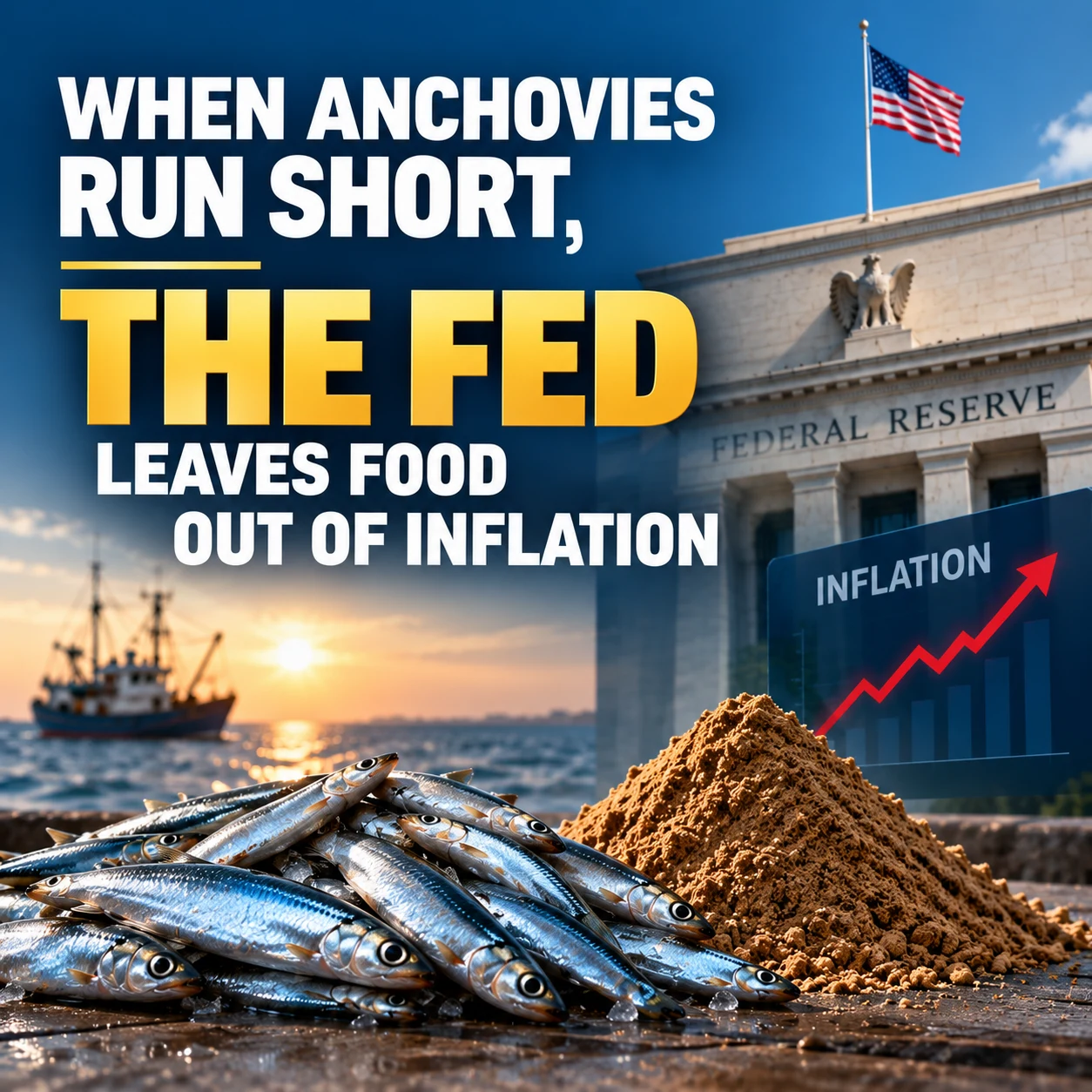
In 1973, a failed anchovy season in Peru helped push US food prices up 14.5%. The Fed chair at the time chose to strip food out of the inflation gauge, and America paid with nearly a decade of high inflation. In 2026, Peru's anchovy season has failed again, and the Fed is once more debating which prices to look past.
- 12.4 → 4.4million tonnes of Peruvian anchovy, 1970 → 1972
- +14.5%US food prices in 1973
- ~35%of the CPI basket Burns's Fed still tracked
- 471,000 tmain 2026 season, about 25% of quota
- ~US$2,500per tonne of fishmeal, May 2026, a record
1
The small fish that fed an entire livestock industry
The Peruvian anchovy (anchoveta) is a small fish, under 20 cm long, that lives in the cold waters off Peru. The area teems with fish because winds blowing along the coast push surface water out to sea, drawing cold, nutrient-rich water up from the depths. That water feeds algae and plankton, which are what the anchovies eat.
In the 1960s, Peru expanded its fishing fleet and fishmeal plants very quickly. In 1970 the country caught 12.4 million tonnes of anchovy, a world record. That was more than the entire catch of Western Europe and twice that of North America.
- Anchovycold waters off Peru
- FishmealPeru, world's largest
- Livestock feedsold abroad
- Chickens, pigsmeat, eggs, milk
Almost all of the catch was ground into fishmeal and sold abroad as feed for chickens and pigs. Peru became the world's largest fishmeal producer. About a third of Peru's export earnings came from fishmeal and fish oil.
The Peruvian government and scientists at the time advised catching no more than about 9.5 million tonnes a year. That limit was regularly exceeded by millions of tonnes.
2
1972: El Niño on top of overfishing
In 1972 a strong El Niño arrived. The coastal winds weakened and warm, nutrient-poor water flooded into Peru's waters. Algae declined sharply, the anchovies ran out of food and starved, and very few young fish hatched.
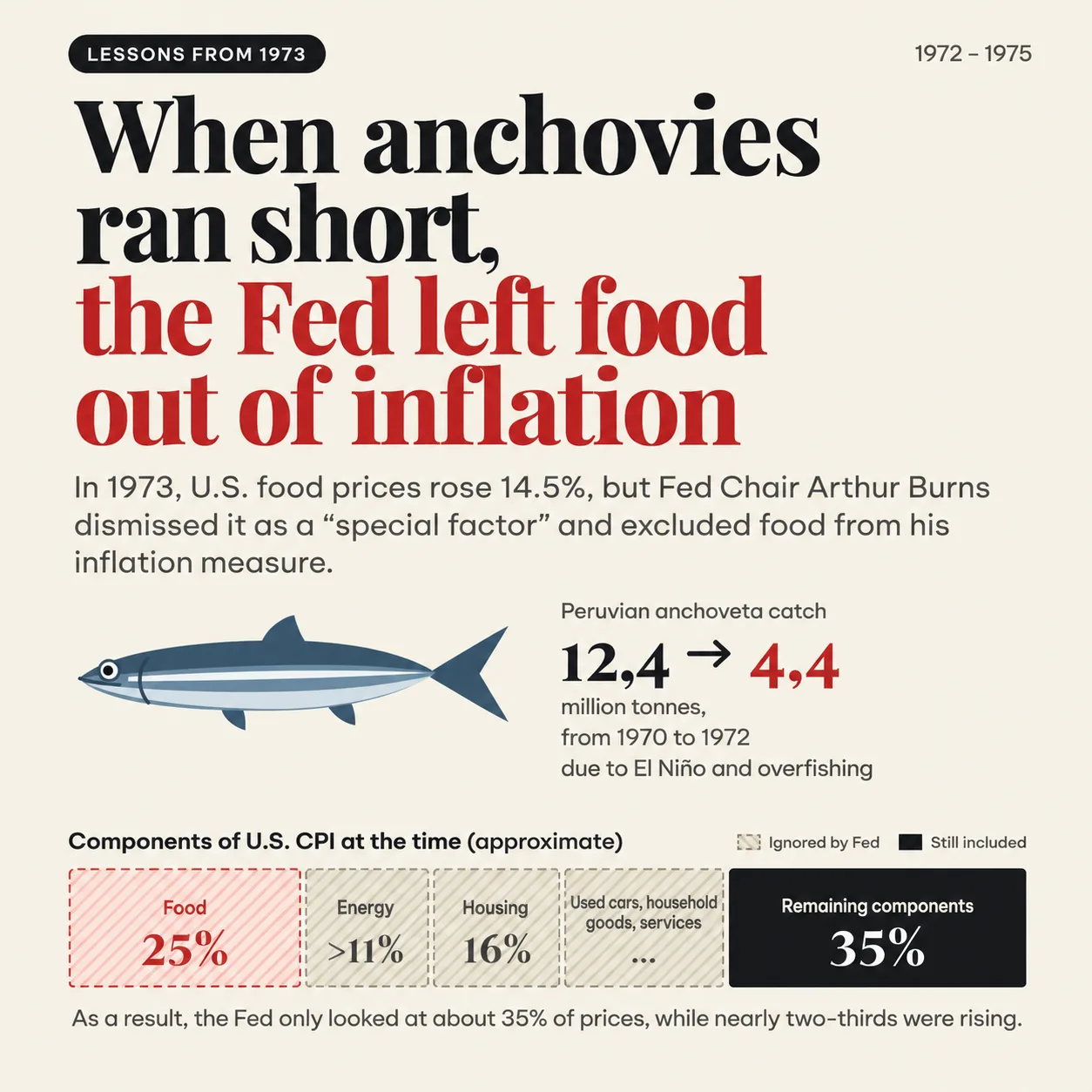
The surviving fish crowded into a few pockets of cold water close to shore, which made them even easier for boats to catch, juveniles included. The catch fell from 12.4 million tonnes in 1970 to 10.3 million tonnes in 1971, then to just 4.4 million tonnes in 1972. In only two years, nearly two-thirds of the catch had vanished.
In only two years, nearly two-thirds of the catch had vanished.
Fishmeal price
US$ per tonne · 1960s → 1973
Peru's fishmeal output in 1972 fell to about 900,000 tonnes.
At first, El Niño took most of the blame. Later research showed that overfishing was also a major cause. In May 1973, Peru nationalized its entire fishmeal industry.
3
From fishmeal to the dinner table
Short of fishmeal, feed mills switched to soybean meal. At the same time, grain and soybean prices in the US were being pushed up from several directions:
- The Soviet Union made the largest grain purchase in the history of US exports. The wheat the Soviets bought alone equaled about 28% of that year's US wheat crop.
- Soybean futures in Chicago climbed from US$3.27 to nearly US$13 a bushel (about 27 kg).
- The US temporarily banned soybean exports to keep supplies at home, until early October. Japan, which got about 92% of its soybeans from the US, was shaken — afterwards it stepped up investment in growing soybeans abroad, especially in Brazil.
- The Arab oil embargo sent energy prices soaring.
- The US food price index rose 14.5% in 1973 and 14.3% in 1974.
When feed gets expensive, the prices of meat, eggs and milk follow.
4
The Fed chose to strip food out
Arthur Burns chaired the Fed from 1970 to 1978. He was a highly respected economist, nicknamed “the Pope of economics”.
Burns's argument: the Fed can only adjust money and interest rates; it cannot produce more fish or oil. Price rises caused by anchovies or the oil embargo were “special factors”, beyond the reach of monetary policy. So he had his staff remove those items from the consumer price index (CPI) to see “true” inflation.
Stephen Roach, then a young economist at the Fed, later recounted it step by step:
Energymore than 11% of the CPI basket, excluded after the oil embargo.Food25% of the CPI basket, excluded on the grounds that El Niño had wiped out Peru's anchovies, driving up the cost of fertilizer and animal feed.Mobile homes, used cars, children's toys, women's jewelryBurns called it a “gold rush” — and homeownership costs (16% of the CPI basket).
With all that removed, Burns was looking at only about 35% of the CPI basket, and even that remainder was still rising at double-digit rates. Not until 1975 did he admit the US had an inflation problem.
The cost was steep
- > 12%US inflation in 1974
- > 14%US inflation in 1980
- ~ 20%interest rates Paul Volcker (Fed chair from August 1979) had to push to bring inflation down
- ~ 11%unemployment as the US fell into the 1981–1982 recession
5
Where it went wrong
Fine to look past
Looking past a one-off price shock is not a mistake. If a drought makes coffee more expensive, a Fed rate hike will not make it rain. Central banks should look through temporary swings like that.
Burns's mistake
Whenever a group of goods went up in price, he found a reason to exclude it. Each exclusion sounded reasonable. But added together, he was left looking at only a third of the basket, and that part was still rising fast.
When many groups of goods rise in price at the same time, that is no longer a “special factor”. It is inflation that has spread. When food and fuel prices rise, workers demand higher wages, businesses raise their prices, and everyone comes to believe prices will keep rising.
The rule after the 1970s: central banks always set food and energy aside, which is known as core inflation. The method is crude, but no one gets to pick which prices count.
6
2026: the anchovy season fails again, and the Fed is debating again
Fed Chair Kevin Warsh is looking for a way to measure underlying inflation, meaning the part of inflation likely to persist. He considers core inflation only a rough estimate. He prefers to rank price increases from lowest to highest, drop the extremes at both ends and calculate from the middle.
On September 16, 2026, Warsh complained that too many categories were rising by more than 3%. That was one reason the Fed raised interest rates for the first time in three years.
The Economist (September 24, 2026) warned that measuring from the middle has blind spots too. In 2021, many items rose sharply in price while the median barely moved, so these measures underestimated inflation. According to the magazine, no rule is perfect, and Warsh should keep a fixed rule rather than choose which prices to ignore, as Burns did.
Meanwhile, Peru's anchovies are once again facing a coastal El Niño. The main 2026 fishing season opened on April 1 with a quota of 1.91 million tonnes, the lowest in 10 years except for 2023. Juveniles made up more than half of the catch, forcing Peru to halt fishing for 30 days in May and June.
In August, Peru closed the season after boats had landed only 471,000 tonnes, about 25% of the quota.
According to IFFO, fishmeal production in the first quarter of 2026 was down 38% year on year. Spot fishmeal prices rose to about US$2,500 per tonne in May 2026, a record high.
| 1972 – 1973 | 2026 | |
|---|---|---|
| Cause | Strong El Niño + overfishing | Coastal El Niño, juveniles over half of the catch |
| Catch | 4.4 million tonnes (from 12.4 in 1970) | 471,000 tonnes, about 25% of a 1.91 million tonne quota |
| Fishmeal price | US$385 per tonne (1973) | ~US$2,500 per tonne (May 2026), a record |
| The Fed | Burns stripped food and energy out of the CPI basket | Warsh debating how to measure underlying inflation |
As for the Fed, the lesson of 1973 still holds: a temporary shock can be looked past, but not every price that rises should be stripped out.
References
- The Economist, “How the Fed should measure inflation”, September 24, 2026
- Wikipedia: 1972 Peruvian anchoveta crisis
- Stephen Roach: The Ghost of Arthur Burns
- farmdoc daily: A Brief Review of the Consequential Seventies
- Popula: Nixon vs. Soybeans
- USDA ERS: U.S. food price inflation has trended downward since the 1970s
- Federal Reserve History: The Great Inflation
- SeafoodSource (August 21, 2026): Peru ends North-Central anchovy season after lengthy pause
- Aquaculture Magazine (August 31, 2026): Peru’s Anchovy Fishery Crisis