
Toxic ammonia (NH₃) & nitrite calculator by salinity, pH and temperature
The same ammonia test can be safe in one pond and deadly in another — toxic NH₃ soars as pH and temperature rise, and nitrite is far more toxic in low-salinity ponds. Enter your readings to see the risk level, the afternoon pH to stay under, and what to do.
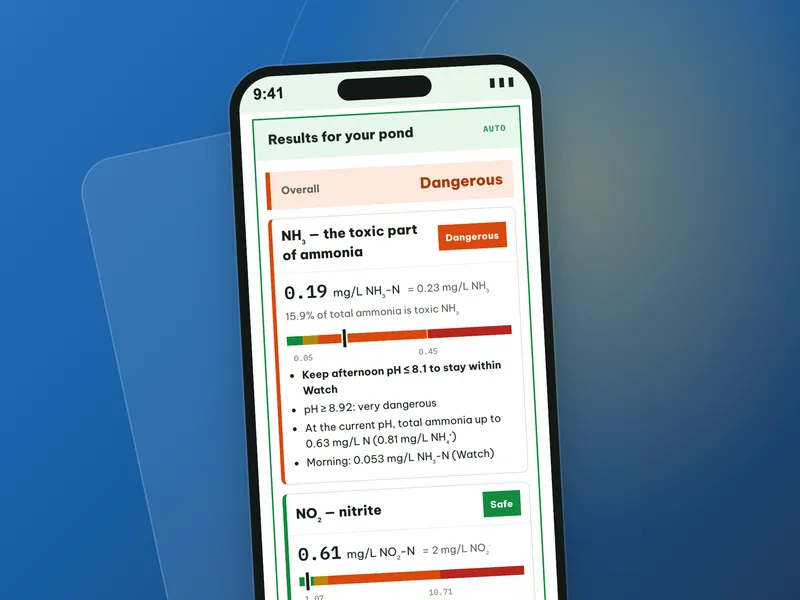
Results for your pondAUTO
Enter salinity, temperature, pH and at least one gas reading — results appear here.
Why the same ammonia is sometimes safe, sometimes dangerous
Ammonia exists as NH₄⁺ (low toxicity) and NH₃ (highly toxic). Kits measure the total. The NH₃ share is driven mainly by pH: +1 pH unit ≈ 10× more NH₃.
Higher temperature also raises NH₃ — and animals are more sensitive in warm water (Kir et al. 2004). Higher salinity lowers NH₃ slightly (about 15–20% at 35‰ vs freshwater).
Pond pH peaks in the sunny afternoon (2–3 pm) — a pond that looks fine in the morning can be dangerous later. Table: 1 mg/L total ammonia-N, 30 °C, 10‰.
| pH | % NH₃ | NH₃-N (mg/L) |
|---|---|---|
| 7.0 | 0.7 | 0.007 |
| 7.5 | 2.3 | 0.023 |
| 8.0 | 7.0 | 0.070 |
| 8.5 | 19.2 | 0.192 |
| 9.0 | 43.0 | 0.430 |
Nitrite and salinity — why low-salinity ponds suffer from NO₂
Nitrite enters the blood through the gill's chloride (Cl⁻) uptake route. More chloride, less nitrite uptake. In fish, nitrite turns haemoglobin into methaemoglobin that cannot carry oxygen — brown blood, fish gasping even with enough oxygen.
So low salinity (little chloride) makes nitrite far more toxic. For whiteleg shrimp the 96-h lethal level is about 8 mg/L NO₂-N at 1‰ but near 180 mg/L at 25‰ (Ramírez-Rochín 2017; Lin & Chen 2003). Freshwater fish ponds should keep chloride ≥ 20 × nitrite-N — the calculator gives the salt dose.
| Salinity (‰) | 96-h lethal (mg/L NO₂-N) | Safe — 5% (mg/L NO₂-N) |
|---|---|---|
| 1 | 7.8 | 0.39 |
| 3 | 12.6 | 0.63 |
| 5 | 19.1 | 0.95 |
| 10 | 42.8 | 2.14 |
| 15 | 77.2 | 3.86 |
| 25 | 177.9 | 8.89 |
Measuring correctly
- Measure pH at 2–3 pm (and at 6 am if possible) — when NH₃ peaks.
- Check the unit on the kit. Sera and Merck usually report NH₄⁺ and NO₂⁻; Hanna meters may report as N. The same water reads 1.29× higher as NH₄⁺ than as N, and 3.28× higher as NO₂⁻ than as NO₂-N.
- Sample mid-depth away from aerators; test ammonia and nitrite together with pH and temperature.
- Well water, freshwater or inland saline ponds: measure chloride instead of estimating from salinity.
How it calculates
NH₃ share: pKa = 0.0901821 + 2729.92/(t + 273.2) + (0.1552 − 0.0003142·t)·I, I = 19.9273·S/(1000 − 1.005109·S), t in °C, S in ‰; fraction = 1/(1 + 10^(pKa − pH)). Emerson (1975) freshwater equation plus salinity correction (Khoo 1977, Spotte & Adams 1983, as printed by Florida DEP and US EPA). Checked against CCME and Florida DEP tables: under 1% difference.
Species thresholds come from 96-h LC50 studies × the usual 0.05–0.1 application factor (Boyd), cross-checked with TCVN 13656:2023 and QCVN 02-19/02-20:2014. Tiger shrimp nitrite is estimated from whiteleg data — flagged in the results.
The calculator gives a reference direction for quick pond-side decisions — accuracy depends on your test kit. Study thresholds are from constant lab exposures; real ponds fluctuate hourly. If animals look abnormal, call a technician: +84 867 957 568.
Other tools:Mineral calculatorShrimp feed calculatorAll tools