
Countdown to harvest day
- 7–10 days before
Check fish health and condition the fish
Review losses over recent days and dissect 5–10 fish. If fish show signs of disease, do not harvest yet.
- Last 5 days
Cut feed, add anti-stress
Reduce feed by 5–10% each day. GRO C30 in 1 meal a day, preferably the midday or afternoon meal.
- 1–2 days beforeThe evening before
Stop feeding, mild disinfection
Stop feeding 1–2 days before seining.
- Harvest day
Gather and transport
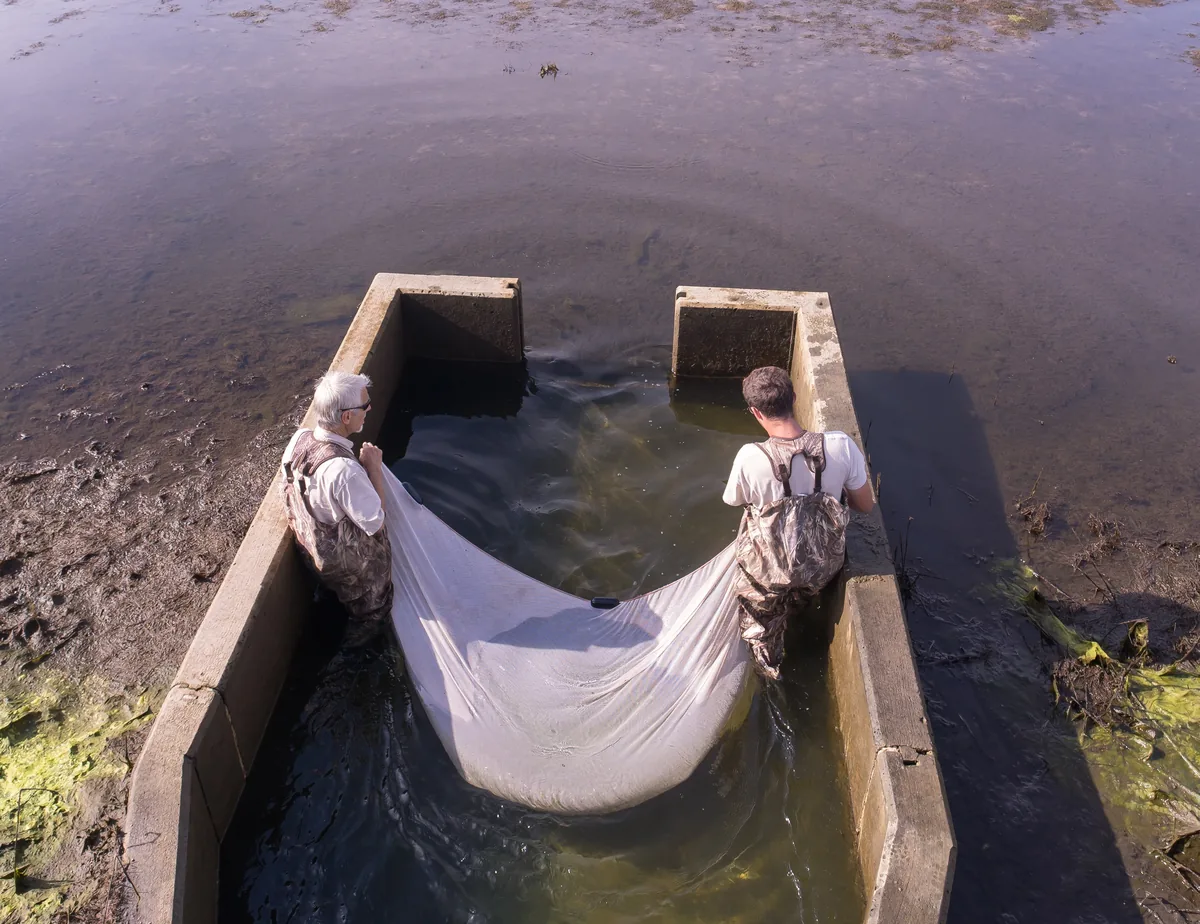
Apply where fish are gathered in the net; handle gently to avoid abrasions. Add anti-stress products to the holding-tank or transport-boat water.
The shorter the trip, the less the stress
A Can Tho University study measured striped catfish carried by boat for 2, 4 and 6 hours: cortisol and glucose differed significantly only in the 4-hour and 6-hour groups. A day after restocking, cortisol was still high.
Requirements under QCVN 02-33-2:2021
| Stage | Age | Length | Weight | Max deformity |
|---|---|---|---|---|
| Fry | From hatching to yolk absorption | – | – | 2% |
| Advanced fry | Up to 30 days | 3 to under 7 cm | 0.5 to under 3 g | 1% |
| Small fingerlings | 31–60 days | 7 to under 15 cm | 3 to under 10 g | 0.5% |
| Large fingerlings | 61–90 days | 15 to under 20 cm | 10 to under 30 g | 0.5% |
All stages must be free of bacillary necrosis caused by Edwardsiella ictaluri. Age counts from the fry stage. Length is measured from the snout to the caudal peduncle.
Harvest size against the standard
This protocol harvests at about 30 fish/kg, or about 33 g each, which is above the standard's large-fingerling class (under 30 g). Use the table to compare smaller sizes; fish must still be free of bacillary necrosis.
Pre-harvest checklist
Make this schedule for your pond
Enter stocking date, area and depth to get each day's tasks and the kilograms to apply. Open the tools