Working hours: Mon - Fri | 08:00 - 17:00HOTLINE: 0867 95 7568

Active prevention

Disease prevention in pangasius fingerlings

Prevent disease through water, density, feed and routine checks. Use veterinary drugs only after the disease is identified, as labelled.

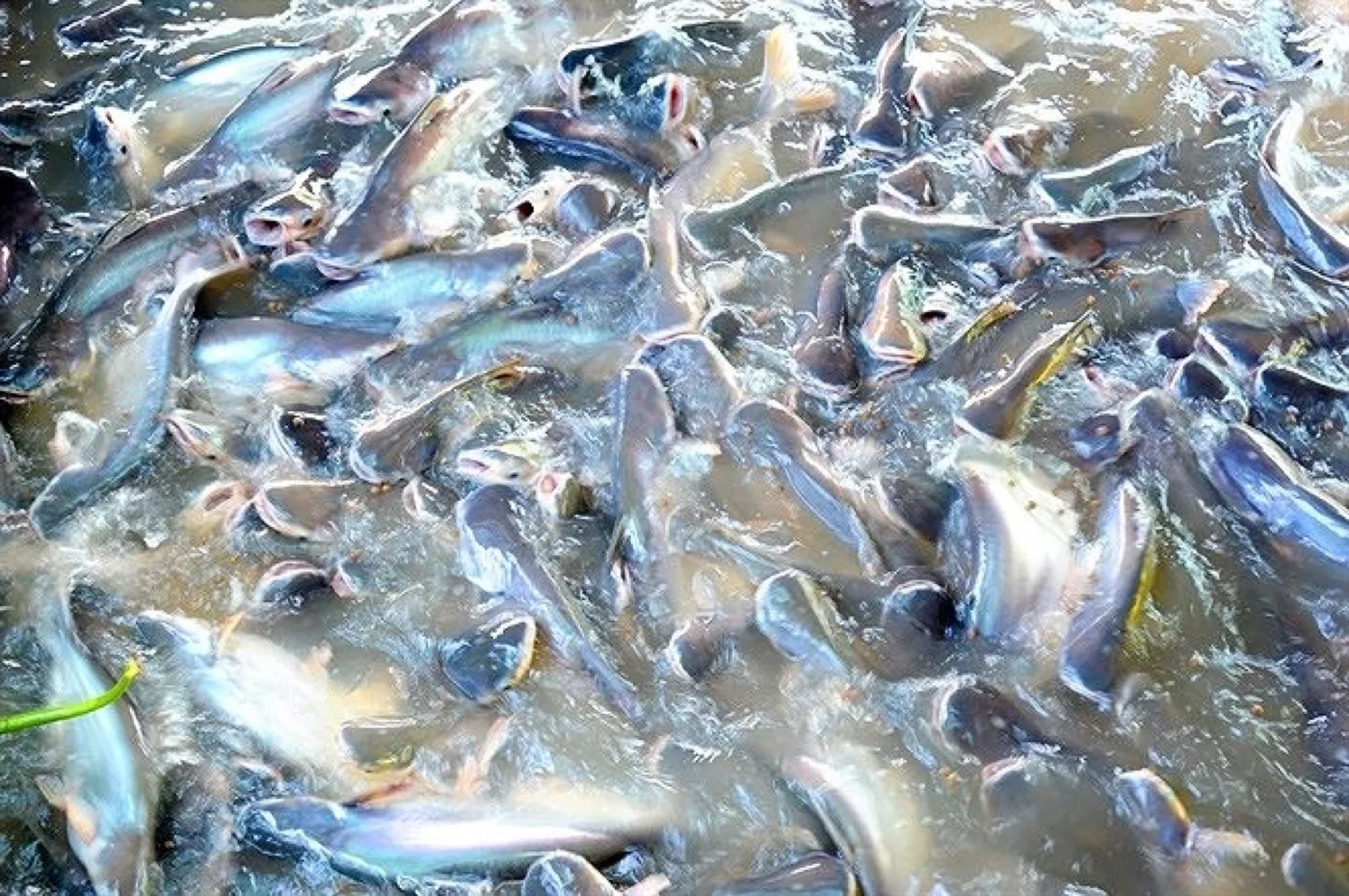
Pangasius rising to floating pellets
Pangasius rising to floating pellets. Spread feed slowly and evenly across the pond so all fish get their share. Photo: Than Vuong archive.

Five prevention habits

Clean intake water

Filter water, remove wild fish during preparation, check pH, NO2 and H2S regularly.

Right density

Stock 500–1,000 fry/m², thin to 150–200 fish/m² at the end of week 4.

Disinfect and re-seed

Follow days 15, 17, 19; then every 10 days, re-seeding after 24–48 hours.

Resistance through feed

Mix in probiotics, vitamins and liver support routinely. Do not mix antibiotics routinely.

Routine checks

From about day 20, examine the skin and gills of 5–10 fish each week; record losses daily.

Gentle handling

Seine gently to avoid abrasions, where fungi and bacteria take hold.

Parasites by stage

Prevalence (%) in 20 nursery ponds in Can Tho, Vinh Long, Dong Thap and An Giang, March 2018 to January 2019. Trichodina occurs from the fry stage; the gill fluke Dactylogyrus from advanced fry on, so gills must be checked from about day 20.

StageTrichodina, dry seasonTrichodina, rainy seasonDactylogyrus, dry seasonDactylogyrus, rainy season
Fry57.2241.80nonenone
Advanced fry75.3641.60none2.00
Fingerlings48.4858.7012.7312.80

Nguyen Thi Thu Hang et al. 2020. In this study fry are days 1–15, advanced fry days 16–39, fingerlings after day 40. These are infection rates, not death rates.

Where to look

The gills, liver and gut show earliest what is happening.

Side-view illustration of a striped catfish, showing: gills, swim bladder.

Gills

Look for protozoa and flukes. Pale gills need a closer look.

  1. Gills. Four gill arches on each side, under the gill cover. The fish takes up oxygen here, so toxic gases in the water act directly on them.

  2. Swim bladder. Runs along the body to beyond the anus. Striped catfish also use it to breathe air.

Side-view illustration of a striped catfish, showing: liver.

Liver

Dissect 5–10 fish: white pus spots on the liver, kidney and spleen point to bacillary necrosis.

  1. Liver. At the front of the body cavity, ahead of the stomach. Processes nutrients, stores energy and breaks down toxins.

Side-view illustration of a striped catfish, showing: stomach, intestine.

Gut

Check whether the gut holds feed and whether there are parasites.

  1. Stomach. A small sac after the oesophagus, where digestion begins.

  2. Intestine. Very long, about 3.7 times body length, coiled in the body cavity.

Striped catfish, side view. Simplified illustration.

Early signs and prevention for each disease

Pick what you see at the pond. Doses and treatment steps are in the protocols; call a technician before using any drug.

External parasitesTrichodina, gill flukes

SIGNS
Fish flash and startle while feeding, gather in small groups weaving through each other, lose a lot of mucus and feed poorly. Skin and gill checks show protozoa or flukes.
PREVENTION
Filter water and remove wild fish thoroughly during pond preparation, stock at the right density and disinfect routinely. Fingerlings can be bathed in WORK COP Plus 3–5 g/m³ for 10–20 minutes.
IF FISH ARE ALREADY SICK
Follow the external parasite protocol.
External parasite protocol →

Internal parasitesFlukes and tapeworms in the gut and liver

SIGNS
Fish pass loose, undigested faeces, feed poorly, grow slowly and vary in size; dissection shows parasites in the gut.
PREVENTION
Check regularly, especially fish in older ponds.
IF FISH ARE ALREADY SICK
AQUA PRAZI as labelled: mix 100 g into 20–30 kg of feed (equal to 100 g for 200–300 kg of fish) for 3–5 days in a row; stop feeding 1 day before deworming. After deworming, mix in BIOMAX 1 g/1.5 kg feed and AQUAMOS 1 kg/1,500–1,800 kg feed for 3–5 days.
Internal parasite protocol →

Water mouldSaprolegnia

SIGNS
White, cotton-like patches on the skin and fins; common in cold weather and when fish are injured.
PREVENTION
Handle fish gently when seining; disinfect routinely with POWER GLUTA (1 bottle/5,000 m³ of water, every 10–15 days).
IF FISH ARE ALREADY SICK
AQUA DINE 1 bottle/1,000–1,500 m³ of water (label: kills disease-causing fungi and bacteria); call technical support if it does not improve.
Call +84 867 957 568

Tail rot, white bodyFlavobacterium columnare bacteria

SIGNS
Fish gather where water flows, swim sluggishly, produce excess mucus and lose skin colour; tails are eroded.
PREVENTION
Follow the day 15, 17, 19 schedule; use clean intake water; check pH, NO2 and H2S regularly.
IF FISH ARE ALREADY SICK
Call Than Vuong technical support for advice based on your pond.
Call +84 867 957 568

Haemorrhagic diseaseAeromonas and opportunistic bacteria

SIGNS
Red fin bases and vent, haemorrhages on the skin. In fingerlings about 25 days old, a red vent is the earliest sign.
PREVENTION
Disinfect and re-seed probiotics routinely; keep the pond bottom clean and do not overfeed.
IF FISH ARE ALREADY SICK
Follow the haemorrhage protocol (OXYTETRA as indicated on the label).
Haemorrhage protocol →

Bacillary necrosisEdwardsiella ictaluri bacteria

SIGNS
Fish are sluggish and stop eating; deaths are scattered at first, then rise quickly; dissection shows white pus spots on the liver, kidney and spleen. The disease peaks in the rainy season, when water drops below 28 °C.
PREVENTION
Stock at the right density and keep the water clean; at the change of season, increase MAX LIVER and BETAGLUCAN GRO in the feed.
IF FISH ARE ALREADY SICK
Follow the bacillary necrosis protocol (FLOR-MAX, a drug for Pangasius and basa).
Bacillary necrosis protocol →

White liver, white gillsMultiple causes

SIGNS
Pale liver and gills; poor appetite for a long time, slow growth; often in ponds that have had many courses of antibiotics.
PREVENTION
Do not overuse antibiotics; deworm on time; give liver support routinely.
IF FISH ARE ALREADY SICK
Follow the white liver, white gills protocol.
White liver, white gills protocol →

Some disease signs in photos

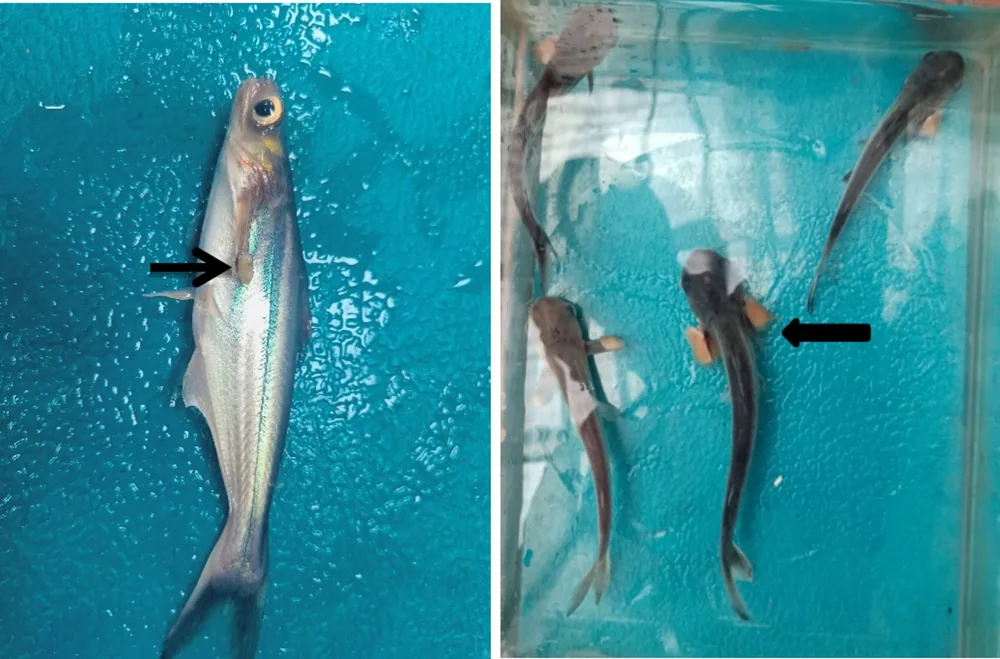
Pangasius fingerling with water mould
Water mould: a Pangasius fingerling infected with Saprolegnia in a trial; the arrow marks fungal growth on the pectoral fin. Photo: Rathod et al., Scientific Reports 2024, CC BY 4.0.
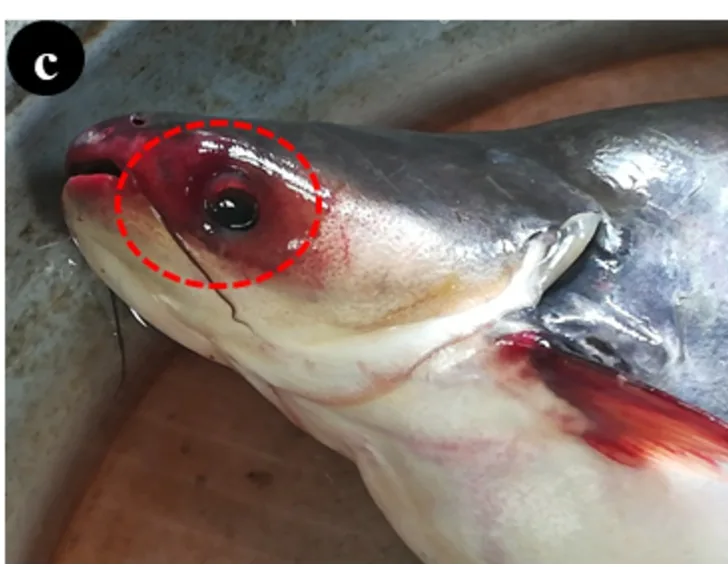
Pangasius with haemorrhage around the eye and head
Haemorrhage around the eye and head (red circle) and at the base of the pectoral fin in Pangasius farmed in Bangladesh, suspected Aeromonas infection. Photo: Ferdousi et al., PLOS ONE 2025, CC BY 4.0.
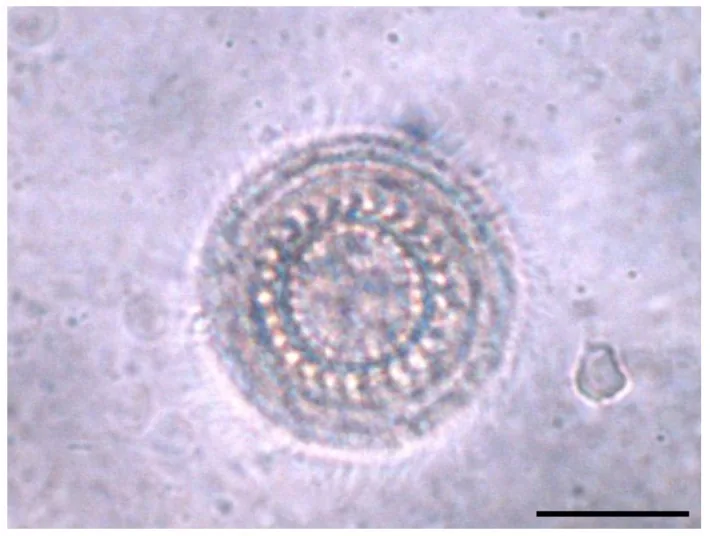
Trichodina under the microscope
Trichodina in fish gill mucus at 400× magnification (a carp sample, shown to illustrate the parasite's shape). Photo: Dărăbuș et al., Microorganisms 2024, CC BY 4.0.
Pangasius with white spots on internal organs
White spots on the internal organs of Pangasius farmed in the Mekong Delta (arrows); the fish showed no clear external signs. The researchers isolated Edwardsiella tarda from these fish. Photo: Ho et al., Applied and Environmental Microbiology 2026, CC BY 4.0.

When losses rise

Losses rising for 2–3 days in a row: cut feed to 50–60% and dissect 5–10 fish. If losses have not fallen after 2–3 days: stop feeding, identify the disease and call Than Vuong technical support at +84 867 957 568 before using any drug.

Want our technical team to look at your nursery pond?

Send us your pond details and water readings. Our technical team will plan each stage with you and reply within 24 hours.

Ask Than Vuong

Aquaculture technical assistant

Hello there 👋

Describe your pond issue or pick a question below.