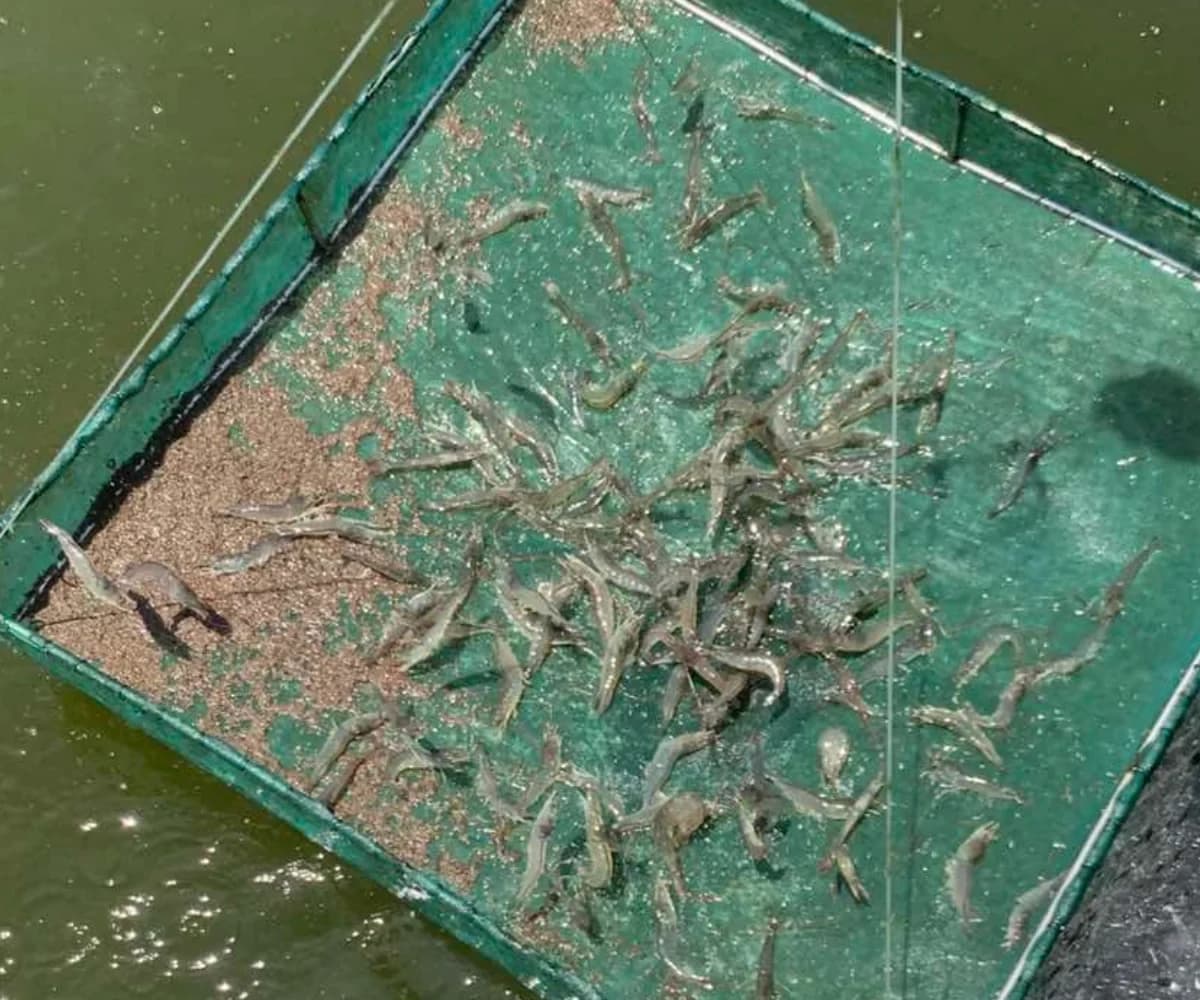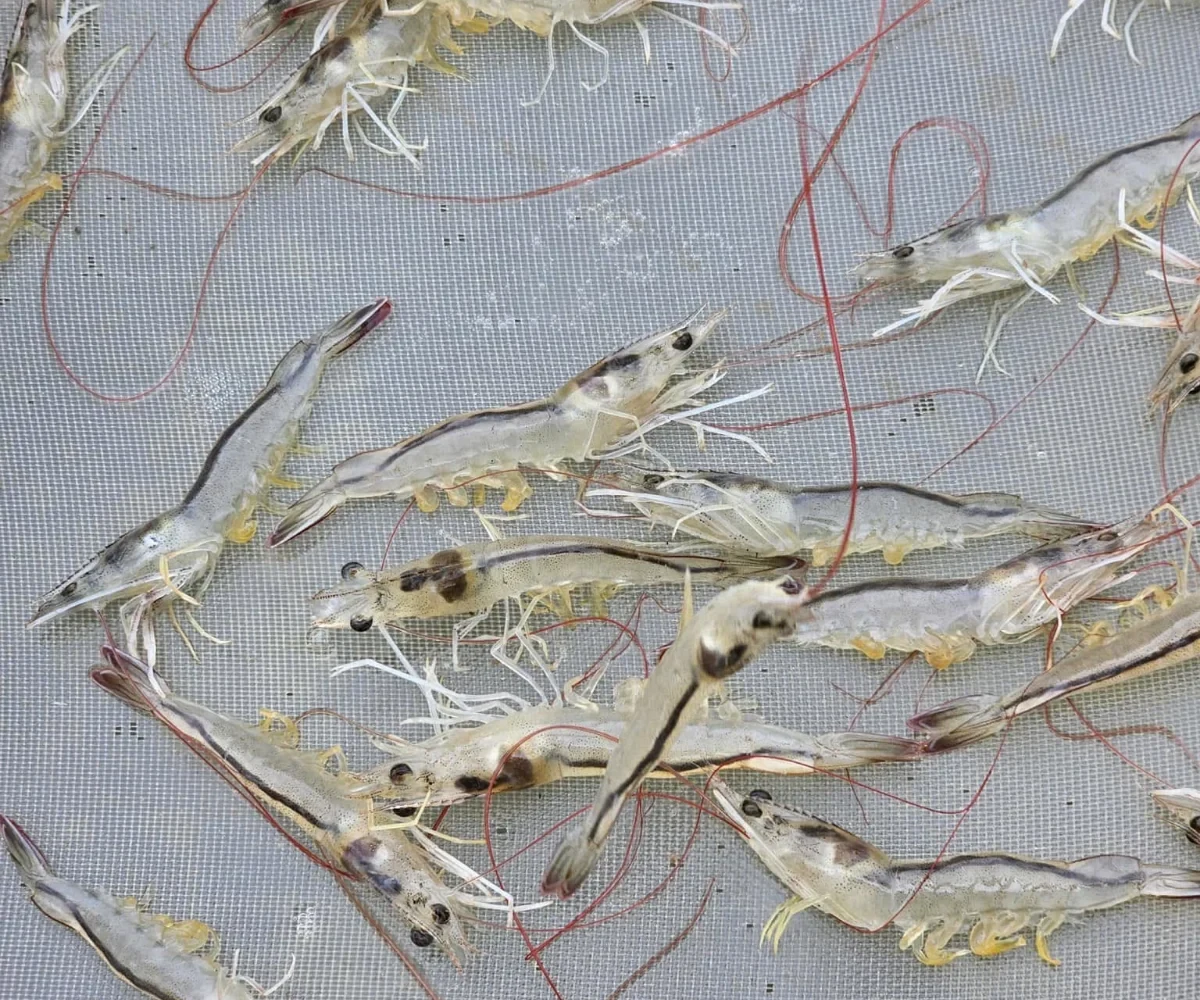
In short: if white-feces guts lack things that healthy guts have, does feeding them back help shrimp resist white feces? A Ningbo University (China) team tried two ways: four beneficial bacterial strains taken from healthy shrimp guts (published 2024) and two metabolites, pyruvic acid and glutamine (published 2026). Both sharply reduced deaths in whiteleg shrimp challenged with a white-feces Vibrio mix. But these are results from 50-litre tanks, with feeding for 14 days beforehand, no pond trial, and a challenge model without EHP.
The idea: give the gut back what healthy shrimp have
Part 1 showed that white-feces guts are out of balance: some Vibrio species surge and beneficial bacteria decline. Professor Xiong Jinbo’s group at Ningbo University asked the reverse question: what do healthy shrimp have in the gut that white-feces shrimp lack, and if it is fed back, can shrimp resist white feces?

Both trials used the same challenge model: immersing shrimp in a mix of V. fluvialis, V. coralliilyticus and V. tubiashii at 7 : 2 : 1, the ratio found in white-feces guts in the ponds. The team had confirmed that this mix gives healthy shrimp white-feces signs and kills them; the authors themselves say other pathogens cannot be ruled out.
Trial 1 (2024): four beneficial strains
- Choosing the strains: from gut sequencing data, the team built an interaction network between species and ran simulations to pick the set that best antagonised the three Vibrio. The result was four species isolated from healthy shrimp guts: Ruegeria lacuscaerulensis, Nioella nitratireducens, Bacillus subtilis and Streptomyces euryhalinus, mixed 4 : 3 : 2 : 1.
- Design: 900 healthy whiteleg post-larvae in 18 tanks of 50 litres, split into three groups: not challenged; challenged only; fed the strains then challenged. The bacteria were mixed into feed at 107 CFU/g feed, fed at 3% of body weight twice a day for 14 days before challenge. The challenge was immersion in the Vibrio mix at 108 CFU/mL, followed for 14 days.
- Results: after 14 days, 5.2% of the fed group died versus 30.4% of the challenged-only group. The first death in the fed group came on day 7, 4 days later. The unchallenged group lost 10.7%, more than the fed group; the paper does not explain this.
- In the gut: fewer of the three Vibrio; genes that keep gut-wall cells tightly joined (such as mucins) went up; the gut bacterial network was more stable.
Trial 2 (2026): pyruvic acid and glutamine
- Finding the compounds: gut metabolites were compared between healthy and white-feces shrimp from greenhouse ponds in Ningbo. Pyruvic acid and glutamine were the two "keystone" compounds that dropped in white-feces shrimp; they were combined at 1 : 2, the ratio in healthy guts.
- Design: 1,440 specific-pathogen-free whiteleg post-larvae, 24 tanks of 50 litres × 60 shrimp, 6 tanks per group, water at 27 °C. Four groups: control; supplement only; supplement then challenge; challenge only. The supplement was fed for 14 days before challenge; immersion in the Vibrio mix at 107 CFU/mL, followed for 9 days.
- Results: after 9 days, 12.7% of the supplemented group died, close to the unchallenged group (9.6%), versus 45.2% in the challenged-only group. The first death came 2 days later. The hepatopancreas kept its structure and gut villi did not shorten as in the challenged-only group. On day 9, supplemented shrimp were 8.3% heavier than controls.
- Proposed mechanism: the two compounds boosted three beneficial species (Ruegeria lacuscaerulensis, Bacillus subtilis, Nioella nitratireducens), which kept up levels of lipoxin A4, a compound that damps down inflammation, in the gut and hepatopancreas. Feeding the three-strain community alone (4 : 3 : 2) for 14 days also significantly improved survival after challenge; the exact figures appear only in the paper’s chart.

How far has the evidence got?

A 2026 review of microbiome-based approaches in shrimp farming (probiotics, prebiotics, postbiotics, microbiota transplantation, synthetic communities and more) concludes that the field must move from laboratory efficacy to reproducible farm-scale validation. The Ningbo team also writes that pond trials are the next step.
In practice: what farmers can take from this
- Prevention, not cure. Both trials fed the supplement for 14 days before challenge. Nothing shows the approach rescues shrimp that already have white feces.
- The only dose in the papers: beneficial bacteria at 107 CFU/g feed (10 billion CFU per kg of feed), fed continuously for 14 days. That is a tank dose, not a pond dose.
- The strain matters more than the species name. Bacillus subtilis is in many products, but the effect in the trial came from a set of strains isolated from healthy shrimp guts; nobody has tested B. subtilis alone against white feces. When choosing a probiotic, ask for the strain name, CFU per gram and the registration number.
- The model is Vibrio, not EHP. Where EHP is endemic, part 1 shows the white strings are mostly EHP spores. A stable gut microbiota does not replace EHP-free post-larvae and careful pond preparation.
- Keep the gut stable every day: good feed, no overfeeding, pond bottom management, and extra care on hot days and after sudden temperature swings.
Quick questions
Can I buy the four strains used in the trial?
They are strains the research team isolated from healthy shrimp guts; the paper does not mention any commercial product. Bacillus subtilis is in many products, but strains differ, and the effect in the trial came from the four-strain set as a whole.
Should I add pyruvic acid and glutamine to feed myself?
No. The paper does not give the dietary level of either compound, the 1 : 2 ratio still needs precise measurement, and there is no pond trial. There is no dose to apply yet.
Why feed for 14 days beforehand?
In both trials shrimp received the supplement for 14 days before challenge. There are no data for shorter periods, and nothing shows the approach rescues shrimp that already have white feces.
Does this apply to ponds with EHP?
Unknown. Both trials challenged specific-pathogen-free shrimp with three Vibrio species, with no EHP. Where EHP is endemic, white feces is usually linked to heavy EHP, so EHP-free post-larvae and careful pond preparation remain essential.
Sources
- Sha H., Lu J., Chen J., Xiong J. Rationally designed probiotics prevent shrimp white feces syndrome via the probiotics–gut microbiome–immunity axis. npj Biofilms Microbiomes 2024;10:40 DOI 10.1038/s41522-024-00509-5. Open access, CC BY.
- Sha H., Chen J., He J. et al. Precisely designed keystone metabolites boost shrimp disease resistance by recruiting symbionts via the lipoxin A4-AP-1 pathway. Microbiome 2026;14:168 DOI 10.1186/s40168-026-02418-5. Open access, CC BY-NC-ND.
- Imran S., Junejo Y., Ahmad H.I., Ozaslan M., Safdar M. From dysbiosis to resilience: Microbiome engineering for sustainable shrimp aquaculture. Comp Biochem Physiol Part D 2026;61:102024 DOI 10.1016/j.cbd.2026.102024.
- Wang Y., Zhang J., Zhou J.Y. et al. Pathological evidence links white feces syndrome in farmed Penaeus vannamei to severe hepatopancreatic Ecytonucleospora hepatopenaei infection in China. J Invertebr Pathol 2026;220:108770 DOI 10.1016/j.jip.2026.108770.
- Amin M. et al. Gut microbiota and functional metabolic predictions in white feces disease-infected Pacific white shrimp, Penaeus vannamei, from Indonesian farms. Fish Shellfish Immunol 2025;158:110171 DOI 10.1016/j.fsi.2025.110171.
This article is a synthesis and interpretation by Than Vuong. Numbers come from the original papers (full text or abstract); charts were redrawn by Than Vuong and the papers’ own figures and tables are not reproduced. The "What farmers should know" and "In practice" sections are editorial opinion.