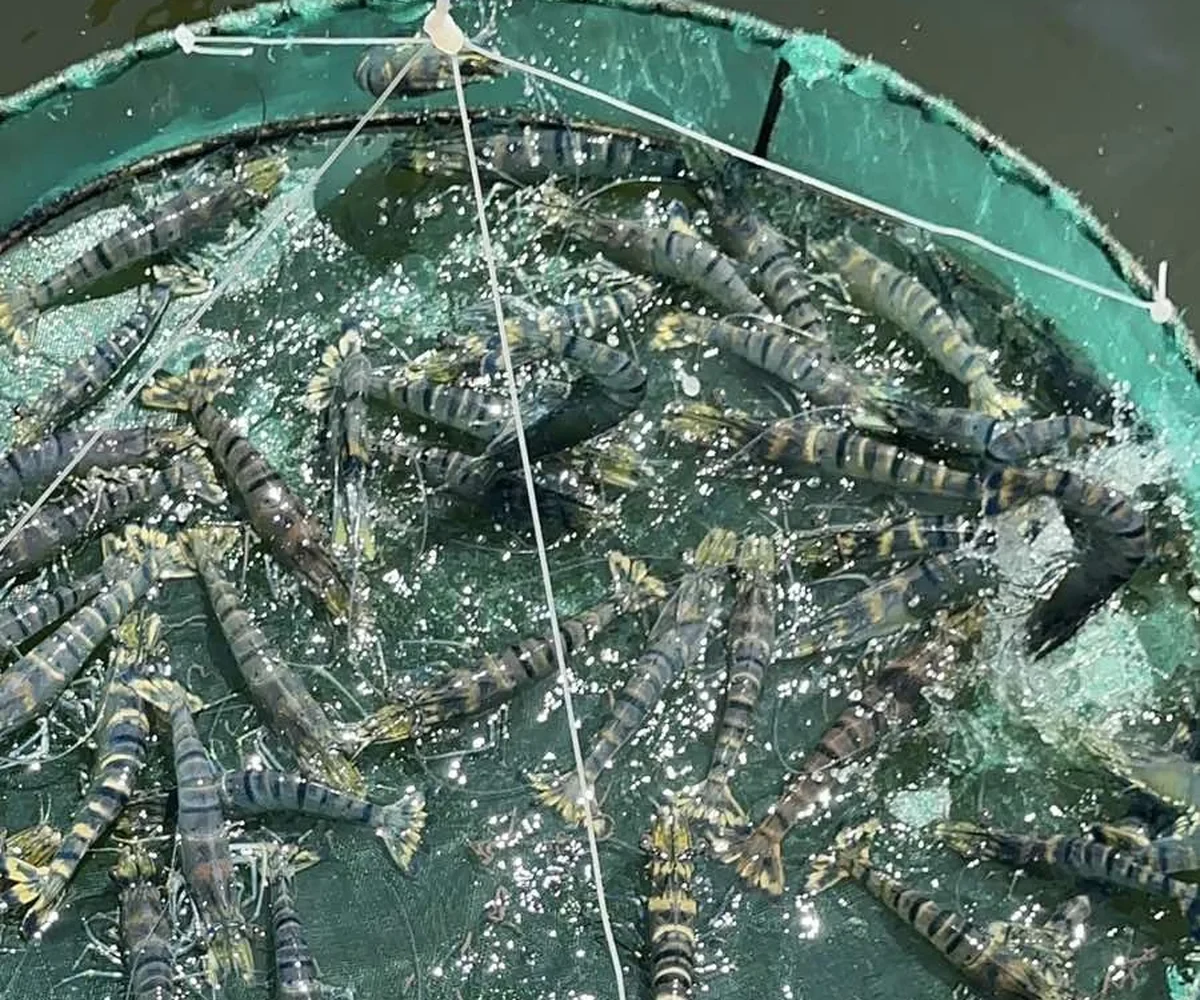
In short: butyrate comes in several forms: a salt, glycerin-bound esters and a polymer. A team at the South China Sea Fisheries Research Institute compared all four forms for the first time in black tiger shrimp, each at 1% of feed for 56 days. All four improved growth, lowered FCR, reduced gut Vibrio and improved nitrite tolerance; the two slow-release forms, tributyrin and PHB, did best.
- Butyric acid and Vibrio in whiteleg shrimp (2025) (coming soon)
- Four butyrate forms for black tiger shrimp (2026) (this article)
- Tributyrin and an AHPND challenge (2026)
How the four forms differ
| Form | Properties according to the paper |
|---|---|
| Sodium butyrate (SB) | Water-soluble; releases butyrate quickly in the stomach and upper gut, so delivery along the gut is uneven. |
| Monobutyrin (MB) | One butyric acid bound to glycerin (an ester). Bypasses the stomach and releases gradually in the gut. |
| Tributyrin (TB) | Three butyric acids bound to glycerin. Also releases gradually in the gut, and releases more butyrate than monobutyrin. |
| PHB (poly-β-hydroxybutyrate) | A bacterial polymer broken down gradually by gut bacteria; slow release and a carbon source that steers the microbiota. |
The trial
- Shrimp: 2.09 g black tiger shrimp, 3 tanks per group, 40 shrimp per tank; salinity 30‰, 30 °C, pH 8.2–8.4, two-thirds water exchange daily.
- Feed: 5 groups: a control and four groups with monobutyrin, tributyrin, sodium butyrate or PHB at 1% of feed (10 g/kg). Fed 5% of body weight, three times a day, for 56 days.
- Nitrite stress: after 56 days, 10 shrimp per tank were exposed to 20 mg/L nitrite for 48 hours.
Growth and FCR

| Group | Final weight | Weight gain | FCR |
|---|---|---|---|
| Control | 7.00 g | 235.8% | 1.68 |
| Monobutyrin | 8.33 g | 297.0% | 1.36 |
| Tributyrin | 9.30 g | 341.8% | 1.32 |
| Sodium butyrate | 8.50 g | 306.0% | 1.39 |
| PHB | 9.11 g | 336.1% | 1.30 |
All four groups were significantly better than the control. Tributyrin and PHB were highest; the other two were lower. Survival over the 56 days was also significantly higher in all four groups.
Gut Vibrio and nitrite tolerance

- Microbiota: in all four groups, Vibrio declined together with other opportunistic bacteria (Shewanella, Serratia, Escherichia-Shigella), while groups the authors consider beneficial, such as Rhodobacteraceae, Ruegeria and Shimia, rose.
- Gut lining: the control group showed damaged mucosa; the butyrate groups kept the lining more intact.
- Antioxidant and immune markers: MDA (a marker of oxidative damage) fell; SOD, total antioxidant capacity and antimicrobial peptide genes (ALF, penaeidin) rose.
- Nitrite stress, 20 mg/L for 48 h: all four groups survived better than the control; tributyrin best, PHB second. The authors report a difference of more than 28%.
In practice
- An indoor tank trial with daily water exchange, not a pond trial.
- 1% (10 g/kg) is the pure compound in the trial feed, a fairly high level. Only one dose was tested, so there is no optimum dose for black tiger shrimp yet.
- There was no Vibrio challenge. "Lower Vibrio" here is a share of the gut microbiota, not proof of resistance to Vibrio disease.
- Most earlier butyrate studies were on whiteleg shrimp; this one adds data for black tiger shrimp.
What farmers should know
- Form matters as much as dose. Forms that release gradually in the gut (tributyrin, PHB) did better than the fast-dissolving salt in this trial.
- Butyrate supports gut health and stress tolerance, but it does not replace keeping nitrite low: feed only what is eaten, siphon, and use water-treatment probiotics.
- Follow the label for commercial products, as content and form differ between products.
Quick questions
Which butyrate form worked best in black tiger shrimp?
In Duan and colleagues’ trial (2026), all four forms at 1% of feed beat the control. Overall ranking: tributyrin, then PHB, monobutyrin and sodium butyrate, under these trial conditions.
How much more did the shrimp grow?
After 56 days, control shrimp reached 7.00 g; tributyrin 9.30 g and PHB 9.11 g. Weight gain rose from 235.8% to 297–342%; FCR fell from 1.68 to 1.30–1.39.
Did butyrate lower gut Vibrio in black tiger shrimp?
Yes. By gene sequencing (16S), Vibrio together with Shewanella, Serratia and Escherichia-Shigella declined in all four groups, while Rhodobacteraceae rose. The paper shows a heat map without percentages.
Did butyrate help shrimp tolerate nitrite?
Under 48 hours of 20 mg/L nitrite, all four groups survived better than the control; tributyrin best, PHB second. The authors report a survival difference of more than 28%.
Source
- Duan Y., Zhu R., Wang Y., Huang J., Jiang S., Yang Q., Li Y., Shi J., Yang Y., Yang L., Ding Y., Zhou F. Comparative Efficacy of Monobutyrin, Tributyrin, Sodium Butyrate, and Poly-β-hydroxybutyrate on Growth, Intestinal Health, and Nitrite Stress Resistance in Penaeus monodon. Antioxidants, 2026;15(8):929. DOI 10.3390/antiox15080929. Open access, CC BY 4.0 licence.
- This article is a summary and interpretation by Than Vuong. Charts were redrawn by Than Vuong from the reported numbers; the paper’s own figures and tables are not reproduced. The "What farmers should know" section is editorial opinion.