
Water and sand
Water and sand management
Snails live on and in the sand, so the bed matters as much as the water.
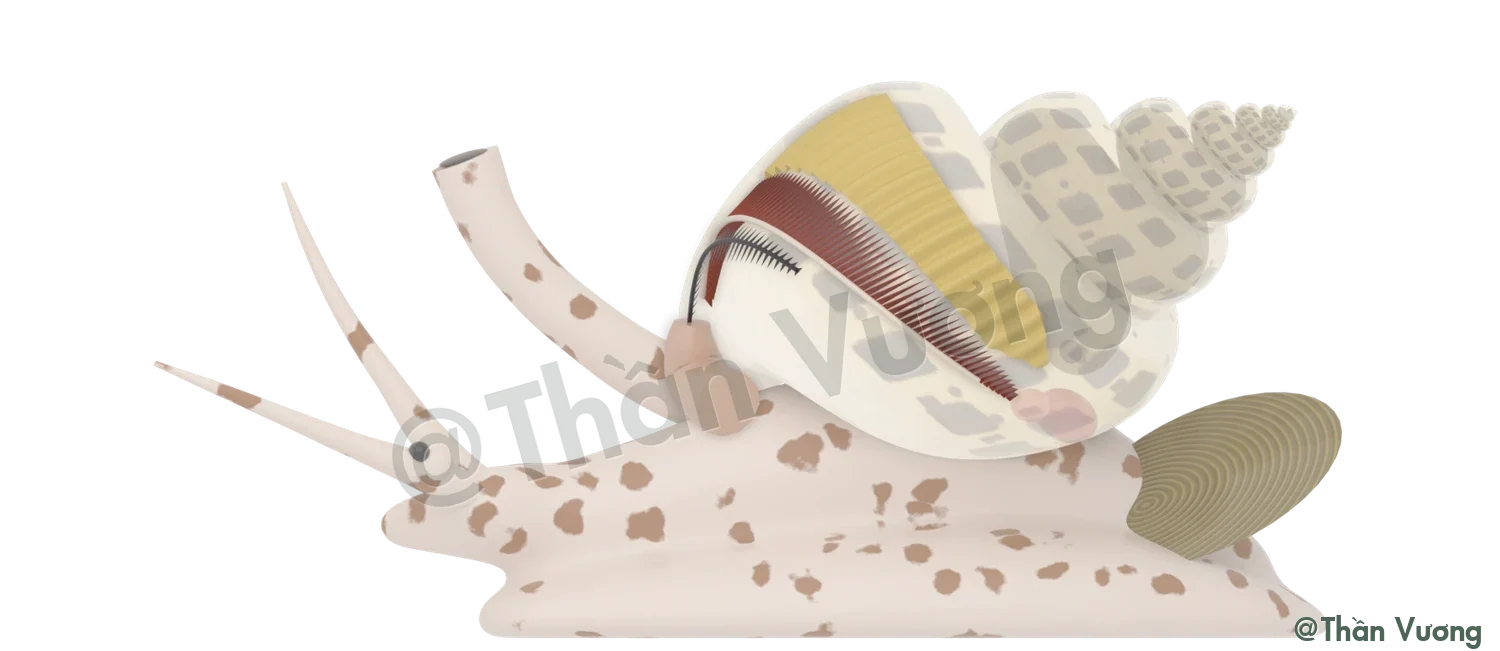
- 1
Siphon. Draws water into the mantle cavity through the notch at the base of the shell.
- 2
Osphradium*. Sits at the end of the siphon, so incoming water passes it first. Gene studies in this species point to it as the gateway for food signals.
- 3
Gill. A single gill with closely packed leaflets. In a 7-week ammonia trial on juveniles the gill was clearly damaged, and growth fell from 5 mg/L (given as NH4Cl).
- 4
Hypobranchial gland. Folds in the roof of the mantle cavity that secrete mucus.
Simplified illustration. Shell, head, foot, gill and proboscis follow work on this species and the genus Babylonia. * Based on Buccinum, a snail of the same order; no dissection has been published for this species.
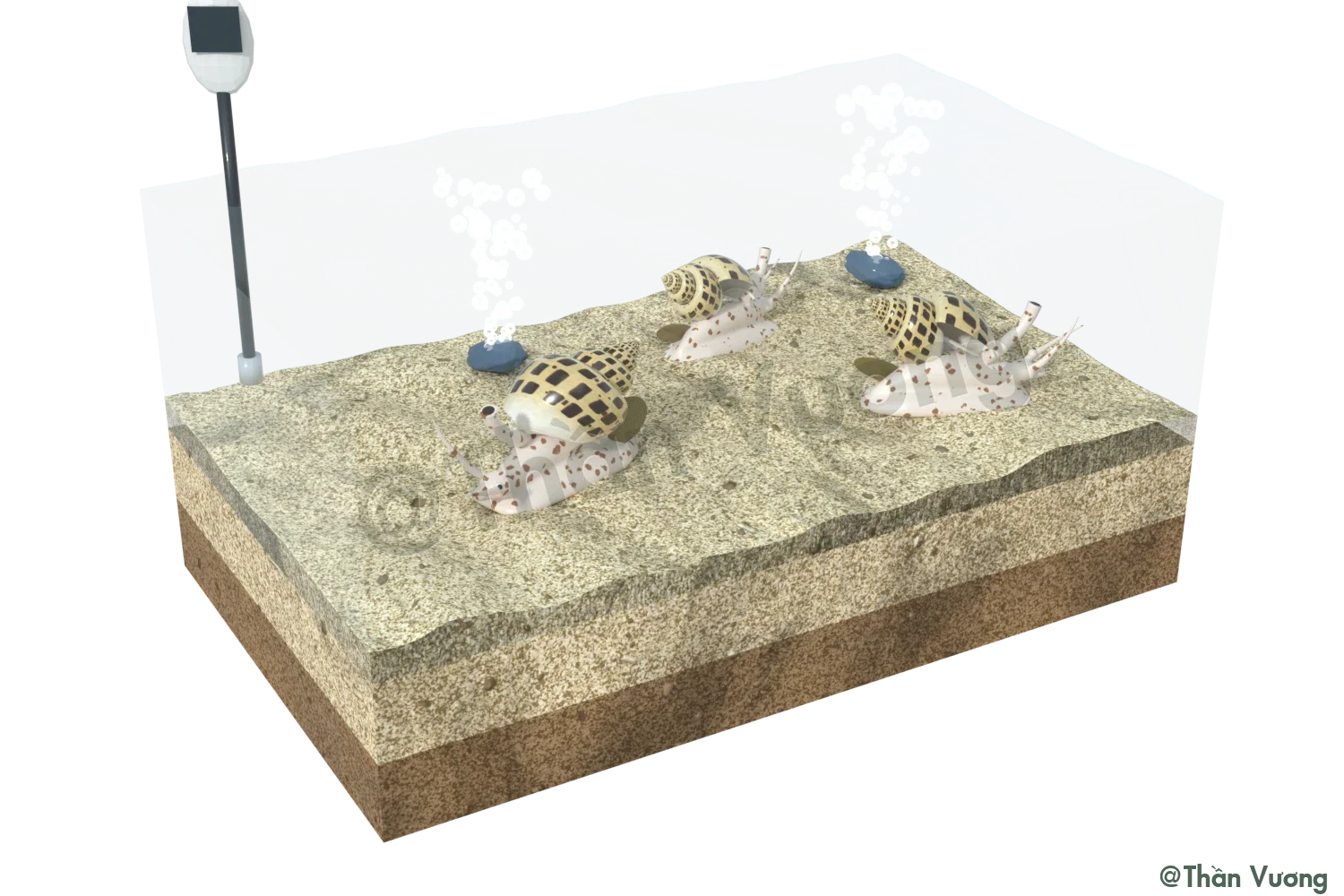
Steady aeration, regular testing
Water passes through the siphon into the mantle cavity and over the gill, so water quality reaches the snail directly. Test regularly to catch changes early.
- 20–30 ‰
- salinity for growing juveniles
- 26–30 °C
- temperature
- Above 4.5 mg/L
- dissolved oxygen
Water targets
| Parameter | Target | Basis |
|---|---|---|
| Salinity | 20–30 ppt for growing juveniles | 2023 trial: from 35 ppt growth and survival fell and gills were damaged. Extension guides give 25–35 ppt |
| Temperature | 26–30 °C | 2010 trial |
| pH | 7,5–8,5 | Extension guides. In trials, pH 7 and pH 9 caused more snails to turn over than pH 8 |
| Dissolved oxygen | Above 4.5 mg/L | Extension guide. In a 144-hour trial on juveniles, 5% died at 2 mg/L and 51.67% at 0.5 mg/L |
| Ammonia | As low as possible | 7-week trial (concentrations given as NH4Cl): slower growth from 5 mg/L, more deaths at 7.5–10 mg/L |
| Free NH3 | Below 0.1 mg/L | General aquaculture limit; no snail-specific figure |
| Nitrite (NO2) | Below 0.3–0.5 mg/L | General aquaculture limit. RAS systems measured 0.02–0.30 mg/L |
| H2S | No snail-specific limit | Black, smelly sand means act at once |
Work out NH3 from total ammonia, pH, temperature and salinity →
Keeping the sand clean
Sand snails can bury in
Sand, or sand with coral, and little silt. Snails spend much of their time buried.
Little oxygen under the sand
Some beds measured below 1 mg/L. The dirtier the bed, the worse it gets.
Black sand is a warning
If water or sand turns black and smells, move the snails to another pond or tank, or exchange about 30–50% of the water and clean up before carrying on.
When the water worsens
Cut feed
Cut straight away to reduce the organic load.
Add oxygen
Run more aeration, especially at night.
Add new water
Pump in clean filtered water, keeping salinity steady.
Support with lime and probiotics
Use aquaculture lime and probiotics at the label dose to improve conditions.
The lesson from Cẩm Xuyên, 2024
Hà Tĩnh's authorities ruled out disease. Density was tens of times the advised level, and farmers paid little attention to salinity, pH or regular bottom cleaning. Heavy losses do not always mean disease, so check water, sand and density first.
Sources
- Liu et al. 2023. Aquaculture. salinity in juveniles
- Siuvai et al. 2010. Journal of the World Aquaculture Society. temperature and salinity
- Zhou et al. 2022. Aquaculture. long-term ammonia exposure in juveniles
- Tang et al. 2025. Biology 14. hypoxia in juveniles
- Ding et al. 2023. Antioxidants 12. nitrite and pH
- Ding et al. 2024. Heliyon. ammonia and pH
- Hoàng Văn Duật và cs. 2024. Tạp chí Khoa học Trường ĐH Cần Thơ. RAS culture
- Dương Tử 2020. Ốc hương: đặc sản biển. Thủy sản Việt Nam
- Như Ý 2022. Kỹ thuật nuôi ốc hương thương phẩm trong ao. Dân tộc và Phát triển
- Ban KHKT 2025. Biện pháp khắc phục ốc hương bị sưng vòi. Thủy sản Việt Nam
- Báo Hà Tĩnh 2024. Kết luận chính thức nguyên nhân ốc hương chết hàng loạt ở Cẩm Xuyên
Want our technical team to look at your snail pond?
Send us your pond or tank details and water readings. Our technical team will work out a care schedule with you for each stage.