
Every day
Daily care of babylon snails
Four steady jobs: feed the right amount, remove leftovers, keep the sand clean and watch the snails.
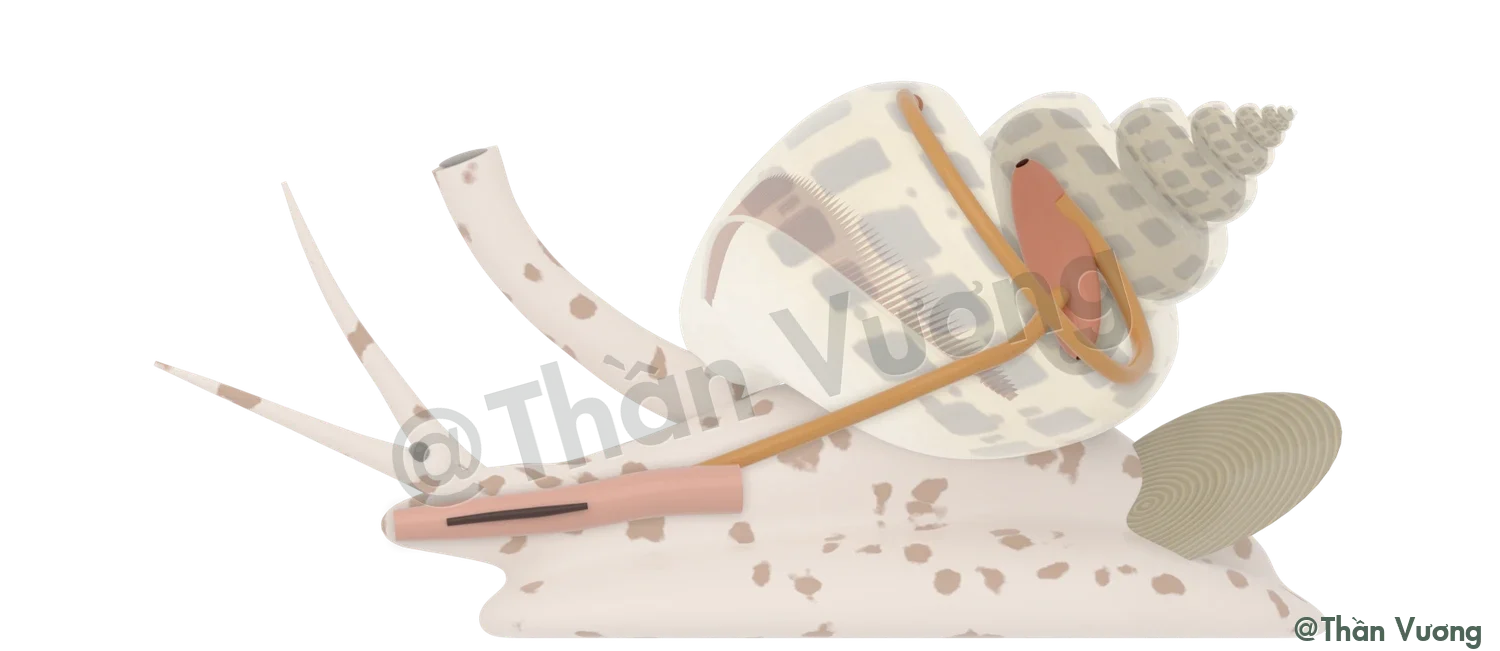
- 1
Proboscis. Long and retractable, with the mouth at its tip.
- 2
Radula. About 40 rows of three teeth, used to rasp food.
- 3
Oesophagus*. Carries food from the proboscis to the stomach.
- 4
Stomach*. A flattened sac against the digestive gland, which drains into it.
- 5
Intestine and rectum*. Runs forward along the right edge of the mantle cavity and ends at the anus.
Simplified illustration. Shell, head, foot, gill and proboscis follow work on this species and the genus Babylonia. * Based on Buccinum, a snail of the same order; no dissection has been published for this species.
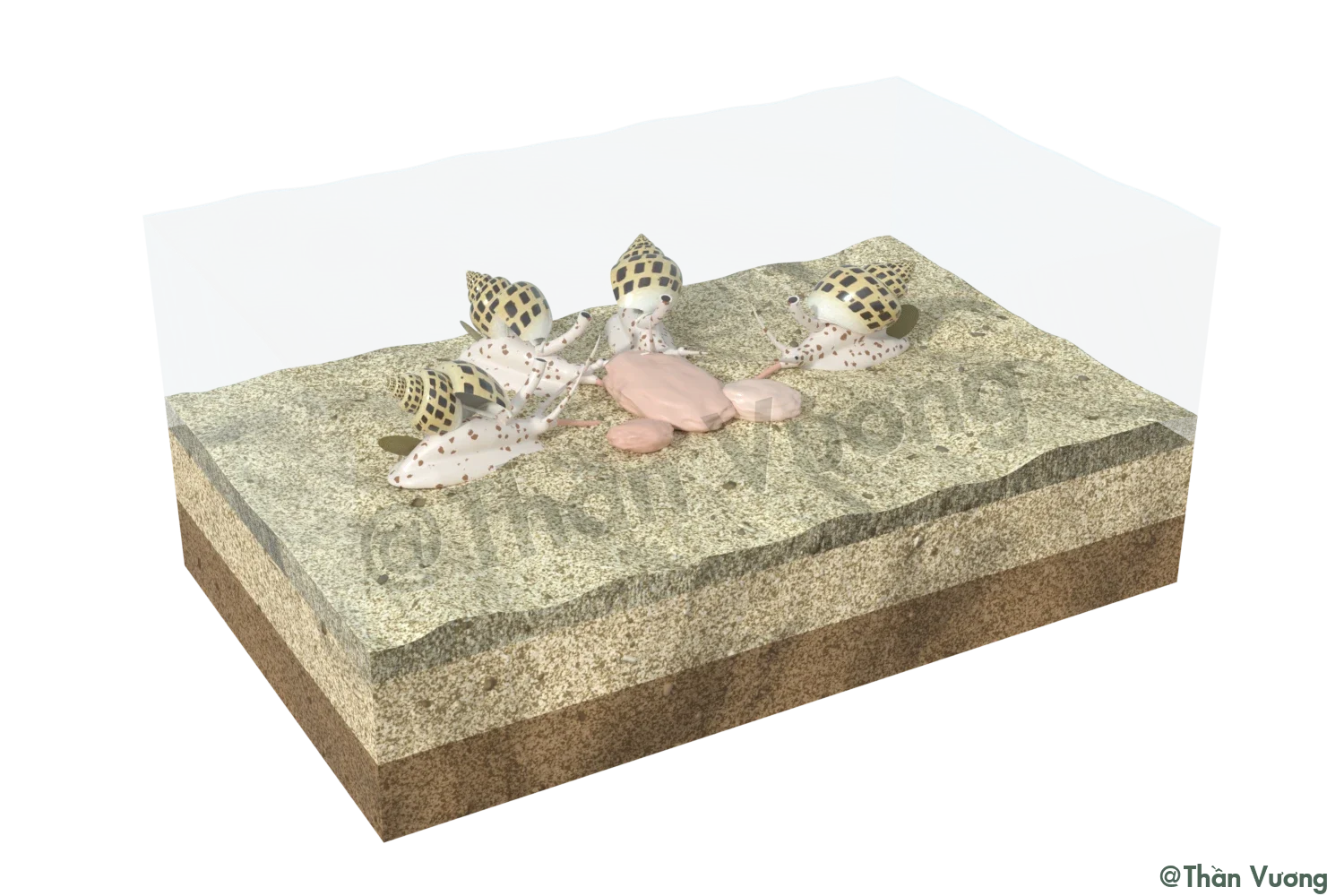
A carnivore that needs fresh feed
Babylon snails prefer bivalve meat and fish. Leftovers on the sand foul the bed quickly, so feed amount and removing leftovers go together.
- 15–20 %
- fresh feed in month one
- 5–7 %
- from month four
- 1–3 hours
- after feeding, remove leftovers
Every day
Feed the right amount
Work it out from the snail weight in the pond, then adjust to what they finish. Feed must be fresh, with no chemical preservatives.
Remove leftovers
Remove shells, bones and anything left 1–3 hours after feeding. Nothing does more to keep the sand clean.
Watch the snails
See whether snails come up to feed and bury again. Remove and count any dead.
Keep the log
Write down feed, water readings, dead snails and what you did.
Feed reference
Given as a percentage of the snail weight in the pond, per day.
| Feed | Stage | Daily amount | Basis |
|---|---|---|---|
| Fresh: fish, crab, shrimp | Month 1 | 15–20 % | Extension guide |
| Fresh | Month 2 | 10–15 % | Extension guide |
| Fresh | Month 3 | 8–10 % | Extension guide |
| Fresh | From month 4 | 5–7 % | Extension guide |
| Pellets | Ponds and RAS | 0.8–1.2% | 2022 trial |
| Pellets | RAS | 1–2 % | 2024 trial |
Underfeeding also costs snails: in a 150-day trial on 0.26 g juveniles, rations of 10–15% gave 96.9–97.3% survival, while 3–5% gave only 49.5–54.8%. From month two, adjust to what you see in the pond.
Meals and feeding time
- Trials usually fed one meal a day in the morning, and some used two.
- Extension guides feed one meal at dusk, because the snails feed at night, with one day off after every three.
- A trial comparing six feeding regimes over 180 days found no difference in growth or survival.
- Pick a fixed time that fits your day, as long as you can remove leftovers on time.
Sand and water routine
| Job | How often | Basis |
|---|---|---|
| Pond water exchange | Every 7–15 days, 30–70% each time | Earthen-pond trial: 4.22 g gain with 7-day exchange, 2.68 g with 30-day. Percentage from extension guides |
| Full bed cleaning | At spring tides, together with water exchange | Extension guide |
| Washing sand in tanks | Jet-wash and sun-dry every 30 days | Tank trial |
| Water testing | Every 3 days, 1 hour after feeding | RAS trial |
| Weight sampling | Every 15 days | RAS trial |
Bad-weather days
Heavy rain
Re-test salinity and pH. If the water worsens, cut feed, add new water and run more aeration.
Hot spells
Run more aeration, especially at night. Lined ponds can be shaded with netting. In a trial, survival was 71.7% at 32 °C against 94.2% at 28 °C.
Thinning and grading
- Densely stocked snails need thinning as they grow. No source gives a standard schedule, so go by size, feed intake and the state of the sand.
- In the nursery stage, extension guides sort by sieve after 10–15 days.
Sources
- Như Ý 2022. Kỹ thuật nuôi ốc hương thương phẩm trong ao. Dân tộc và Phát triển
- Đỗ Kim Tâm 2018. Kỹ thuật nuôi ốc hương, nguyên nhân ốc chết và biện pháp phòng
- Chaitanawisuti et al. 2001. Aquaculture Research. feeding rates
- Chaitanawisuti & Kritsanapuntu 1999. Aquaculture Research. six feeding regimes
- Chaitanawisuti et al. 2001. Asian Fisheries Science 14. tank culture
- Kritsanapuntu et al. 2009. Aquaculture Research. density and water exchange in earthen ponds
- Mai et al. 2022. Agriculture, Forestry and Fisheries 11(5). pellets in ponds and RAS
- Hoàng Văn Duật và cs. 2024. Tạp chí Khoa học Trường ĐH Cần Thơ. RAS culture
- Siuvai et al. 2010. Journal of the World Aquaculture Society. temperature and salinity
- Nguyễn Phương 2020. Quy trình sinh sản nhân tạo ốc hương. Thủy sản Việt Nam
Want our technical team to look at your snail pond?
Send us your pond or tank details and water readings. Our technical team will work out a care schedule with you for each stage.