
Before stocking
Preparing the pond and stocking
A clean sand bed and moderate density decide most of how a crop turns out.
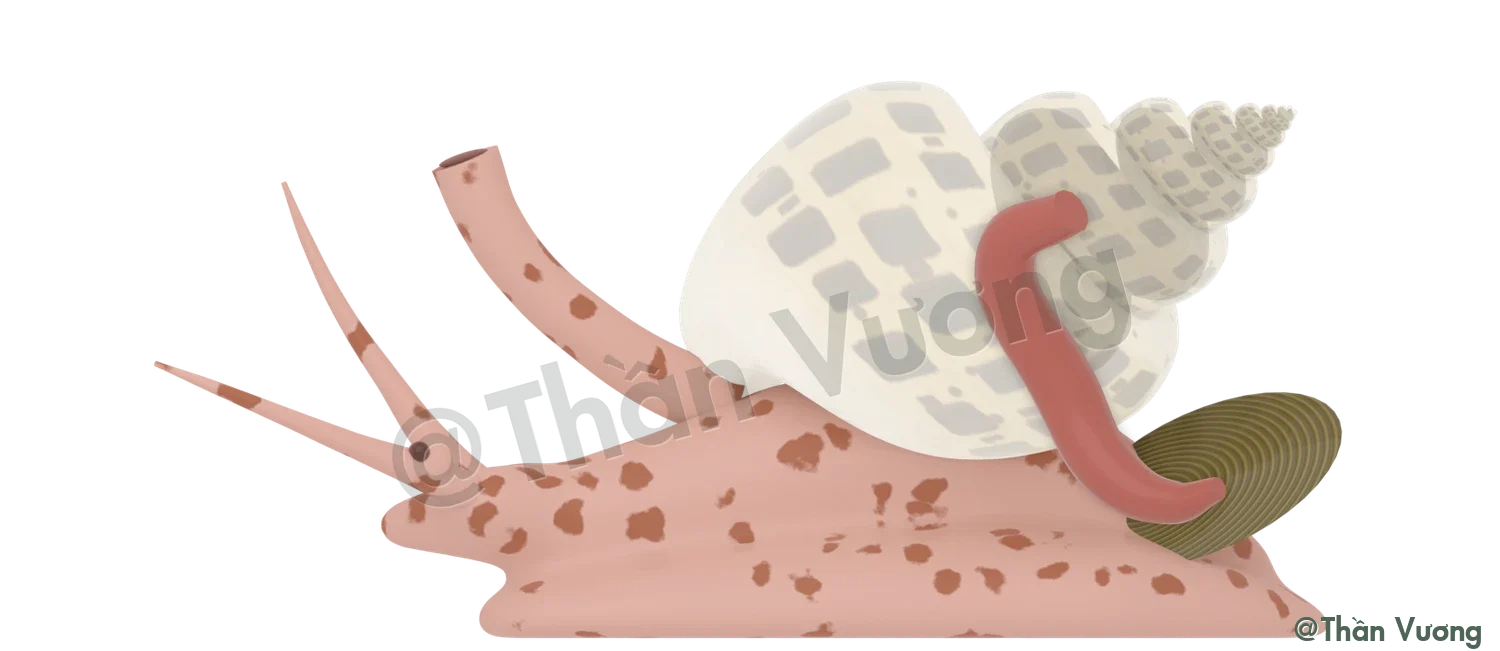
- 1
Foot. A long muscular mass with a flat sole, used for crawling and burying in sand.
- 2
Columellar muscle*. Runs from the shell column through the foot to the underside of the operculum, and pulls the snail into its shell.
- 3
Operculum. A horny plate on the rear of the foot that closes the aperture when the snail withdraws.
Simplified illustration. Shell, head, foot, gill and proboscis follow work on this species and the genus Babylonia. * Based on Buccinum, a snail of the same order; no dissection has been published for this species.
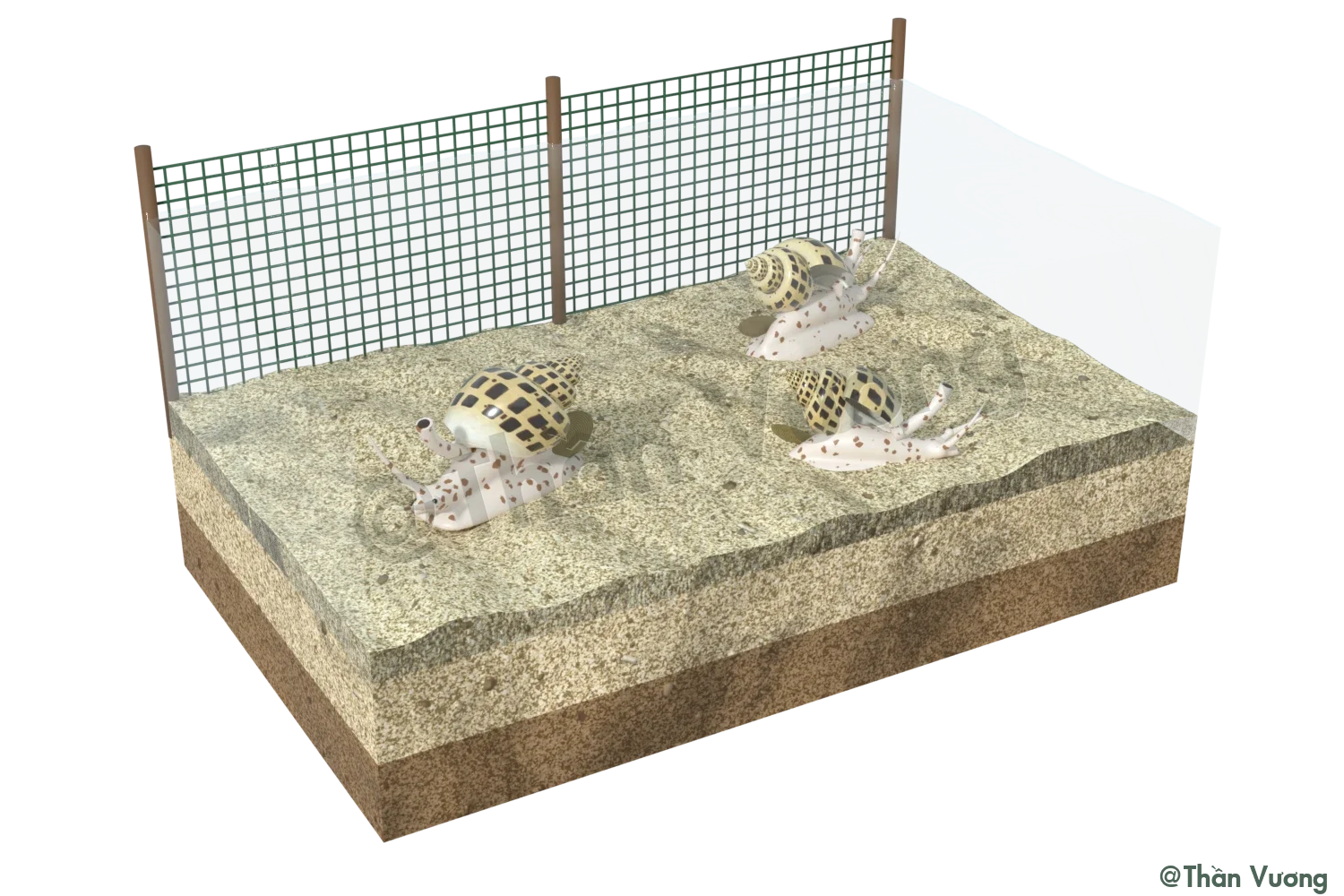
Sand bed, water depth and edge net
Snails need clean sand to bury in, enough water depth and a net so they cannot crawl out.
- 7–10 cm
- of fresh sand in ponds
- 0.8–1.5 m
- pond water depth
- 50–100/m²
- advised pond density
Choosing a system
| System | Water depth | Bed | Notes |
|---|---|---|---|
| Earthen or sand pond | 0,8–1,5 m | Sand or sand with coral, little silt; 7–10 cm of fresh sand | Fit a net round the waterline so snails cannot crawl out |
| Tank | 0,5–1 m | 5 cm of coarse sand, or 10–15 cm of fine sand | Easy to wash the bed and control the water |
| Recirculating (RAS) | 0,4 m | 2 cm of sand over 2–3 cm of coral or gravel | High yield, but still at trial stage |
In a RAS trial, culture without a bed gave very poor results, so snails always need something to bury in.
Pond preparation steps
Drain and clean out
Collect any leftover and dead snails. Remove all black sludge and debris.
Lime and renew the sand
Apply 100–300 kg of lime per 1,000 m² to neutralise acidity and raise bottom pH, then lay 7–10 cm of fresh sand. Replace any sand that is black or smells.
Secure banks and nets
Banks must be sound with no leaks, and water must fill and drain easily. Fit a net round the waterline.
Fill through a filter
Filter well to keep out predators. Check salinity and pH before stocking.
Seed the bottom
Apply MAX 4000 two to three days before stocking, at the label dose.
Choosing and stocking seed
Choosing seed
Even in size, disease-free and bright in colour. Do not stock seed that is too small or has not been quarantine-checked.
Seed size
Extension guides give about 5,000–7,000 snails/kg. Trials usually used snails of 0.2–0.3 g.
Transport
Use closed transport with oxygen.
Acclimation
Let snails adjust gradually to the pond's temperature and water before release. No source gives a standard time, so ask a technician for each batch.
When to stock
Early morning or the cool of the evening.
Stocking density reference
| System | Density | Basis |
|---|---|---|
| Grow-out pond | 50–100/m² | Hà Tĩnh authority advice and extension guides |
| Earthen pond, 6-month trial | No more than 300/m² | 100–300/m²: 0.58–0.59 g/month; 400–500/m²: only 0.41–0.42 g/month |
| RAS, trial | 1,500–2,500/m² | Needs recirculating filtration and tight control; not for ponds |
Sources differ widely: one extension guide gives 300–500/m². The higher the density, the better your water exchange, aeration and bed cleaning must be. Start low if you are new to this.
Sources
- Như Ý 2022. Kỹ thuật nuôi ốc hương thương phẩm trong ao. Dân tộc và Phát triển
- Đỗ Kim Tâm 2018. Kỹ thuật nuôi ốc hương, nguyên nhân ốc chết và biện pháp phòng
- Nhân Dân 2005. Công nghệ sản xuất giống và nuôi ốc hương thương phẩm
- Báo Hà Tĩnh 2024. Kết luận chính thức nguyên nhân ốc hương chết hàng loạt ở Cẩm Xuyên
- Kritsanapuntu et al. 2009. Aquaculture Research. density and water exchange in earthen ponds
- Chaitanawisuti et al. 2001. Asian Fisheries Science 14. tank culture
- Hoàng Văn Duật và cs. 2024. Tạp chí Khoa học Trường ĐH Cần Thơ. RAS culture
- Mai et al. 2022. Agriculture, Forestry and Fisheries 11(5). pellets in ponds and RAS
Want our technical team to look at your snail pond?
Send us your pond or tank details and water readings. Our technical team will work out a care schedule with you for each stage.