
Farm design
Designing a sustainable snail farm
A sustainable farm has a stable water source, a separate nursery, density it can handle, and treatment before discharge.

A farm layout

- 1
Seawater source. Take water through a filter, away from freshwater influence.
- 2
Reservoir and settling pond. Stores and settles water before use, so you are not caught out when the source turns bad.
- 3
Covered nursery. Rears small snails apart, with easier control of water and feed.
- 4
Grow-out ponds. Several moderate ponds allow thinning and resting in turn.
- 5
Effluent treatment pond. Settles sludge and treats water before discharge.
Illustrative layout. No published ratio exists for the effluent pond area for this species.
Grow-out pond model

- 1
Edge net. 40–60 cm above water, slightly angled, keeps snails from crawling out.
- 2
Inlet filter bag. Water enters through a filter bag to keep out predators.
- 3
Paddlewheel. 2–4 sets depending on density. Run more in hot spells, especially at night.
- 4
Water depth. 0.8–1.5 m in extension guides.
- 5
Sand layer. Clean sand with little silt, not too fine. 5–30 cm depending on the source.
- 6
Liner. Lines the banks and bottom, with sand on top.
- 7
Center drain pit. The bottom slopes only slightly to the center; a steep slope would send the sand into the pit. The rim stands above the sand and a mesh cover keeps sand and snails in.
- 8
Horizontal drain pipe. Runs under the bottom from the pit out past the bank. Drains the pond for cleaning and harvest.
Illustrative model cut through the pond center. Snails are drawn larger than real. Snail guides call for a bottom sloped to the outlet but give no figure.
Nursery model (concrete tank)

- 1
Shade net. Shades outdoor tanks.
- 2
Inlet pipe. Supplies new filtered water. One Chinese farm exchanged 100% daily.
- 3
Aeration grid. Constant aeration. One guide also uses aeration to wash the sand.
- 4
Anti-climb lip. Fixed around the wall 50 cm above the floor. Water stays 4–10 cm below it.
- 5
Fine sand bed. 0.1–0.5 mm sand, 2–3 cm deep.
- 6
Center collector pipe. A standpipe with its mouth above the sand and a net cover. Guides do not describe the outlet fitting; this is one layout.
- 7
Horizontal drain pipe. Runs under the bottom out of the tank. Drain water goes to the treatment pond.
- 8
Dip net for leftovers. Lift out leftovers each morning before changing water.
- 9
Grading sieve. Extension guides sort by sieve after 10–15 days.
- 10
Small snails. RAS trial: up to 18,000/m² at 4.6–11 mm.
Illustrative model cut through the tank center. Blue arrows show water flow. Snails and sand are drawn larger than real.
Grow-out tank model (concrete tank)

- 1
Inlet pipe. Guides give 50–70% water exchange a day.
- 2
Aeration grid. Constant aeration in the tank.
- 3
Sand layer. Sand laid straight on the floor. Guides give 1.5–4 cm by snail age, others 5–8 cm. The thicker the sand, the harder it is to wash.
- 4
Center collector pipe. A standpipe with its mouth above the sand and a net cover. Guides do not describe the outlet fitting; this is one layout.
- 5
Horizontal drain pipe. Runs under the bottom out of the tank. Drain water goes to the treatment pond.
- 6
Dip net for leftovers. Lift out leftovers each morning before changing water.
Illustrative model cut through the tank center. Blue arrows show water flow. Snails and sand are drawn larger than real.
How organic waste leaves a sand bed
A siphon easily takes the sand too, and no guide describes how to do it on a sand bed. This grow-out trial compared bottom types at 2,500 snails/m² over 176 days.
| Bottom type | Waste removal | Survival | FCR | Yield |
|---|---|---|---|---|
| No sand, nylon or cotton media | Flow carries waste to a collection funnel. Snails stop eating and lie upturned | 36–47 % | 15–16 | 1.8–2.4 kg/m² |
| Plastic floor, mesh, sand | Water flows down through the sand. Still needs draining, raking and hosing | 58 % | 6.6 | 4.75 kg/m² |
| Plastic floor, coral, mesh, sand | Backwashed. Still needs draining, raking and hosing | 63 % | 4.4 | 6.33 kg/m² |
| Coral, mesh, sand, no floor | Water rises through the bed into the collector. No raking or hosing over 176 days | 70 % | 2.3 | 11.77 kg/m² |
One trial in Khánh Hoà: RAS, 83.3 m² tanks, 0.2 g seed, one crop. It did not measure H2S or conditions inside the stone layer, and does not cover pump stoppages. Organic matter reaching the stones could produce toxic gas, so treat these as reference figures, not a design to copy. These beds need a concrete floor. Plastic-floor beds at times needed raking and hosing 2–4 times a day, which disturbed the sand and scratched shells.
Plain sand tanks are cleaned by hand
Sand laid straight on the tank floor, in nursery and grow-out tanks. From Vietnamese and Chinese technical guides, not compared in trials.
Remove leftovers
Each morning, lift out all bones, fish heads and shells before changing water and feeding.
Change water
Vietnamese guides give 50–70% exchange a day. The outlet must be covered with a net.
Drain, rake and hose the sand
Grow-out tanks: guides give every 3–7 days, one trial every 30 days. The thicker the sand, the harder it is to wash. Nursery tanks: wash the sand with aeration or replace it, and at harvest scoop snails and sand together onto a sieve.
Renew the sand
Guides differ: about weekly, or every 40–50 days. Renew at once if the bottom smells or snails eat less.
Move snails if the bottom is too foul
Move them to a new tank and clean the old one before reuse.
Send drain water to treatment
Do not discharge straight into shared waters. Settle sludge and treat the water first.
Keeping the bottom of a large sand pond
Large sand ponds cannot take a stone layer because stones sink. The bottom is kept by clearing leftovers, exchanging water and raking.
Remove leftovers
Regularly lift out all leftovers, bones, fish heads and crab shells.
Exchange water regularly
Guides give 20–30% every 3–5 days, or 30–70% each time. Mid- and high-tide ponds should pump daily.
Full clean on spring tides
Clean the whole bottom and exchange the water thoroughly.
Check the bottom monthly
If it smells or turns black, rake, aerate and exchange water. About 2 cm of clean sand can be added.
Too much silt or algae
Drain and clean the pond, and move snails to another pond or pen.
Choosing a site
Stable salt water
Extension guides give 25–35 ppt, with no influence from rivers or streams.
Separate inlet and outlet
Sound banks with no leaks, and separate inlet and outlet so you control water exchange.
Possible away from the sea
One Thai RAS farm used 10 ppt canal water mixed with salt-farm brine up to 30 ppt.
Reference sizes
| Item | Value | Basis |
|---|---|---|
| Land split | 0.8 ha farm: 0.3 ha ponds, 0.4 ha seawater reservoir | Thai pilot farm |
| Sand layer | Sources differ: 5–10, 7–10 or 20–30 cm | Extension guides. Trials all used 10 cm or less |
| Edge net | 40–60 cm above water, slightly angled | Extension guide |
| Concrete tank | 4 × 5 × 1 m, 0.1–0.5 mm sand, shade net, constant aeration, 100% daily exchange | Chinese farm (2011) |
| Tank with raised floor | 6 × 3 × 1 m, bottom sloped to the drain; wood floor 20 cm up, 80–100 mesh screen, 6–8 cm sand | Chinese guide, author not stated |
| RAS tank | 10 × 8.33 m, 0.4 m water; 2–3 cm coral, 150 µm mesh, 2 cm sand; water fed upward | Vietnamese trial (2024) |
Density by stage
Each system has its own level. Do not carry a figure from one system to another.
| Stage, system | Density | Result | Basis |
|---|---|---|---|
| Nursery 4.6 → 11 mm, RAS, 30 days | 12,000–18,000/m² | 94–95% survival, falling to 73% from 24,000/m² | 2023 trial |
| Pond, months 1–2, seed from 20,000/kg | 500–700/m² inside the net | No measured outcome | Extension guide |
| Pond, after 2 months | Thin to 200–300/m² inside the net | No measured outcome | Extension guide |
| Earthen pond, 6 months | No more than 300/m² | Clearly slower at 400–500/m² | 2009 trial |
| Lined pond, to harvest | 80–100/m² | About 1 kg/m² after 6 months | Extension guide |
| Pond, Hà Tĩnh advice | 50–100 con/m² | A safe level for new farmers | Provincial authority |
| Tanks, 6 months | 200 and 400/m² | Clearly faster at 200/m² | 2011 trial |
| Concrete tanks, flow-through, 144 days | 1,000/m² | About 90% survival, 5.49 g | Chinese farm |
| 98 m² RAS, 6 months | 300/m² | 90.5% survival, 5.6 g, 147/kg | Thai farm |
| RAS, 176 days | 2,500/m² | 70.3% survival, 11.77 kg/m² | Vietnamese trial |
No trial has compared thinned with unthinned stock: trials kept one density throughout. The 500–700 then 200–300/m² schedule is extension practice.
How to thin
Decide when
Extension guides thin after 2 months. Also go by sampling, feed intake and the colour of the sand in each pond.
Prepare the new pond first
For an empty pond with a black bottom: VIBRIO CLEAR by the label at 1–2 kg/1,000 m³ (20–30 cm deep), then seed probiotics and stock after 24–48 hours.
Grade by size
Sort by size so small snails are not held back. In the nursery, use a sieve. No source gives a mesh size.
Disinfect when moving
AQUA DINE by the label: dip in 2–50 g/m³ for 1–2 minutes.
Stock and recalculate
Stock in cool hours, weigh each pond again and recalculate the feed.
Sustainable practice
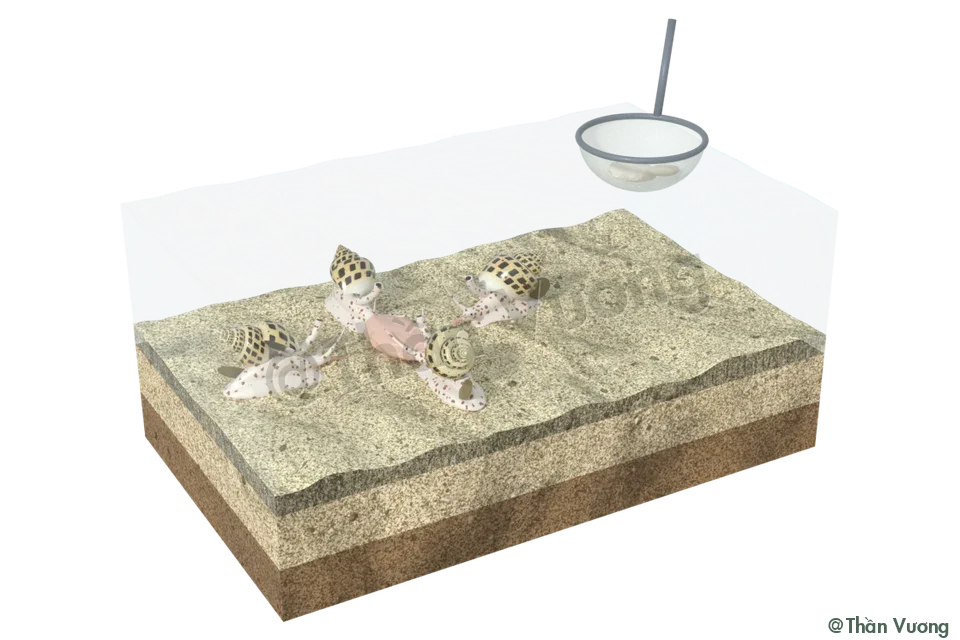
Low-waste feeding
Feed the right amount and remove leftovers. In a trial, 40–41% protein beat 36%.
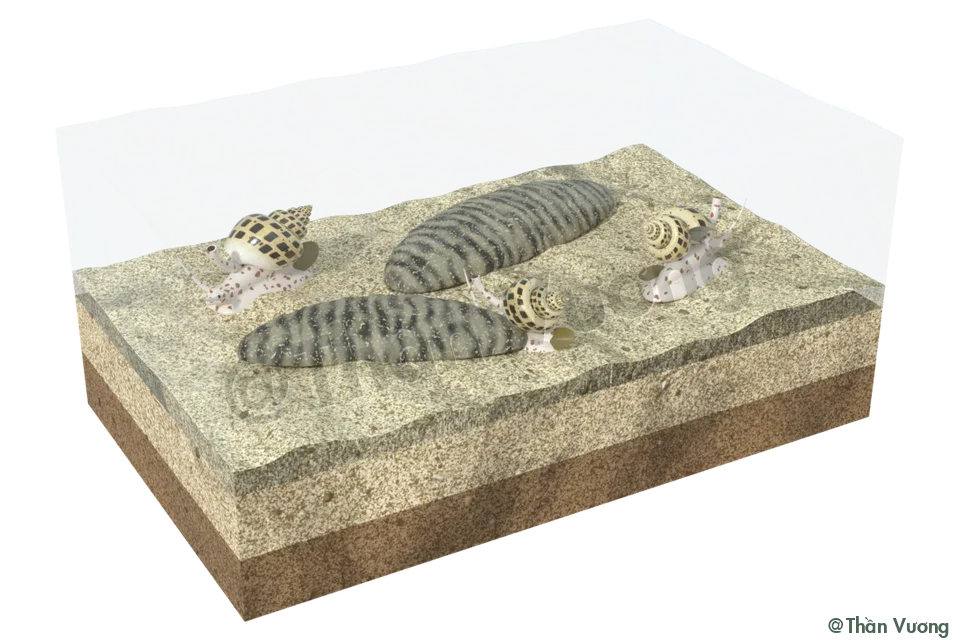
Co-culture with sandfish
In raceways, snail gain doubled and sand nitrogen fell 20%. In earthen ponds there was no clear benefit. Still experimental.
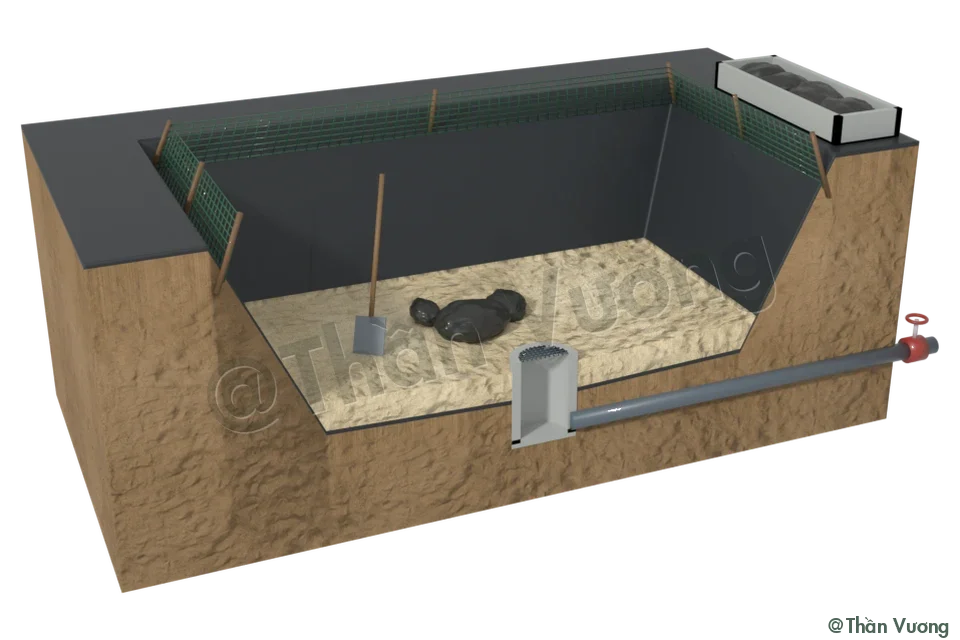
Rest ponds, deal with sludge
After losses of 50% or more, clean up and rest at least a month. Do not dump bottom sludge into shared waters.
Waste water
QCVN 40:2025/BTNMT requires aquaculture waste water to control COD, BOD5, TSS, pH, total coliform, total nitrogen and total phosphorus. The applicable limit column depends on the receiving water, so check with your local authority.
Sources
- Liên hiệp các hội KHKT Ninh Bình 2021. Kỹ thuật nuôi ốc hương thương phẩm
- Khuyến nông Đà Nẵng 2018. Nuôi ốc hương trong ao trên cát lót bạt
- Đỗ Kim Tâm 2018. Kỹ thuật nuôi ốc hương, nguyên nhân ốc chết và biện pháp phòng
- Báo Hà Tĩnh 2024. Kết luận chính thức nguyên nhân ốc hương chết hàng loạt ở Cẩm Xuyên
- Kritsanapuntu et al. 2006. Aquaculture Research. pilot earthen pond culture
- Kritsanapuntu et al. 2009. Aquaculture Research. density and water exchange in earthen ponds
- Kritsanapuntu 2011. Prince of Songkla University. density and dietary protein
- Liu et al. 2023. Journal of Hainan University. nursery density in RAS
- Lin 2011. Fujian Fisheries. outdoor concrete tanks
- Chaitanawisuti et al. 2009. International Journal of Recirculating Aquaculture 10. large-scale RAS farm
- Hoàng Văn Duật và cs. 2024. Tạp chí Khoa học Trường ĐH Cần Thơ. RAS culture
- Tiếp thị Nông nghiệp 2016. concrete tank culture procedure
- Tép Bạc. babylon snail seed production
- Chen Chui 2009. Babylon snail culture, Shanwei fisheries centre
- 肥渔志 2024. Factory culture of babylon snails
- Hải An 2020. Tạp chí Thủy sản Việt Nam. co-culture of otter clams, snails and seaweed
- Như Ý 2022. Kỹ thuật nuôi ốc hương thương phẩm trong ao. Dân tộc và Phát triển
- Dobson et al. 2021. Journal of the World Aquaculture Society. co-culture with sandfish
- QCVN 40:2025/BTNMT. Quy chuẩn kỹ thuật quốc gia về nước thải công nghiệp
Want our technical team to look at your snail pond?
Send us your pond or tank details and water readings. Our technical team will work out a care schedule with you for each stage.