
01 / WHY PHAGES
When antibiotics are no longer the way out
Overuse of antibiotics in aquaculture spreads resistant bacteria and leaves residues in products. According to the author, antibiotic residues cause friction in trade with the largest seafood markets — the European Union, the United States and Japan — and significant losses for exporting countries. Vaccines are limited by side effects and cost. The author also notes that shrimp lack a vertebrate-like adaptive immune system, so once shrimp are infected, antibiotics are almost the only remedy left.
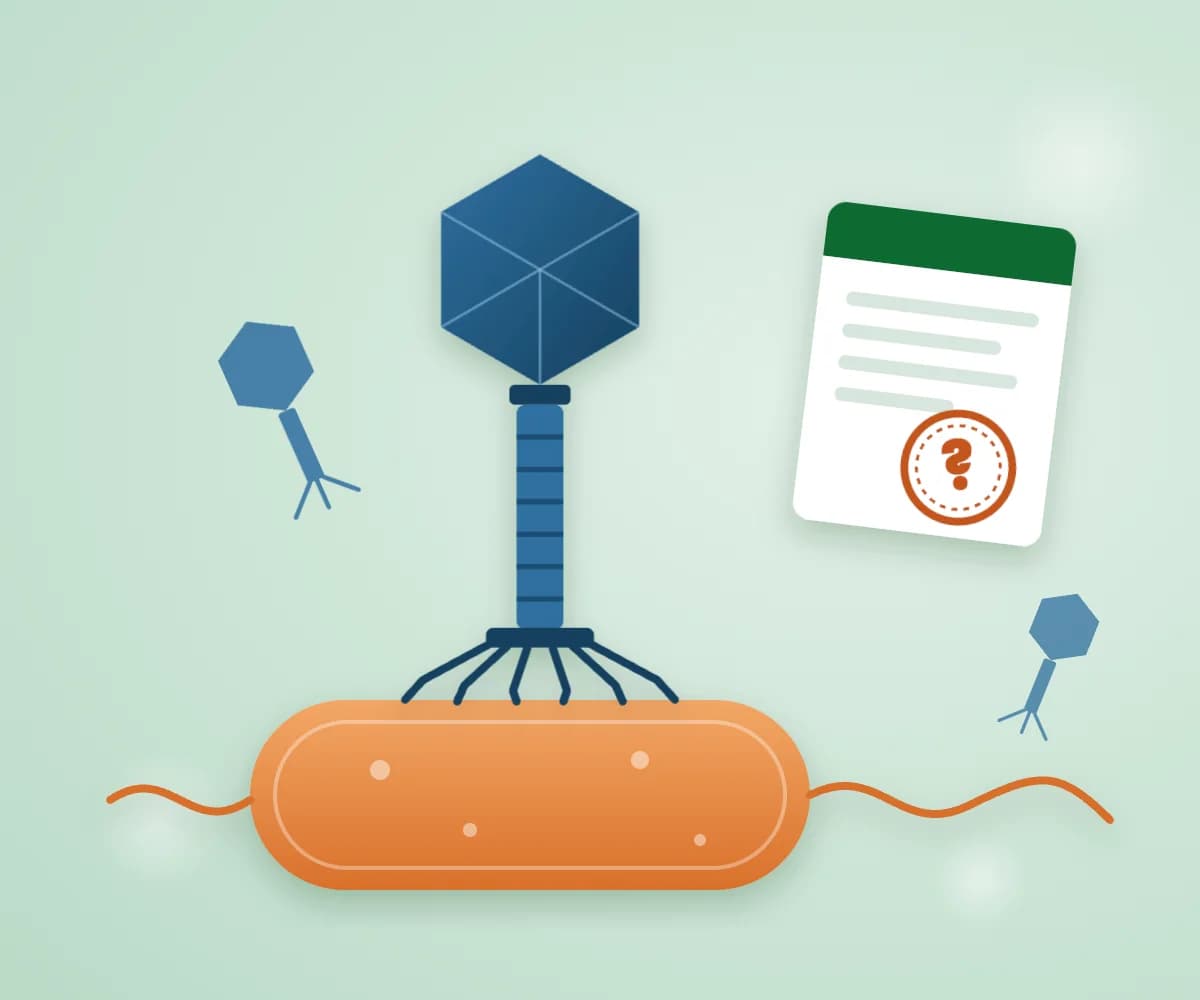
Bacteriophages (phages) — viruses that attack only bacteria — have therefore been studied for decades as an alternative. But the author stresses that most research has stayed in the test tube. This review selects only trials carried out in live aquatic animals.
“Without in vivo evidence, phage therapy cannot fulfill the requirements of aquaculturists.”
Jin Woo Jun, Viruses 2024
02 / SHRIMP
Evidence in shrimp: hatcheries and acute hepatopancreatic necrosis disease

In shrimp, phages are mostly given by bath. In hatcheries, studies in India showed that phages against Vibrio harveyi — the cause of luminous vibriosis — improved the survival of black tiger shrimp larvae: from 17% to 86% in one study, and from 26.6% to 86.6% with a phage cocktail in another; in a simulated hatchery system, mortality fell from 70% to 20%.
For acute hepatopancreatic necrosis disease (AHPND) in whiteleg shrimp, a 2018 study by the author and colleagues (carried out at the University of Arizona, USA) used phage pVp-1. The trial was very small: each 3-litre tank held only 4 shrimp, at 25 °C and 25‰ salinity, infected by immersion in the bacteria. Doses: a bath of 1.5 million PFU per ml of water, or feed pellets coated with phage, about 150 million PFU per shrimp per feeding.
- Phage only 1 hour after infection (feed or bath): all shrimp still died, 4/4 in every tank.
- Phage only before infection (24, 6 and 1 hours before): 25–50% died.
- Phage in feed before infection plus once 1 hour after: no deaths (0/4 in both tanks), while all untreated shrimp died.
In other words, phages protected shrimp only when they were present before the disease took hold. The author also stresses that this disease moves very fast, and delayed treatment reduces protection.
03 / FISH AND SHELLFISH
In fish, sea cucumbers, oysters and mussels
- Phages in feed for fish: yellowtail infected with Lactococcus garvieae saw mortality fall from 65% to 10%; ayu infected with Pseudomonas plecoglossicida fell from 93.3% to 20% with a two-phage cocktail — better than either phage alone.
- Phage baths for fish: Atlantic salmon infected with Vibrio anguillarum saw survival rise from under 10% to 100%; Senegalese sole infected with Aeromonas salmonicida saw mortality fall from 36% to 0%.
- Phage injection: Nile tilapia infected with Streptococcus agalactiae rose from 0% to 60% survival; Japanese flounder infected with S. iniae reached up to 90% survival with a four-phage cocktail.
- Shellfish and sea cucumbers: abalone larvae survival rose from 0% to 70% with a phage bath; phages cut V. parahaemolyticus on oysters from about a million to about 10 cells per gram, and in mussels to undetectable levels; sea cucumbers fed phages rose from 18% to 82% survival.
A recurring pattern: phage cocktails usually work better than a single phage, and besides injection, both feeding and baths gave results.
TRIAL DOSES
How much phage was used, and what about real farms?
Phage doses are not measured in grams but in PFU (plaque-forming units) — the number of live phage particles, counted from clear spots on a bacterial lawn — per ml of water, per gram of feed or per animal. Some studies use MOI: phage particles per bacterial cell. Doses in the original studies (the review does not list them; Than Vuong checked each study):
- Whiteleg shrimp, AHPND (Jun et al. 2018, 3-litre tanks): bath of 1.5 million PFU/ml, or about 150 million PFU per shrimp per feeding; challenge at 500,000 bacterial cells/ml.
- Black tiger shrimp larvae — tested in a working hatchery (Karunasagar et al. 2007, India): bath of 2 million PFU/ml, larval survival above 85%.
- Black tiger shrimp larvae in test tanks (Stalin and Srinivasan 2017, India): bath of 1 billion PFU/ml against about 100,000 bacterial cells/ml; larvae survived better than controls after 96 hours.
- Ayu (Park and Nakai 2003, Japan): phage-coated feed, 10 million PFU per fish; 20% mortality against 93.3%.
- Atlantic salmon (Higuera et al. 2013, Chile): bath at 1 and 20 phage particles per bacterial cell; 100% survival against under 10%.
In real-world settings, the sources Than Vuong read show only three cases: the black tiger shrimp hatchery in India (bath at 2 million PFU/ml); an ayu pond in Japan with natural disease, where phage-coated feed cut daily mortality from about 5% to one third of that within 2 weeks; and a phage product used in water at salmon farms in Norway, whose dose is not given in the sources read. No study has published a dose for shrimp grow-out ponds.
Scaling to a pond — an illustrative calculation by Than Vuong: a bath of 2 million PFU/ml for a 1-hectare pond 1.2 m deep (12,000 m³) would need about 2.4 × 10¹⁶ PFU, or about 2,400 litres of phage stock at 10 billion PFU per ml. Feeding 150 million PFU per shrimp to a pond of 1 million shrimp would need about 1.5 × 10¹⁴ PFU per feeding, or about 15 litres of the same stock. This is why the author argues that delivery must suit farm scale, and why feed is more practical than bathing a whole pond.
04 / BARRIERS
Four conditions for phages to reach farms

1. Evidence in live animals. Test-tube results do not predict results in animals, and trials in live aquatic animals — even under laboratory conditions — are still too few. The author recommends collaborating with facilities approved for animal experiments.
“Although there is no scientific evidence to suggest that phages pose a safety problem, the issue of safety remains a significant barrier within legal and regulatory frameworks.”
Jin Woo Jun, Viruses 2024
2. Proven safety. Sequencing the whole phage genome helps address the concerns raised by regulators; regulatory approval will still need much more research in live animals.
3. Affordable at farm scale. Injection often works well but is impractical on a farm. Phage strategies must fit the farmed species and the size of the stock.
4. Right timing. With fast-moving diseases, the timing of phage treatment decides the outcome. For why licensing is still hard in many countries, see phage therapy in aquaculture: why many countries have yet to approve it.
05 / THAN VUONG’S VIEW
What should farmers know?
- These figures come from challenge trials, mostly in tanks — not pond results.
- Phages must match the strain: each phage kills only certain bacterial strains, so a product that works in one area may not work in another.
- If a product is advertised as containing phages: check its registration number, target species and the bacteria named on the label before buying.
- Prevention first: with fast diseases such as AHPND, the main work is still disease-free seed, biosecurity, and good water and pond-bottom management. When animals fall sick, take samples to identify the bacteria; use only approved medicines, at the label dose and with the withdrawal period.
Read more: our technical article on phages to control Vibrio parahaemolyticus in shrimp; Vibrio prevention for shrimp seed.
QUICK ANSWERS
Frequently asked questions about phages in shrimp and fish
Can phages protect shrimp from acute hepatopancreatic necrosis disease (AHPND)?
In the trial by Jun and colleagues (2018), each 3-litre tank held only 4 whiteleg shrimp. Shrimp fed phage 24, 6 and 1 hours before infection and again 1 hour after had no deaths (0/4 in both tanks), against 4/4 without phage. Phage given only 1 hour after infection did not save them; phage given only before infection left 25–50% mortality. It is a small trial, not a pond result.
What phage dose works on a real farm?
There is no standard dose for shrimp grow-out ponds. Trial doses are counted in PFU (live phage particles), not grams: baths of about 1.5–2 million PFU per ml of water, or about 150 million PFU per shrimp in feed. Real-world trials exist only for a black tiger shrimp hatchery (India, bath at 2 million PFU/ml, over 85% larval survival) and an ayu pond (Japan, phage-coated feed, daily mortality fell to one third within 2 weeks).
Have phages been tested in shrimp hatcheries?
Studies in India bathed black tiger shrimp larvae infected with Vibrio harveyi in phages: survival rose from 17% to 86% in one study, and mortality fell from 70% to 20% in a simulated hatchery system.
Why are phages not yet widely used on farms?
According to the author, there is still too little evidence in live animals; safety remains a regulatory barrier even though there is no scientific evidence that phages are harmful; delivery must be affordable at farm scale; and timing must be right.
Can farmers in Vietnam use phage products?
The source article does not cover licensing in Vietnam. Before buying a product advertised as containing phages, farmers should check its registration number, the target species and the bacteria named on the label.