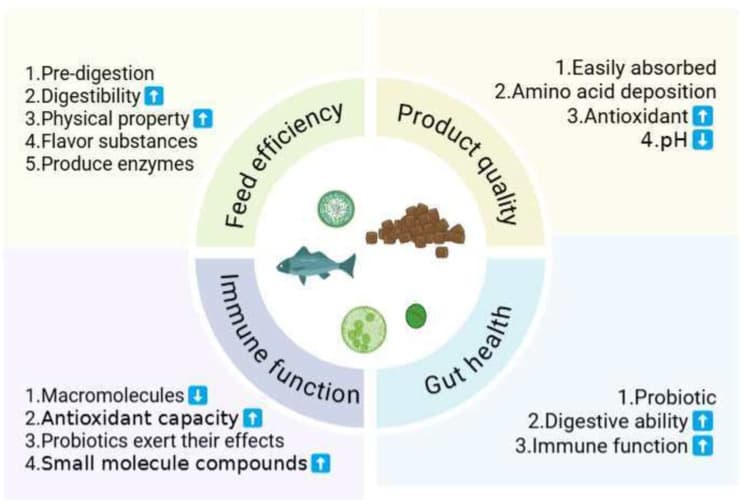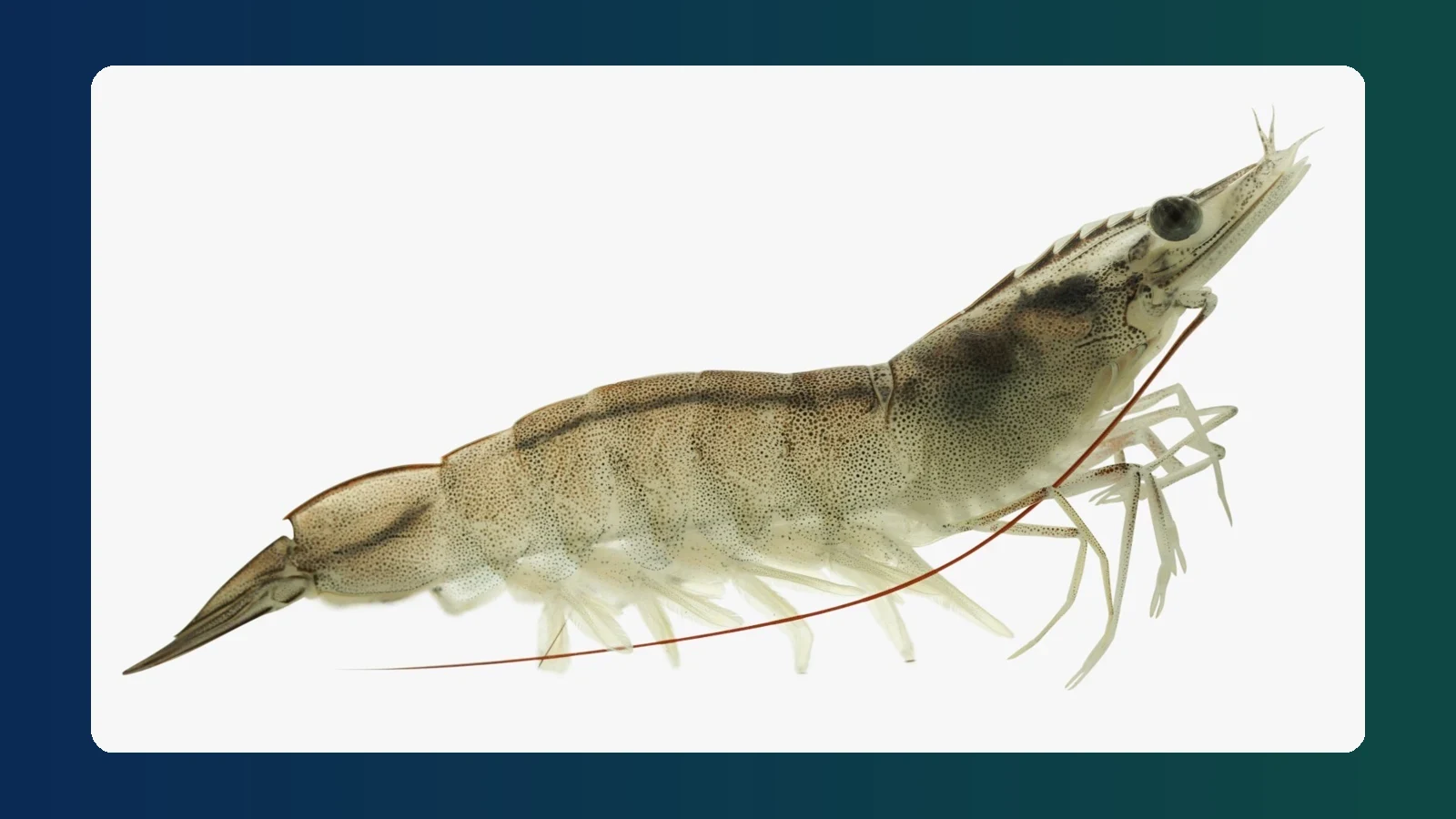
In short: this 2025 Animal Nutrition study did not ferment a single ingredient. It fermented a whole feed formula and mixed it with commercial feed to raise whiteleg shrimp at a scale close to real production. Fermented feed gave clearly higher survival (from 65.5% to 88.2%) and stable water; the point to improve is that the shrimp grew more slowly, which the authors attribute to feed that was not water-stable enough. This article presents both sides.
How the fermented feed was made
The authors first screened microbial combinations. The best one used five organisms: Enterococcus faecalis, Lactobacillus plantarum, Bacillus subtilis, Saccharomyces cerevisiae and the mould Aspergillus niger, chosen because it raised acid-soluble protein the most (smaller peptides and proteins).
- Fermented formula: only 15% fishmeal, 45% soybean meal, 25% corn germ meal, 13% wheat bran, 2% premix (about 42% protein). The commercial control feed contained 30% fishmeal.
- Process: mixed with 40–50% water, sterilised at 121 °C for 30 minutes, cooled to about 25 °C and inoculated; 2 days with oxygen, then 12 days anaerobic, 14 days in total.
- No pelleting after fermentation, to keep the microbes alive and heat-sensitive compounds intact. Acid-soluble protein in the fermented feed was 12.31%, versus 0.29% in the commercial feed.
The feeding trial
The trial ran 56 days with about 100,000 shrimp starting at 0.12 g, in 30 m³ water bodies that the authors describe as close to production conditions. The control group received non-fermented commercial feed (30% fishmeal). The treatment group received a mix of 2 parts fermented feed to 3 parts commercial feed (dry matter basis).

Results
| Measure | Commercial feed | Fermented mix | Significance |
|---|---|---|---|
| Survival | 65.48% | 88.16% | P = 0.002 |
| Yield per water body | 52.55 kg | 41.65 kg | P = 0.032 |
| Final weight | 3.14 g | 1.85 g | P = 0.003 |
| FCR | 0.96 | 1.54 | P = 0.006 |
| Feed intake per shrimp | 2.90 g | 2.67 g | no difference |
In the water, the fermented-feed group did not raise ammonia or nitrite and was even lower at some time points; pH and alkalinity were higher at some points. Two Vibrio species, V. viridis and V. flavus, did not increase in the water and were lower at some time points.
In the gut, the fermented group had clearly lower microbial diversity (P < 0.001), more Proteobacteria and fewer Bacteroidetes, and a higher Firmicutes/Bacteroidetes ratio (P = 0.016). The paper does not conclude whether lower diversity is good or bad.
What farmers should know
- Fermented feed clearly raised survival in this trial, but it needs water-stable feed so shrimp do not grow slowly; growth and FCR were poorer under the trial conditions.
- It cannot be concluded that fermented feed is better in every respect.
- It is one trial with 0.12 g shrimp and one specific formula. It cannot be generalised to every fermented feed, shrimp size or microbial strain.
- Fermentation is a process that needs control (hygiene, time, moisture). Done on-farm without control it can fail and bring other risks.
- To add live yeast and probiotics without fermenting feed yourself, they can be mixed or coated directly onto finished feed.
Source
- Cheng Y., Fan L., Liu Y., Su K., Xu G. Integrated commercial and low-fishmeal fermented feed boosts survival and modulates intestinal microbiota in pacific white shrimp (Litopenaeus vannamei). Animal Nutrition, 2025. DOI 10.1016/j.aninu.2025.01.011. Open access, CC BY-NC-ND 4.0 licence.
- This article is a summary and interpretation by Than Vuong. Charts were redrawn by Than Vuong from the reported numbers; the original paper’s own figures and tables are not reproduced. The "What farmers should know" section is editorial opinion.