01 / WHY LYSINE
An amino acid that runs short in plant-heavy feeds
Lysine is an essential amino acid: fish cannot make it and must get it from feed. Corn gluten meal and distillers’ dried grains (DDGS) — cheap plant proteins widely used in tilapia feed — are poor in lysine, so the less fishmeal a feed contains, the more likely it is short of lysine.
The lysine level still widely used for tilapia is 1.4% of the diet (5.4% of dietary protein), from a 1988 study. Meanwhile GIFT tilapia — selected over many generations for fast growth — are very different from the fish of the 1980s. The WorldFish team re-measured the lysine requirement in two recent GIFT generations.
02 / THE TRIAL
Three lysine levels, two GIFT generations, 10 weeks
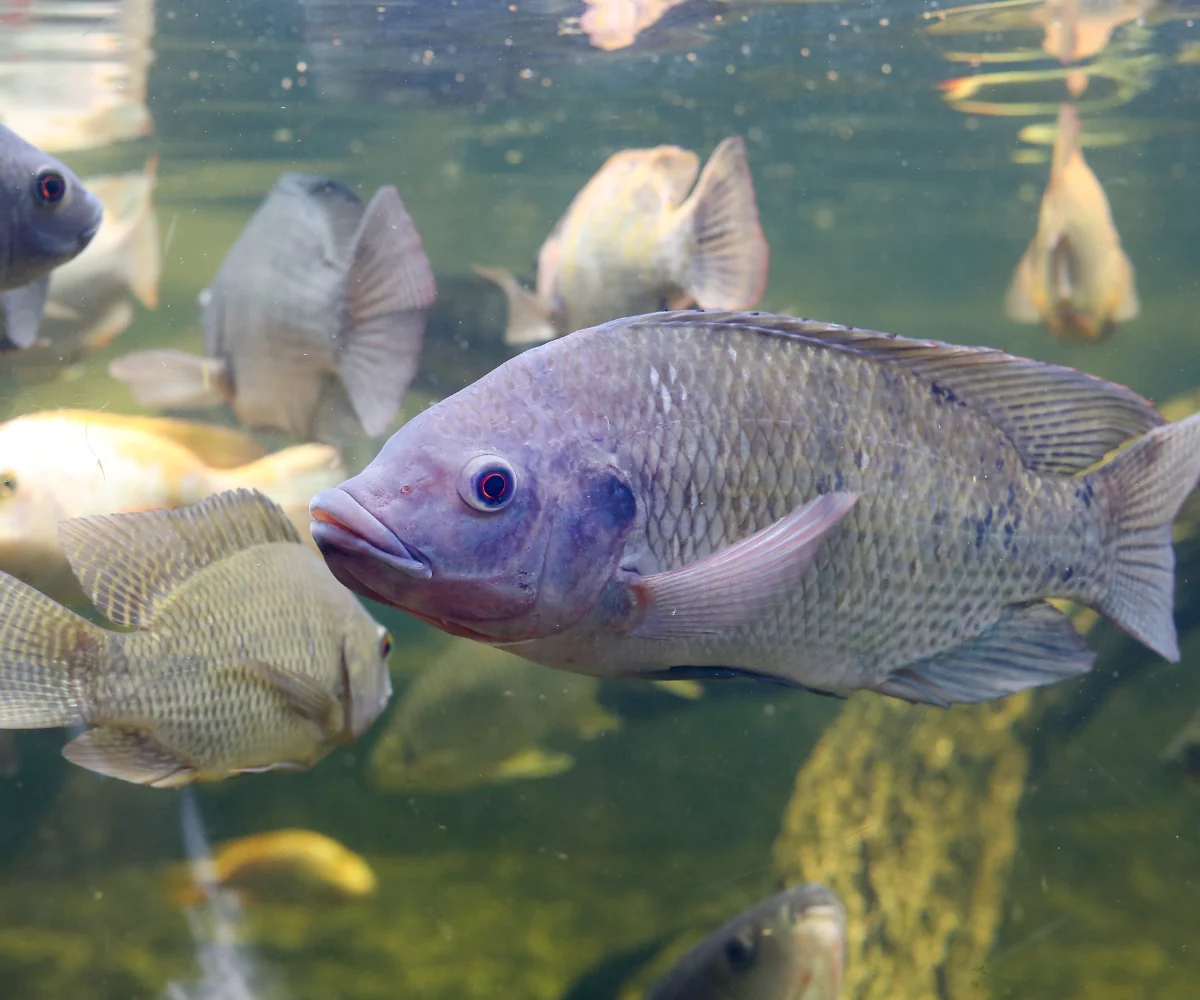
- Fish: 16th- and 17th-generation GIFT from WorldFish’s breeding programme, about 154 g, mixed sex; 10 fish per 190-litre glass tank in a recirculating system, three tanks per group.
- Feed: about 35.5% protein and 10% lipid, almost all plant protein: soybean meal 24.6%, corn meal 19.3%, DDGS 17.6%, corn gluten meal 16.7%, wheat bran 7.8%.
- Lysine: L-lysine added at 0, 0.6 and 1.2%, measured at 1.16%, 1.56% and 2.41% of the diet; glutamic acid was reduced accordingly so all diets had the same protein.
- Feeding: three meals a day to satiation for 10 weeks.
03 / RESULTS
2.41% lysine: 47–51 g more weight gain than the two lower levels

- 1.16% lysine: fish averaged 295 g, a gain of 139 g.
- 1.56% lysine: 291 g, a gain of 135 g — no different from 1.16%.
- 2.41% lysine: 340 g, a gain of 186 g, clearly higher. The thermal-unit growth coefficient (TGC) was also highest.
Weight gain at 2.41% lysine (186 g) compared with 1.16% (139 g), after 10 weeks.
Highest final weight: 17th-generation GIFT fed 2.41% lysine, from about 154 g.
Feed conversion (about 2.0–2.5), protein efficiency, feed intake and survival did not differ significantly between lysine levels, and body composition did not change. By generation, 17th-generation GIFT averaged 323 g and the 16th generation 297 g.
04 / NEW LEVEL VERSUS OLD
From 1.4% to about 2.4% of the diet

The authors conclude that the lysine requirement of grow-out GIFT tilapia is 2.41% of the diet, which they put at about 6.5% of dietary protein — higher than the 5.4% of protein in common use and the 5.87% estimated in a 2020 study on fish of about 160 g.
“Nutrient requirements should be continually studied and adjusted for new GIFT generations.”
Ahmad Fatan et al., Heliyon 2023 · Paraphrased
05 / READ THE LIMITS
A clear result, but the optimum is not pinned down
- Only three lysine levels, with 2.41% the highest tested. The true requirement could be higher, or somewhere between 1.56% and 2.41% — the trial had too few points to tell.
- Glutamic acid changed along with lysine to keep protein equal, so the differences are not due to lysine alone.
- Small tanks and non-extruded pellets, with feed conversion above 2 — unlike commercial feeds and ponds.
- “Newer generations need more” is the authors’ interpretation; statistically, the generation × lysine interaction was not significant.
06 / THAN VUONG’S VIEW
What should farmers know?
- With fast-growing strains, look beyond crude protein: ask the feed maker for the lysine content (as % of feed or % of protein) and compare it with the levels above.
- Cheap feeds heavy in corn and DDGS are the most likely to be short of lysine — fish eat a lot but do not grow to match.
- Do not mix in pure lysine without balancing the whole formula; an excess of one amino acid cannot make up for another that is lacking.
- Ponds with natural food may respond differently from trial tanks.
Also in this series: vitamin E for whiteleg shrimp; arginine for whiteleg shrimp post-larvae.
QUICK ANSWERS
Frequently asked questions about lysine for tilapia
How much lysine do GIFT tilapia need in feed?
A WorldFish trial (Heliyon 2023) with 155 g GIFT tilapia gave the best results at 2.41% lysine in the diet (a feed with about 35.5% protein), which the authors put at about 6.5% of dietary protein. This was the highest level tested, so the exact optimum was not pinned down.
How much faster do fish grow with more lysine?
After 10 weeks, fish fed 2.41% lysine averaged 340 g, a gain of 186 g; fish fed 1.16% and 1.56% lysine reached only about 295 and 291 g, gaining 139 and 135 g. Feed conversion and survival did not differ significantly.
What was the old lysine recommendation for tilapia?
According to the paper, the level still widely used is 1.4% of the diet, or 5.4% of dietary protein (Santiago and Lovell, 1988). A 2020 study on fish of about 160 g estimated 5.87% of protein. The GIFT result is higher than both.
Why would improved strains need more lysine?
GIFT tilapia have been selected over many generations for fast growth; in the trial the 17th generation was heavier than the 16th (323 g versus 297 g). The authors argue that faster-growing lines need more lysine and that requirements should be re-measured for new generations, although the generation × lysine interaction was not statistically significant.