
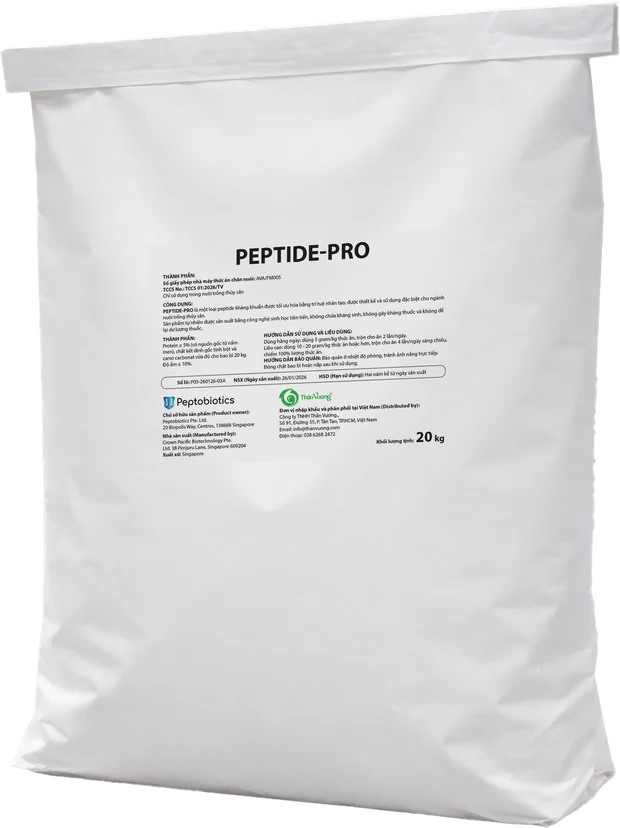

Inhibits antibiotic-resistant Vibrio behind TPD, AHPND, EMS and WFS — by attacking the cell membrane, the part bacteria find hardest to change. No antibiotics, no residue.
🇸🇬 Made in Singapore
- 72.4%
- survival rate, vs. 2% control
- 72.7%
- higher than OTC antibiotic (61.1%)
- 400–500%
- vs. infected control
- 10×
- survival rate at 1.5% feed inclusion
- Pack size
- 20 kg bag
- Origin
- Singapore
- Maintenance dose
- 5–10 g/kg feed
- Standard
- TCCS 01:2026/TV
Peptide attacks the Vibrio membrane — in 98 seconds
Four jobs PEPTIDE-PRO does for a shrimp pond
Kills antibiotic-resistant Vibrio behind TPD, AHPND, EMS and WFS…
Doesn't drive resistance, no residue, biologically safe.
Doesn't kill beneficial bacteria, supports the shrimp's natural immune balance.
Protects shrimp health during bad weather and stress.
Mix into feed, don't dissolve in water
Use as maintenance from the start of the season — don't wait for the pond to show signs. Resistance takes time to build up.
Maintenance dose
Mix evenly into feed, feed 2 times a day (morning and afternoon) under normal farming conditions. Use as maintenance for at least the first 50 days after stocking.
High dose
Feed 4 times a day, morning and afternoon, covering 100% of the feed ration. Use when the pond is under pressure — see the specific signs below.
Room temperature, away from sunlight
Reseal the bag tightly after each use. Shelf life is 2 years from the manufacturing date.
When to escalate to the high dose
If you see any of the signs below, switch to 10–20 g/kg, feeding 4 times a day — don't wait until shrimp stop eating to make the change.
- Vibrio density rising in the pond
- Shrimp under stress
- Broken/segmented gut
- Loose stool
- Crumbly stool
- Bad weather
- Gut health needs improvement
These figures are for order-planning estimates. Actual feed amounts vary day to day, so recalculate against your real feeding rate.
Ask technical support about your doseRead further — open each section
Why a different approach is neededIn many farming regions, Vibrio has already developed resistance to several antibiotics at once
Antibiotics target one metabolic point inside the bacterium. A single mutation at that exact point is enough for the whole line to survive — and pass that ability on to others. These are four compounds that Vibrio strains isolated in some Vietnamese farming regions have been recorded resisting. The extent varies by region and by season — to know your own pond, you need an antibiogram.
- Cefotaximeresistance recorded in some regions
- Oxytetracyclineresistance recorded in some regions
- Florfenicolresistance recorded in some regions
- Enrofloxacinresistance recorded in some regions
Source: Peptobiotics' technical dossier for the Vietnamese market. At the same time, regulations on antibiotic use in aquaculture are tightening — covering both residue limits and traceability for exports.
MechanismAttacks structure, not a single target
Click to compare the two ways of killing bacteria. The difference comes down to whether the bacterium can dodge it.
Antimicrobial peptides carry a positive charge, get pulled in by the bacterium's negatively-charged membrane, then punch straight through it. The bacterium loses its internal pressure and dies instantly. And because the membrane is already breached, treatment drugs get inside more easily too — the two work together instead of getting in each other's way.
Doesn't kill beneficial bacteriaThe peptide selects by membrane surface charge. Pathogenic bacteria carry a much stronger negative charge than beneficial bacteria or shrimp cell membranes.
Leaves no residueAs an amino acid chain, it's digested and broken down like feed protein — not a chemical molecule that lingers in shrimp meat.
Opens the door for treatment drugsOnce the membrane is breached, drug molecules get inside the bacterium more easily. Peptobiotics' testing found peptide combined with oxytetracycline inhibited Vibrio better than either alone — even when the antibiotic was below its minimum inhibitory concentration (MIC).
Doesn't push bacteria toward resistanceAntimicrobial peptides have been part of animal immune systems for hundreds of millions of years and remain effective — the longest real-world evidence there is that bacteria struggle to adapt to this mechanism.
Where the active ingredient comes fromFrom marine-organism genes to a 20 kg bag
Antimicrobial peptides are defense proteins found in the immune systems of most animals. Peptobiotics' work is finding which sequence kills Vibrio most effectively, then making it producible at industrial scale.
- Stage 01 — Screening
Scanning the DNA of thousands of marine organisms
The ocean is where bacteria are most densely packed, so organisms that survive there need strong defenses. Thousands of genomes are read to find the sequences that encode antimicrobial peptides.
- Stage 02 — AI selection
Keeping only the strongest Vibrio-killing sequences
Out of thousands of candidates, only a small number have real potency against shrimp pathogens AND can be produced at a price farmers will accept. This is a computational screening stage combined with lab testing.
- Stage 03 — Production
Made with biotechnology
No animal is harvested to make this product — marine organisms only contribute genetic sequence information. The active ingredient is produced using recombinant technology; that's why the label states protein of yeast origin.
Reading the label correctly. The line "Protein ≥ 5% (of yeast origin)" on the packaging is a regulatory ingredient declaration, not a claim that the product is a yeast preparation. The rest — starch-based binder and calcium carbonate (≤ 85%) — is the carrier, which helps the powder mix evenly into feed without clumping.
Why broad coverage mattersToxins don't belong to any single bacterial species
The toxin genes behind TPD, AHPND and WFS sit on plasmids — small DNA fragments that bacteria can trade with each other. That means many different Vibrio species can carry them, not just V. parahaemolyticus, and not just the green or black colonies we're used to seeing on culture plates.
PirA / PirB toxins
Structurally similar to the Cry toxin from Bacillus thuringiensis — still used as a biological pesticide. They destroy hepatopancreas cells, causing acute hepatopancreatic necrosis.
VHVP‑1 / VHVP‑2 toxin complex
Belongs to the insecticidal toxin family, related to some Salmonella toxins. Its attack mechanism is entirely different from PirA/PirB, so shrimp can contract both diseases at once from two distinct toxin groups.
The practical takeaway: a prevention solution aimed at only one bacterial species falls short. It needs to be effective across the whole cluster of toxin-carrying Vibrio to actually help a pond.
Trial dataFour trials, four scenarios
All data was generated and published by Peptobiotics. The four charts below are redrawn from the original figures in the technical dossier — the data is unchanged, only the colors were adjusted to match the page. Thần Vương has not yet run its own independent challenge trial for the batch imported into Vietnam.
Early Mortality Syndrome (EMS)
Survival curve · challenge-trial method · 107-hour follow-up
Peptide Pro held the curve at 72.4% while the competitor probiotic and standard feed groups had already fallen to ≈ 2% — roughly a 36-fold gap. Peptobiotics' written materials cite an 80% figure for this trial; the original chart tops out at 72.4%.
Acute Hepatopancreatic Necrosis (AHPND)
Survival curve · immersion-challenge method · 149-hour follow-up
Peptide Pro 72.7%, higher than the oxytetracycline antibiotic at 61.1%. The untreated infected group remained at 22%.
Translucent Post-larvae Disease (TPD)
Survival rate on day 12 post-challenge · P < 0.05 · whiskers are error bars from the original figure
The letters a, b, c, e are statistical markers: two bars carrying different letters differ significantly. Peptide Pro low dose (c) and the OTC antibiotic (c) fall in the same group — not significantly different; the high dose (b) stands clearly apart above them.
Feed-mill trial
Survival rate 7 days post-challenge · Peptide Pro pre-mixed into finished feed
This is the second trial, run with feed pre-mixed at the feed mill. Mixing in 1.5% gave a survival rate roughly 10× the control; 0.5% gave roughly 9×.
Reading the data correctly — two things to know.
One, the challenge trials ran at feed-inclusion levels of 1.5% and 5%, i.e. 15–50 g/kg. The recommended daily maintenance dose is 5–10 g/kg — lower than the tested range. The high dose of 10–20 g/kg sits closer to what was tested.
Two, this is a deliberate challenge trial under controlled conditions, not real-world pond performance. Actual ponds also depend on water quality, stocking density, seed quality and feed.
SpecificationsWhat's on the bag
- Protein
- ≥ 5% (of yeast origin)
- Moisture
- ≤ 10%
- Carrier
- Starch-based binder + calcium carbonate (≤ 85%)
- Net weight
- 20 kg
- Standard
- TCCS 01:2026/TV
- Facility license
- AVA/FM005
- Intended use
- Shrimp — aquaculture use only
- Shelf life
- 2 years from manufacturing date
- Owner
- Peptobiotics Pte. Ltd., Singapore
- Manufacturer
- Crown Pacific Biotechnology Pte. Ltd., Singapore
- Origin
- Singapore
- Imported & distributed by
- Than Vuong Co., Ltd.
Frequently asked questionsWhat farmers usually ask
- If I use peptide, do I have to stop antibiotics?
- PEPTIDE‑PRO is a feed additive, not a treatment drug, so it doesn't replace a technician's treatment protocol. Its correct use is preventive: keeping Vibrio pressure low so disease doesn't flare up in the first place.Worth noting: the two don't conflict. The peptide punches through the bacterial membrane, which makes it easier for treatment drugs to get inside; Peptobiotics' testing recorded better Vibrio inhibition when the two were used together versus alone. That said, dosing and combination decisions still need to be made by a technician based on the pond's condition — don't combine them on your own.
- Why is it harder for bacteria to develop resistance to peptide than to antibiotics?
- Antibiotics typically lock onto one enzyme or one specific target inside the bacterium. A mutation at exactly that target is enough to dodge it. Antimicrobial peptides instead punch straight through the cell membrane — to dodge that, the bacterium has to change its membrane structure, which is far more costly and usually leaves it weaker.To be precise: this is harder, not impossible. Reduced peptide sensitivity has been recorded in bacteria under lab conditions. What's reassuring is that this molecule class has kept its effectiveness across hundreds of millions of years of evolution inside animal immune systems.
- Does it also kill the beneficial bacteria in the shrimp gut?
- Antimicrobial peptides discriminate by membrane surface charge. Many pathogenic bacteria carry a strongly negative membrane charge, which attracts the positively-charged peptide; beneficial-bacteria membranes and shrimp cell membranes differ in composition and bind it less. According to Peptobiotics' dossier, the active ingredient inhibits every Vibrio strain tested without harming the beneficial microbiome.
- Can it be mixed with digestive enzymes?
- Check whether that enzyme contains protease. Protease cleaves protein chains, and the active ingredient in PEPTIDE‑PRO is itself an amino-acid chain — mixing the two will reduce effectiveness. Enzymes without protease aren't a problem. If you're not sure, separate the feeding times or call technical support.
- How much does a 20 kg bag cover for a pond?
- Calculate based on feed volume, not pond area. At the 5 g/kg maintenance dose, one 20 kg bag covers 4 tonnes of feed. A pond feeding 100 kg/day would get roughly 40 days out of one bag. Use the calculator in the Usage guide section to get the number for your own pond.
- Does the product leave residue at harvest?
- The active ingredient is an amino-acid chain — the same basic nature as the protein in feed — so it's digested and broken down rather than accumulating in shrimp meat the way an antibiotic molecule does. The label states clearly: no antibiotics, no resistance, no residue.
Peptide handles the pathogen, these three handle the environment
Peptide reduces Vibrio pressure in the shrimp gut. But if the pond bottom and water stay poor, Vibrio just re-establishes. The three products below each handle a different environmental job: water treatment, bottom treatment, and cultivating beneficial microbes.
Seeing signs of Vibrio in your pond? Call technical support before you buy.
Thần Vương's technical team assesses your pond's condition before advising on dose and protocol. Free, response within 24 hours.