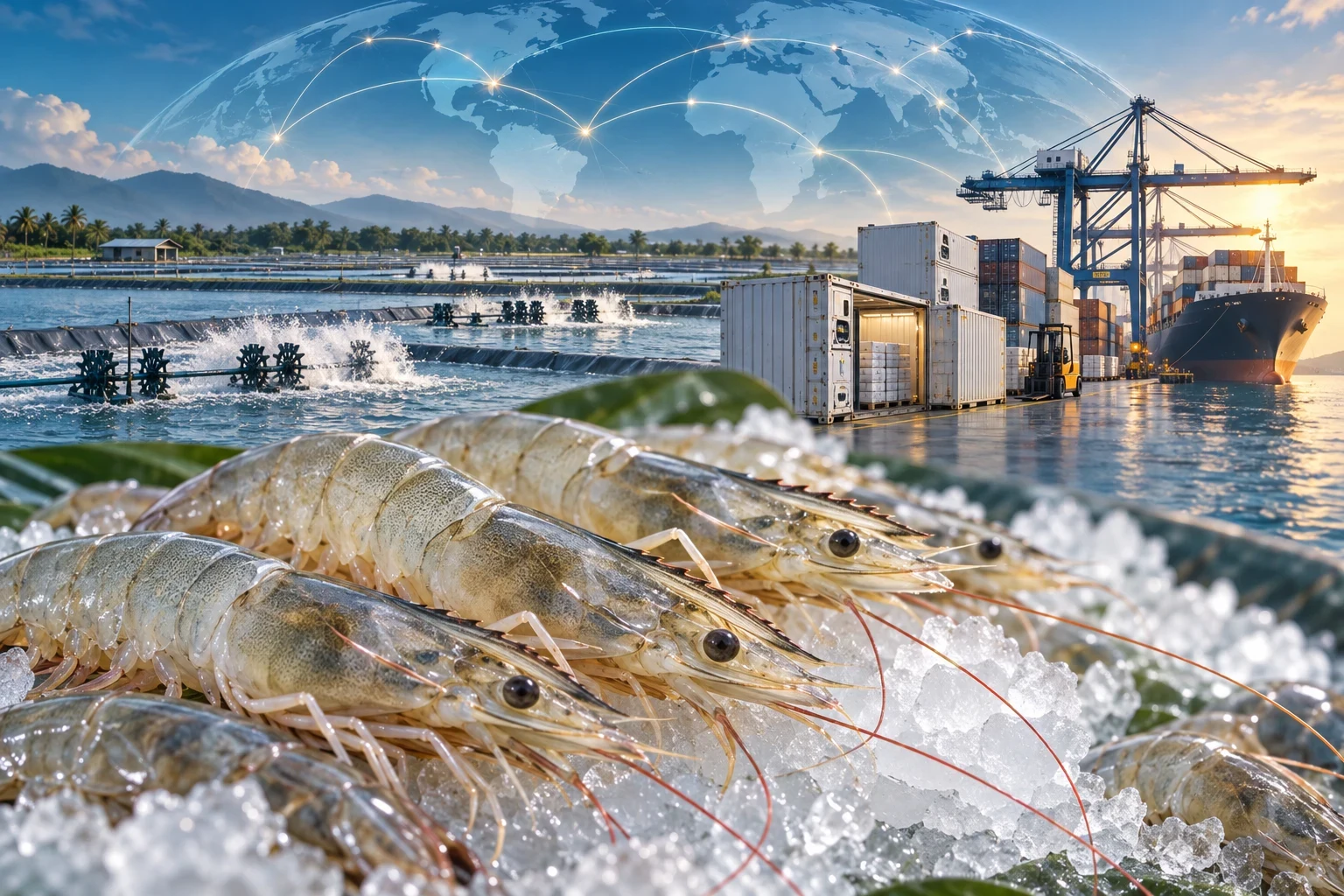
Cover image: AI illustration of the global shrimp supply chain and trade.
Discussions at the Global Shrimp Forum 2026 showed that the shrimp industry needs to look beyond import and export figures. Alongside trade volumes, profitability also depends on selling prices, costs, product mix and the real demand in each market.
Ecuador exports more, but pressure on farm-gate prices remains
After stalling in 2024, Ecuador's shrimp exports returned to growth in 2025. Both the first and second quarters of 2026 were up 14% on the same period a year earlier.
At the forum, Willem van der Pijl estimated that full-year exports could reach 1.6 million tonnes, provided El Niño does not slow production. This is a conditional forecast, not an actual full-year result.
China still took about half of Ecuador's shrimp exports in the first six months of the year. The United States has overtaken the European Union (EU) to become the second-largest market, while other markets absorbed a significant share of the additional volume.
However, higher volumes have not brought a matching improvement in farm-gate prices. The price recovery in May–June has faded. China's rejection of shipments linked to metabisulfite has also made sales harder: more than 350 cases were rejected in those two months, equivalent to about 7,000 tonnes.
To adapt to shifting markets, Ecuador is expanding domestic processing capacity and working with processors in Asia. The ability to switch markets and product forms has become an important advantage.
India holds steady by redirecting to other markets
India's shrimp exports rose 9% in 2025 and were almost flat in the first half of 2026, despite many trade challenges. China, Japan and Russia absorbed a significant share of the volume lost in the US market.
Black tiger shrimp exports kept growing, while whiteleg shrimp did not follow the same trend. The exchange rate also affects how prices are perceived: a weaker rupee makes prices in US dollars appear to fall more sharply than prices in local currency.
For farmers, the price received in rupees is what directly drives the decision to stock the next crop. Looking only at US-dollar prices may therefore not fully reflect the production drivers in India.
Vietnam: processing strength and the role of the domestic market
According to 2026 figures presented at the forum, Vietnam's shrimp exports grew by about 10%. Its processing advantage is not limited to products classified as value-added; even some items recorded as frozen raw shrimp in customs statistics have already gone through processing steps.
Vietnam also imports raw material for processing and re-export. Export volume therefore cannot be taken as a direct measure of domestic farmed shrimp output.
Mr Van Vu, co-founder and CEO of TOMOTA, argued that the domestic market may be larger than earlier estimates assumed. He described substantial demand for live and fresh shrimp in restaurants and local markets, and estimated domestic consumption at 200,000 tonnes or more. This is the speaker's estimate, not an official statistic.
Domestic demand helps support farmers under cost pressure. However, small-scale farms still struggle with purchasing power for inputs, disease-control costs, disruption when changing feed suppliers and a shortage of skilled labour.
Indonesia shows the risk of depending on one market
Indonesia's shrimp exports fell 14% in the first half of 2026. Heavy reliance on the United States means trade disruptions hit the country's shrimp sector harder.
During the difficult period, companies shifted shipments to other markets. But once trade with the US returned to normal, this shift reversed, raising questions about how durable the market-diversification strategy is.
Mr Aris Utama, Director of Sales and Marketing at BMI, sees the future of Indonesia's shrimp industry in both farming and processing. A skilled processing workforce is an important asset. Importing raw material from other countries for processing also has potential, if logistics allow.
United States and China: separate imports from consumption
US shrimp imports fell 11% in the first quarter and 2% in the second quarter of 2026. Ecuador increased its presence, while volumes from India moved with tariff developments. In the first half, all main product groups declined except breaded shrimp.
In contrast, China's imports rose 25% in the first quarter and 20% in the second, reaching new records. The question is whether consumption is keeping pace with imports.
Higher imports may include product bought for stockpiling and later sale. Imports, inventories and actual consumption therefore need to be considered together to judge market demand correctly.
Europe and Japan: the right product keeps the customer
Mr Ralph Sanders, head of procurement and sales at Cooke Europe, stressed that Europe should not be treated as a single market. Southern Europe is under more pressure, while retail in Northern Europe is performing better. Weaker restaurant demand and rising costs are making consumers more careful about what they buy.
Convenience products offer opportunities, but stable supply remains very important. To keep customers, suppliers need to deliver the right specification, the right product form, through the right channel and at the right time.
In Japan, specific product requirements highlight the strengths of each origin. Ecuador is growing in headless shell-on shrimp; India is strong in peeled and ready-to-cook products. Vietnam and Thailand have more established experience in ready-to-eat products, which demand strict hygiene control.
Farmed volume is only one part of competitiveness. The ability to meet buyers' exact requirements on product form and quality is what decides whether orders are kept.
Implications for Vietnam's shrimp industry
- Assess growth together with profitability: rising exports do not necessarily improve farm-gate prices or margins.
- Develop several outlets: the domestic market should be considered alongside exports when assessing demand and planning production.
- Strengthen processing and supply capability: consistent quality, correct specifications and on-time delivery are what keep a supplier competitive.
For farmers, market signals should be weighed against actual costs, the disease situation and the results of each crop before deciding to expand production.
Source
Edited from More Shrimp, Different Routes: What the Trade Numbers Tell Us, published by Shrimp Insights on 2 October 2026, summarising discussions at the Global Shrimp Forum 2026.