Test report – Quality Control Department, Than Vuong (GMP-WHO). Report no. QC-RQ-09.
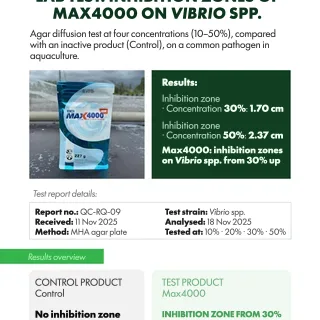
Agar plate diffusion test at four concentrations (10–50%), compared with an inactive product (Control), against a common pathogen in aquaculture.
Results at a glance
- Inhibition zone at 30% concentration: 1.70 cm
- Inhibition zone at 50% concentration: 2.37 cm
MAX 4000 inhibited Vibrio spp. at concentrations of 30% and above.
Test report details
| Item | Detail |
|---|---|
| Report no. | QC-RQ-09 |
| Date received | 11 November 2025 |
| Method | MHA agar plate |
| Test strain | Vibrio spp. |
| Date analysed | 18 November 2025 |
| Concentrations | 10% · 20% · 30% · 50% |
Overview of results
| Product | Result |
|---|---|
| Control product | No inhibition zone: 0 cm at all concentrations (10–50%) |
| Test product: MAX 4000 | Inhibits Vibrio spp. from 30%; inhibition zone 1.70–2.37 cm, increasing with concentration |
Dose–response relationship
Inhibition zone diameter of MAX 4000 by concentration (Control: 0 cm at every concentration):
| Concentration | MAX 4000 (cm) | Control (cm) |
|---|---|---|
| 10% | 0 | 0 |
| 20% | 0 | 0 |
| 30% | 1.70 | 0 |
| 50% | 2.37 | 0 |
MAX 4000 produced no zone at 10–20%; an inhibition zone appeared from 30% and grew larger at 50%. The control product produced no inhibition zone at any concentration.
01. Objective and samples
This report evaluates the antibacterial activity of MAX 4000 against Vibrio spp., compared with a control product (Control). Each product was tested at four concentrations: 10%, 20%, 30% and 50%.
Antibacterial activity was measured by the agar well diffusion method on MHA medium: the sample is injected into wells cut into an agar surface spread with bacteria. Whether an inhibition zone forms around the well, and how large it is, shows how strongly the product inhibits the bacteria.
02. Method
- Activate the Vibrio spp. strain in MHB medium with 1.5% NaCl added, incubated at 30 °C; after 24 h, subculture onto TCBS agar to check that the strain is pure.
- Pick a single colony from the pure strain and inoculate it into 10 mL of MHB medium. Draw 3 mL of the bacterial suspension and measure OD600 to determine its absorbance.
- Dilute the bacterial suspension to OD600 = 0.1 (equivalent to 3.0×10⁸ CFU/mL).*
- Pour MHA medium and let it set naturally; dip a sterile cotton swab in the diluted bacterial suspension and spread it evenly over the MHA surface.
- Use a 1 mL pipette tip to make wells in the agar surface for the test samples.
- Prepare the samples at the test concentrations in the sample diluent (MRD medium with 10% Sinopol added) and dissolve; inject 100 µL of sample into each well.
- Incubate the plates at 30 °C; read and record the results after 20 h and 24 h.
- Each concentration was tested on 2 plates, with 3 wells per plate.
Table 1 – Preparing the test concentrations
| Required concentration (%) | Weight of sample (g) | Volume of diluent (mL) |
|---|---|---|
| 10 | 1 | 9 |
| 20 | 2 | 8 |
| 30 | 3 | 7 |
| 50 | 5 | 5 |
* OD600 converted to bacterial density using the McFarland standard – see References.
03. Antibacterial results
3.1 Control product
Table 2 – Inhibition zone size – Control
| Concentration (%) | Zone – 20 h (cm) | Zone – 24 h (cm) | Result |
|---|---|---|---|
| 10 | 0 – 0 – 0 | 0 – 0 – 0 | No inhibition |
| 20 | 0 – 0 – 0 | 0 – 0 – 0 | No inhibition |
| 30 | 0 – 0 – 0 | 0 – 0 – 0 | No inhibition |
| 50 | 0 – 0 – 0 | 0 – 0 – 0 | No inhibition |
Conclusion: the control product (Control) showed no antibacterial activity against Vibrio spp. at any of the 4 concentrations tested.
3.2 MAX 4000
Table 3 – Inhibition zone size – MAX 4000
| Concentration (%) | Microbial density (CFU/g) | Plate | Zone 20 h (cm) | Zone 24 h (cm) | Mean (cm) | Result |
|---|---|---|---|---|---|---|
| 10 | 1.39×10⁸ | 1 & 2 | 0 – 0 – 0 | 0 – 0 – 0 | – | No inhibition |
| 20 | 2.78×10⁸ | 1 & 2 | 0 – 0 – 0 | 0 – 0 – 0 | – | No inhibition |
| 30 | 4.17×10⁸ | Plate 1 | 2.0 – 2.0 – 2.1 | 1.7 – 1.3 – 1.4 | 1.70 | Inhibition |
| Plate 2 | 2.0 – 2.0 – 1.8 | 1.3 – 1.4 – 1.4 | ||||
| 50 | 6.95×10⁸ | Plate 1 | 2.4 – 2.4 – 2.0 | 2.4 – 2.4 – 2.0 | 2.37 | Inhibition |
| Plate 2 | 2.4 – 2.2 – 2.8 | 2.4 – 2.2 – 2.8 |
Conclusion: MAX 4000 showed no inhibition at 10–20%, but produced clear inhibition zones at 30% (mean 1.70 cm) and 50% (mean 2.37 cm), showing that its activity against Vibrio spp. depends on concentration.
04. Test result photos
The original report includes plate photos:
- Figure 01 – negative control plate (no product added): Vibrio spp. covered the whole agar surface with no inhibition zone, confirming that the test strain grew well and that the test conditions were valid for comparison with the plates containing product.
- Figures 02–05 – Control at 10%, 20%, 30% and 50%: no inhibition.
- Figures 06–07 – MAX 4000 at 10% and 20%: no inhibition.
- Figures 08–09 – MAX 4000 at 30% after 20 h and after 24 h (2 replicate plates): inhibition.
- Figures 10–11 – MAX 4000 at 50% after 20 h (2 replicate plates) and after 24 h: inhibition.
Inhibition zones (the clear area around each well) are clearly visible at 30% and 50% MAX 4000; the measured diameters are given in Table 3.
05. Conclusions and recommendations
MAX 4000 showed antibacterial activity against Vibrio spp. through direct inhibition. The effect depends on concentration: no zone at 10–20%, a clear inhibition zone from 30% (mean 1.70 cm), and a larger zone at 50% (mean 2.37 cm). This dose–response relationship shows a stronger antibacterial effect at higher concentrations.
The control product (Control) produced no inhibition zone at any concentration tested; it showed no direct inhibitory effect on Vibrio spp. by the agar well diffusion method. This control highlights and confirms the antibacterial activity of MAX 4000.
Recommendations
- Give priority to MAX 4000 when the aim is to help keep Vibrio spp. in check; use it at a high enough concentration (effective from 30% upward under the test conditions) to obtain the antibacterial effect.
- The actual dose and method of use should follow the product's instructions and the specific conditions of the pond.
- The in vitro (laboratory) results are a reference; effectiveness in the field should be monitored and evaluated further.
- The "no inhibition" result of the control product (Control) confirms that the inhibition zones seen with MAX 4000 reflect the product's real activity, not background factors of the test.
06. References
* Mahesh, P. P., Kolape, J., Sultana, H., & Neelakanta, G. (2025). McFarland standards-based spectrophotometry method for calculating approximate multiplicity of infection for an obligate intracellular bacterium Anaplasma phagocytophilum. Microorganisms, 13(3), 662.
Performed by: Phạm Nhật Linh, Lê Nguyễn Bảo Ngọc (Quality Control Department).
English text adapted from Than Vuong's original Vietnamese infographic.