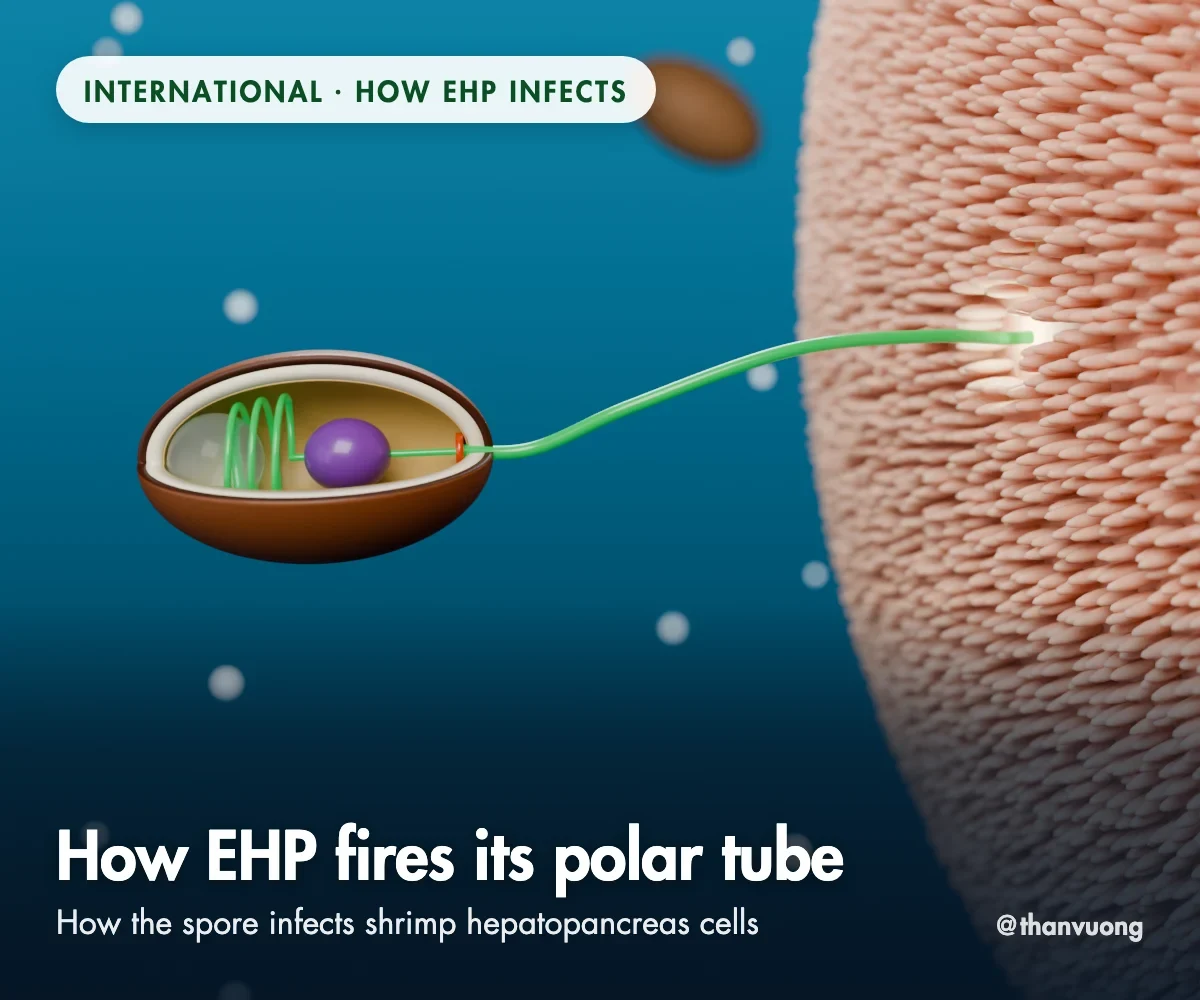
An EHP spore does not simply slip into a shrimp cell. It fires a very thin polar tube, pierces a hepatopancreas cell and injects its infective contents inside. Research groups in Thailand have measured this firing in EHP and used it to find ways of making spores harmless.
- Part 1: How much profit EHP takes — a survey of 145 farms in India
- Part 2: EHP multiplies inside the pond — why control starts with the post-larvae
- Part 3: Which PCR test catches EHP best — six assays compared
- Part 4: How EHP fires its polar tube — the evidence and how to inactivate spores (this article)
The polar tube: the spore’s syringe
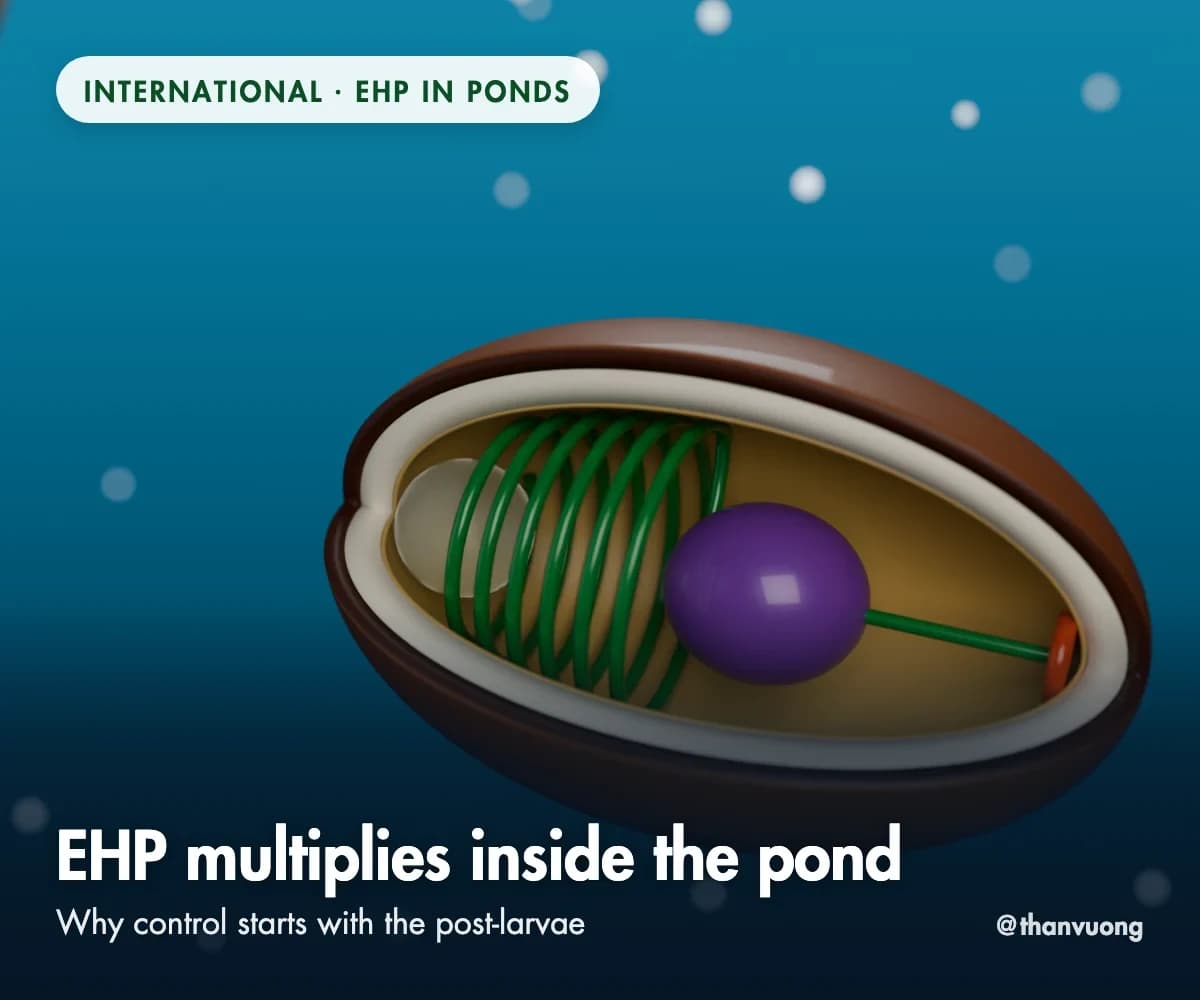
EHP (Enterocytozoon hepatopenaei) is a microsporidian. Its spores are oval and less than 2 µm long. Under the electron microscope each spore holds a polar filament coiled 5–6 times and attached to an anchoring disc at the front (Tourtip et al., 2009).

When the spore is triggered, the filament turns inside out into a hollow tube, like the finger of a glove. The posterior vacuole swells and pushes the infective contents toward the tube. The tube tip pierces a hepatopancreas tubule cell, and the sporoplasm, nucleus included, passes through the tube into the cell. There EHP multiplies and forms new spores, which leave the shrimp with the faeces.

Shrimp become infected by mouth when they swallow spores. This has been shown by feeding healthy shrimp infected tissue (Tangprasittipap et al., 2013) and by rearing shrimp in water containing spores (Pattarayingsakul et al., 2022).

The evidence that EHP really fires a polar tube
- Measured in the test tube (2018). A Mahidol University team (Thailand) isolated live EHP spores from infected hepatopancreas and stained them to count spores that had or had not fired. A spore that can still fire can still infect, so the count became a measure of spore viability.
- Natural firing rate. In a 2020 trial using the same method, 70–77% of control spores fired their tube after 2 hours in sterile water at about 25 °C.
- A polar tube protein (2024). Researchers identified the protein EhPTP2 in the EHP polar tube. Injecting shrimp with RNA that silences this gene clearly reduced EHP inside the shrimp and its spread to healthy tank mates. This was done by injecting individual shrimp and is not yet a pond tool.
What stops spores from firing
Because firing is an essential step in infection, scientists use this test to check which treatments inactivate spores:
| Treatment | Result | Year |
|---|---|---|
| Freezing at −20 °C for at least 2 h | Spores no longer fire the polar tube | 2018 |
| Heating at 75 °C for 45–60 s | No firing; shrimp given heated spores by mouth did not become infected | 2021 |
| Potassium permanganate (KMnO₄) 15 ppm, 15 min | Complete inhibition | 2018 |
| Chlorine (65% active) 40 ppm for 15 min, or 10 ppm for 24 h | Complete inhibition | 2018 |
| Ethanol 20%, 15 min | Complete inhibition | 2018 |
| Formalin 200 ppm | Maximum reduction of 95.33% — not complete | 2018 |
| Spore-laden culture water treated with 20 ppm calcium hypochlorite | PL-12 added afterwards were not infected after 16 days (untreated water: 50% infected) | 2022 |
| Spore-laden culture water rested with aeration for 10 days, no shrimp | No infection; after only 5 days of rest 10% still became infected | 2022 |
Is feed that tests PCR-positive for EHP a risk?
PCR detects DNA and cannot tell live spores from dead ones. In 2021 the Mahidol team fed shrimp for 21 days with two commercial feeds that tested PCR-positive for EHP. The shrimp did not become infected, while shrimp given feed spiked with live spores all did. The authors concluded that commercial feeds heat-processed at 75 °C or more for at least 60 seconds pose no risk of EHP transmission.
Fresh feeds that are not heated, such as live polychaete worms or fresh molluscs, can still carry live spores.
What farmers can do
- Fresh feeds: use them sparingly. When needed, choose EHP-tested sources and heat-treat or deep-freeze them (−20 °C for at least 2 hours stopped spores firing in the lab).
- Intake water: treat it with chlorine in the reservoir, or rest it with aeration for at least 10 days with no shrimp or other carrier crustaceans in the reservoir.
- Pond preparation: do not rely on formalin to kill spores. Combine drying, liming and a disinfectant that works on spores, dosed for real pond conditions.
- Reading PCR results: a PCR-positive commercial feed does not necessarily contain live spores; ask the manufacturer about its heat treatment. For post-larvae and pond shrimp, a positive PCR still signals infection that needs action.
- Clean post-larvae, tested with validated methods, as discussed in Part 3 of this series.
Sources
- Aldama-Cano D.J., Sanguanrut P., Munkongwongsiri N., Ibarra-Gámez J.C., Itsathitphaisarn O., Vanichviriyakit R., Flegel T.W., Sritunyalucksana K., Thitamadee S. Bioassay for spore polar tube extrusion of shrimp Enterocytozoon hepatopenaei (EHP). Aquaculture 2018;490:156–161. DOI 10.1016/j.aquaculture.2018.02.039
- Munkongwongsiri N., Aldama-Cano D.J., Suebsing R., Thaiue D., Prasartset T., Itsathitphaisarn O., Sritunyalucksana K. Microsporidian Enterocytozoon hepatopenaei (EHP) spores are inactivated in 1 min at 75 °C. Aquaculture 2021;533:736178. DOI 10.1016/j.aquaculture.2020.736178
- Pattarayingsakul W., Munkongwongsiri N., Thitamadee S., Sritunyalucksana K., Aldama-Cano D.J. Shrimp microsporidian EHP spores in culture water lose activity in 10 days or can be inactivated quickly with chlorine. Aquaculture 2022;548:737665. DOI 10.1016/j.aquaculture.2021.737665
- Yuanlae S. et al. Shrimp injection with dsRNA targeting the microsporidian EHP polar tube protein reduces internal and external parasite amplification. Scientific Reports 2024;14:4830. DOI 10.1038/s41598-024-55400-2
- Tangprasittipap A. et al. The microsporidian Enterocytozoon hepatopenaei is not the cause of white feces syndrome in whiteleg shrimp Penaeus (Litopenaeus) vannamei. BMC Veterinary Research 2013;9:139. DOI 10.1186/1746-6148-9-139
- Tourtip S., Wongtripop S., Stentiford G.D. et al. Enterocytozoon hepatopenaei sp. nov. (Microsporida: Enterocytozoonidae), a parasite of the black tiger shrimp Penaeus monodon (Decapoda: Penaeidae): fine structure and phylogenetic relationships. J Invertebr Pathol 2009;102(1):21–29. DOI 10.1016/j.jip.2009.06.004 (spore structure).
- In vitro evaluation of two commercial biocides on EHP spore extrusion rate. Global Seafood Alliance – Responsible Seafood Advocate, 24 August 2020. Co-authored by an animal-health company to test its own products; we use only the control-group numbers.
This article is a synthesis and interpretation by Than Vuong, not a translation. Numbers come from the original articles; product promotion in the originals has been left out. Charts were redrawn by Than Vuong from the numbers and the 3D models were built by Than Vuong; the originals’ own figures and tables are not reproduced.