01 / THE TRIP
Produce more, or produce more consistently?
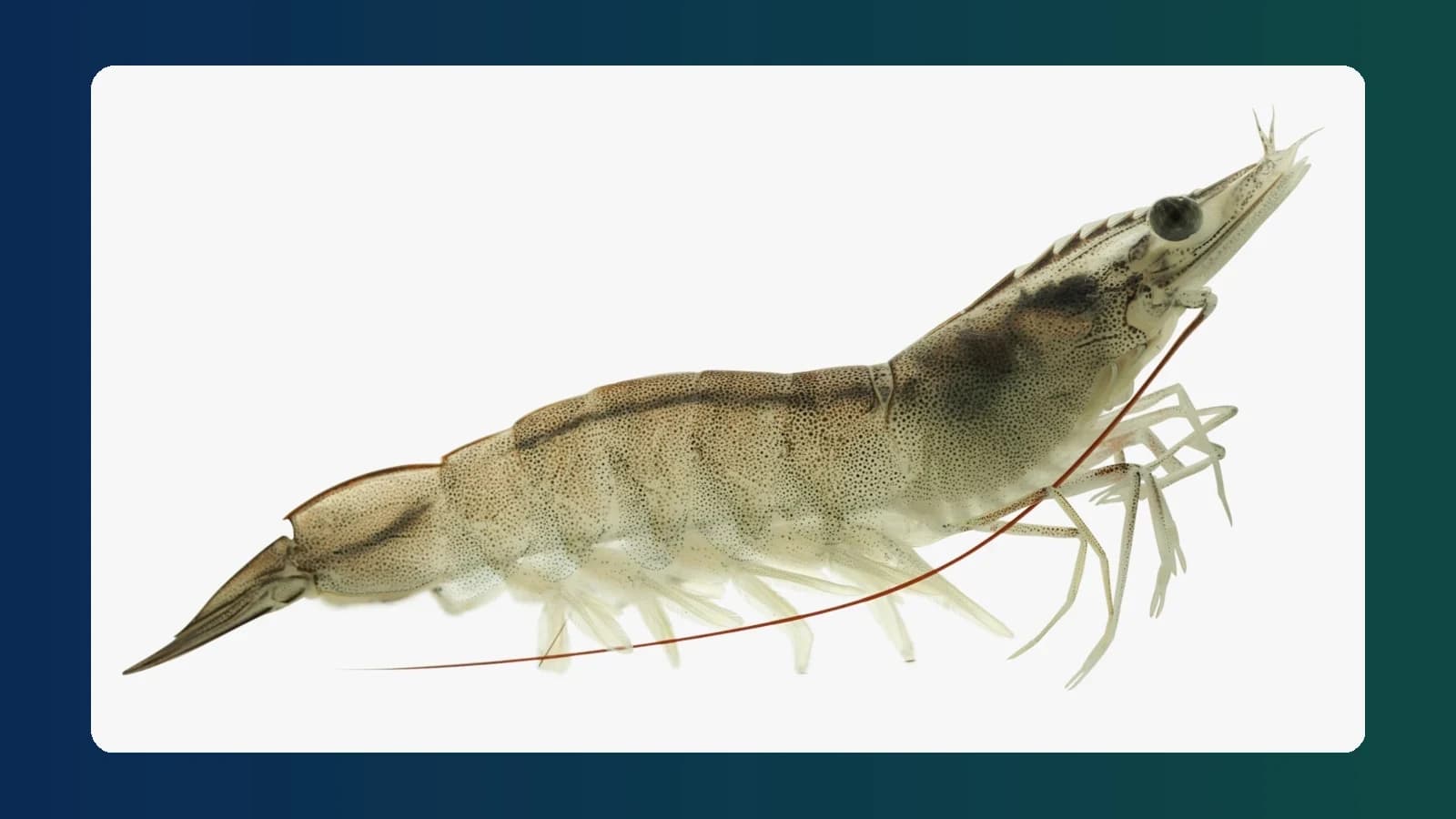
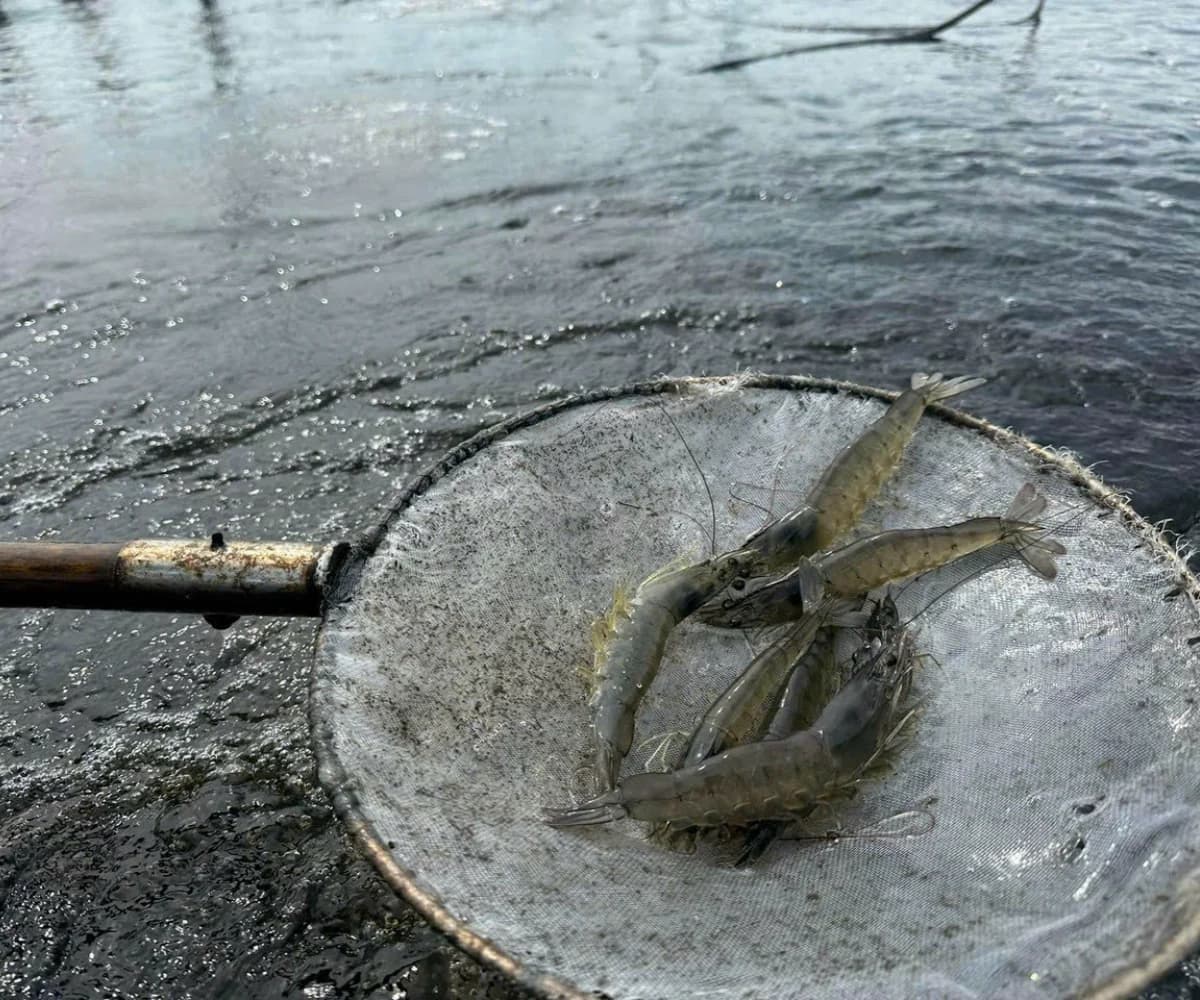
The world's shrimp industry has long followed a simple formula: produce more, faster and cheaper. A group of Southeast Asian shrimp and tilapia farmers and aquafeed producers questioned that formula after a visit to Ecuador, the world's leading shrimp producer and exporter, sponsored by the US Grains and BioProducts Council (USGBC). The group visited farms and joined a panel discussion at the International Aquaculture Conference (IAC), held on 19–21 May in Guayaquil.
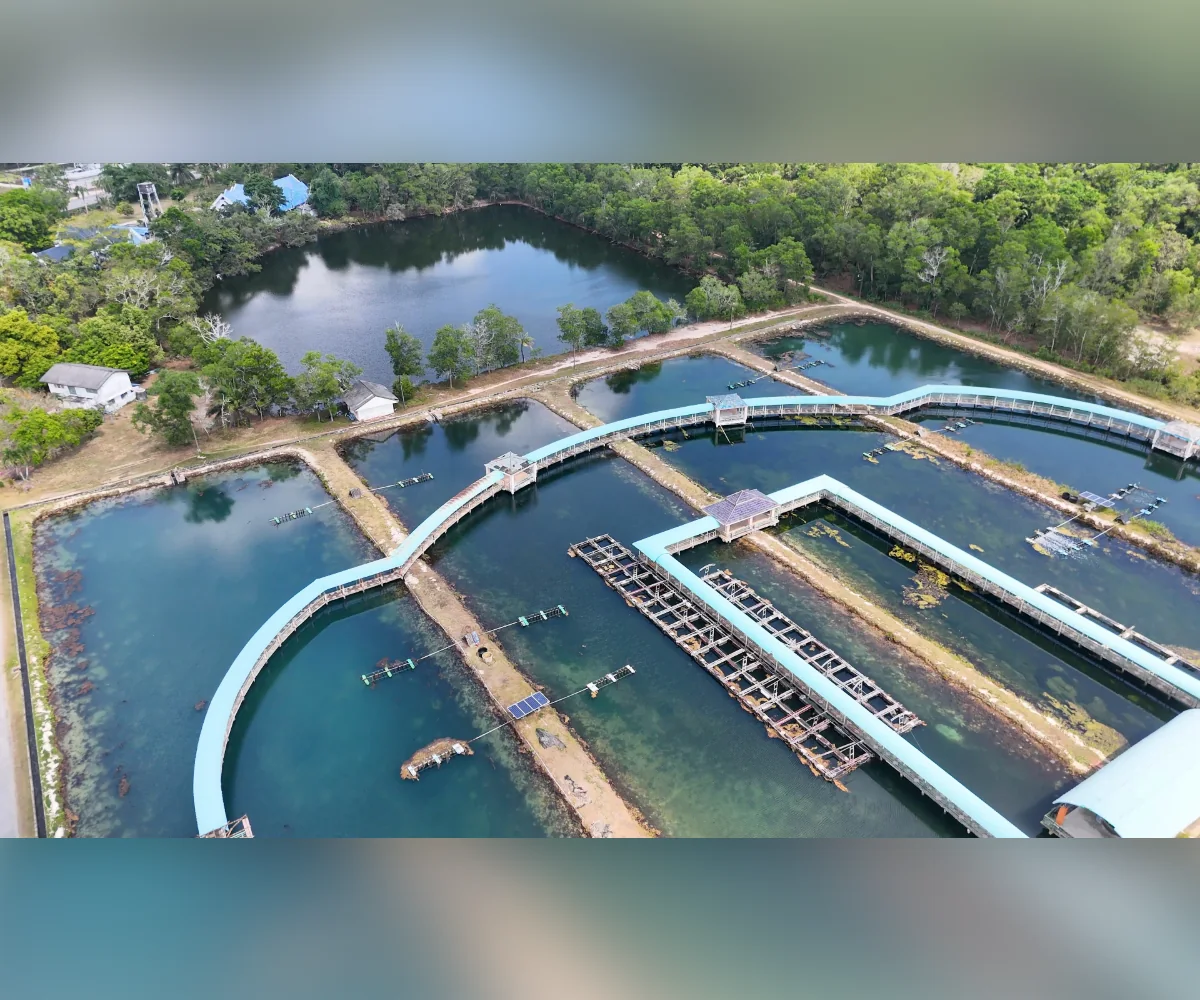
For many people used to high-density farming, Ecuador's approach looked almost counterintuitive: larger ponds, lower stocking densities and modest margins at farm level. Yet the system works because Ecuadorian companies have matched their farming methods to their geography, infrastructure and market structure. The question the group took home: is the future of shrimp farming about producing more shrimp from every hectare, or about producing more consistently and efficiently from the resources available?
02 / INTEGRATION
An industry that works as one
What struck many participants most was the level of integration along the value chain. In their view, Ecuador's advantage comes less from any single farming technique than from how the industry is organised: farms, feed companies, hatcheries and processors operate in close alignment, and the largest players often control several stages at once. In Southeast Asia, these stages are mostly separate businesses.
- About 60% of Ecuador's shrimp output comes from 10 major players, many of which own processing facilities. Farms may appear to earn little, but integrated companies capture value further downstream.
- Their own genetics: Ecuadorian companies have invested steadily in technology and run their own breeding programmes rather than relying on imported broodstock, giving them more control over performance.
- A strong producers' association: the National Aquaculture Chamber (CNA), which represents producers and is not a government agency, helps coordinate industry priorities, negotiate and promote Ecuadorian shrimp internationally.
“They have vertical integration so that’s why they produce at a very low cost compared to us. In Thailand, we are separate in each segment: farm, feed and processing.”
Yanisa Klomsuwan, shrimp aquaculture and strategic manager at a farm in Thailand
For Caleb Wurth, USGBC's regional director for Southeast Asia and Oceania, the lesson was not only about farming technology but about how the industry is organised: Southeast Asia may need stronger collaboration among producers if it wants to compete globally.
03 / LAND AND SCALE
A few cents per kilogram, multiplied across hundreds of hectares
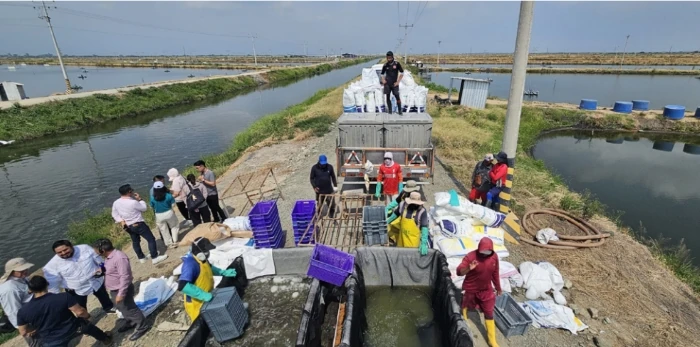
The most obvious difference is land. Rizky Darmawan, CEO of a shrimp farming group in Indonesia, described Ecuador's farming model as “traditional” compared with Asia, but on a completely different scale: individual farms commonly span hundreds of hectares, while Asian farms are far smaller.
Ecuadorian farmers may earn margins of only US 5–15 cents per kilogram, but they farm enormous areas and harvest fairly consistently. The business resembles other commodity industries: thin margins per unit, attractive returns through volume. Caleb Wurth added that Ecuador has abundant land with few alternative uses, whereas in densely populated Asian countries a large parcel of land may be worth more for industry, housing or crops. In Ecuador, shrimp farming is one of the most productive uses of coastal land.
Amorn Luengnaruemitchai, managing director of a shrimp genetics company in Thailand, agreed that scale is central: even with low margins, volume generates meaningful returns. In his view, Ecuador waits for profit to build up over time rather than chasing maximum margins immediately. Preecha Ekatumasuit, CEO of a feed mill in Thailand, drew the contrast: a large Ecuadorian operation harvests consistently across thousands of hectares, while Asian farmers often face more variability from disease, survival and environmental problems.
04 / LOW DENSITY
Low density, consistent results

The biggest surprise for many visitors was that Ecuador leads the world while keeping stocking densities fairly low: farms typically stock under 20 PL/m², compared with 100–200 PL/m² on many Southeast Asian farms.
Preecha argued that this reflects two different philosophies. Southeast Asia has pursued productivity through intensity: more shrimp per pond, more output per hectare and higher potential returns. Ecuador has focused on consistency and risk reduction instead. He described Asian shrimp farming as sometimes resembling a gamble, in which farmers accept greater risk in pursuit of higher returns, while Ecuadorian producers have built a system designed for predictable outcomes.
“They have five or six cycles a year. They might have two good cycles. They can still make money.”
Rizky Darmawan, CEO of a shrimp farming group in Indonesia
Yanisa noted that lower densities reduce stress and disease pressure. During the visit, Ecuadorian farms showed strong survival rates, which may partly explain their lower production costs.
Amorn, however, cautioned that if producers raise stocking densities too aggressively, Ecuador could repeat Thailand's experience, where intensification first brought growth and then disease and environmental problems. He expects that sooner or later Ecuador will increase the number of shrimp per square metre and then face the same problems as Asia. Ecuador's challenge is discipline: low density, biological control and stable production made the industry successful, and they could be undermined by growth without restraint.
05 / TECHNOLOGY
Optimising rather than maximising
Ecuador's farming looks extensive, yet the group was struck by how advanced its operational technology has become. According to Amorn, success comes not from using the most advanced technology available but from using technology effectively:
- Machines instead of labour: automatic feeders, shrimp pumps, acoustic feeding systems and mechanised harvesting let farms run efficiently despite low densities. Khemika Klomsuwan, also a shrimp aquaculture and strategic manager in Thailand, noted that there were very few workers on the farms during the visit.
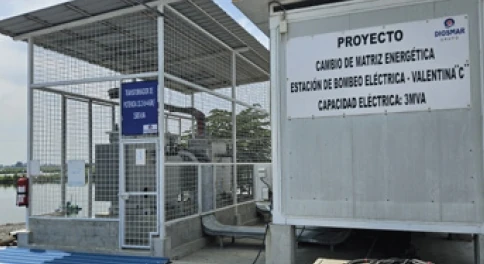
- Cheaper power from a hybrid of hydroelectric and diesel supply. Even so, a photo caption in the original notes that electricity supply is not guaranteed infrastructure on Ecuadorian farms.
- Widespread automated feeding: Hendri Inarto, a nutrition research and technical specialist in Indonesia, said automated feeders reduce feed waste, improve feed conversion ratios (FCR) and need fewer workers. Preecha also pointed to Ecuador's use of artificial intelligence and pond-monitoring tools, while many Southeast Asian farms are only beginning to adopt them.
- Extruded feed: according to Jessica Kaye Turner, assistant managing director of a farm in Thailand, extruded feed is widely used in Ecuador, while pelleted feed still dominates in Asia. Mechanical and thermal processing makes extruded feed more digestible, improves nutrient availability and water stability, and reduces nutrient leaching; shrimp receive more consistent nutrition, water quality holds up better and FCR improves.
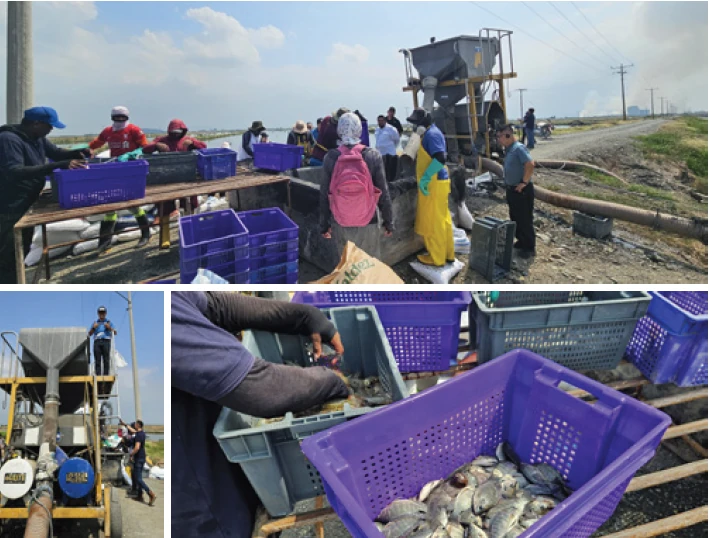
One detail stands out: because extruded pellets are porous, acoustic sensors at first could not “hear” the shrimp chewing. Engineers adjusted feed density, modified extruder dies and developed desiccant technologies to restore friction and sound.
Rizky noted that not every technology transfers directly: some automated feeding systems tested in Asia struggled under higher-density conditions. The group's broader lesson was not to copy Ecuadorian technology, but to understand why and where it works.
06 / GENETICS
Selecting shrimp in real ponds
Genetics is another major factor. Amorn explained that Ecuadorian producers run collaborative breeding programmes: many farms contribute their strongest-performing shrimp, and the survivors become the foundation for future generations. This makes selection cheap but effective, because shrimp are tested under real commercial conditions. Khemika also stressed that, unlike many Asian producers who rely on imported broodstock, Ecuador has built its own genetic base suited to local conditions.
The group discussed the fact that Ecuador's lines are neither specific pathogen free (SPF) nor specific pathogen resistant (SPR), unlike the approaches common elsewhere. Jessica explained that Asian farms have historically relied on SPF genetics, small ponds, high stocking densities, enclosed lined systems and strict pathogen exclusion. Ecuador has built a large-scale, semi-intensive model using genetics selected in pathogen-exposed environments for performance under real farm conditions, combined with lower densities, larger ponds, use of the natural ecosystem, water recirculation and bioremediation to make shrimp more robust against disease.
An open question, raised by Preecha: would Ecuadorian broodstock hold their performance if exposed to much higher stocking pressure?
07 / WHO KEEPS THE MARGIN
Are farmers the weakest link?
For all of Ecuador's success, several participants raised concerns about how value is shared. Rizky argued that farmers may be the weakest link: shrimp production is profitable, but farm-level margins remain very low.
“So I think if the Asian farmers’ profits are as low as Ecuador’s, I think the farmers will just close down their farm and maybe grow something else.”
Rizky Darmawan
According to Rizky, processors and exporters capture much of the added value, particularly when shrimp is processed for premium markets such as the United States. Farmers remain tied to global commodity prices, especially Chinese demand, which sets the benchmark for raw shrimp, and they struggle to capture any premium because processors control market access and value-added opportunities. Preecha saw it differently: Ecuador's low prices are ultimately the result of efficiency. Lower production risk, higher survival and integrated management let Ecuadorian companies stay profitable at lower selling prices.
08 / WHAT SOUTHEAST ASIA TAKES HOME
Don't copy Ecuador — find the model that fits

The group's final message was not that Southeast Asia should copy Ecuador. Rather, Ecuador shows that successful shrimp farming depends on finding the right model for each environment.
- There is no single way to farm shrimp. Rizky argued that where high-density farming brings repeated failures, a lower-density approach could deliver more stable returns.
- Sustainability over matching output. Yanisa agreed that every region has its own limits: land scarcity makes high-density farming understandable in Southeast Asia, but producers should focus on sustainability rather than trying to match Ecuador's model. Yanisa added that the team is very interested in how Ecuador exchanges water by gravity, although that would need considerable infrastructure investment.
- Add value rather than only cutting cost. Another participant argued that Southeast Asia may not win on lower costs and should focus on adding value, building brands and reaching higher-value markets. Preecha said shrimp is becoming a commodity much like poultry; Southeast Asia may struggle to compete with Ecuador purely on cost, but it keeps advantages in processing expertise, product quality and market relationships.
- Lower density a little. Khemika said the farm will try to reduce density so it can deal with organic matter in the pond.
“We can copy its sequencing: choose the animal that suits the place, expand in a way the resource can carry, and build the collective structures that let producers speak with one voice. Technology and density are decisions that come after those, not instead of them.”
Chodpipat Limlertwatee, chief farming officer of a group in Thailand
Caleb Wurth closed the discussion on an optimistic note: Ecuador's success should motivate Southeast Asia rather than discourage it, and the ability of producers in different countries to share knowledge, challenge assumptions and adapt will shape the industry's future. As the article concludes, Ecuador's lesson is not that bigger is always better, but that success comes from understanding one's own environment and optimising every part of the system to suit it.
09 / THAN VUONG'S VIEW
What should farmers know?
- Count profit over the year, not one lucky crop. Ecuadorian farmers accept modest margins per cycle but suffer few total losses. On your own farm, avoiding one failed crop is often worth more than pushing yield up for one cycle. Record costs and results for every crop so you know your real profit.
- Stock to what the pond can carry. Set density by the pond's capacity for aeration, water exchange, siphoning and waste treatment, not by the yield you hope for. Several visitors said their main takeaway was to lower density a little.
- Survival is the root of production cost. Prevent disease from the start of the crop: prepare ponds well, choose seed with a clear origin and test results, and keep the environment stable. Ecuador's genetics come with years of selection in large, low-density ponds; this is no reason to stock seed of unknown origin.
- Right-sized technology, tested in your own ponds. Automatic feeders or new feeds pay off only when they fit your density and management; some systems have struggled at high density.
- Organise for a common voice. Farmer groups and cooperatives let farmers buy inputs together, share experience and have a voice when selling shrimp, rather than every household going it alone.
QUICK ANSWERS
Frequently asked questions about Ecuador's shrimp model
How densely do Ecuadorian farms stock shrimp?
According to Aqua Culture Asia Pacific (2 November 2026), Ecuadorian farms typically stock under 20 PL/m², compared with 100–200 PL/m² on many Southeast Asian farms. In return, Ecuadorian farms are very large, often hundreds of hectares each, and survival is high.
Why is Ecuadorian shrimp cheap to produce?
Members of the Southeast Asian group cited several reasons: abundant land for large-scale farming; integration along the value chain (about 60% of output comes from 10 major players, many with processing plants); low density, which means less stress, less disease pressure and high survival; machinery such as automatic feeders, shrimp pumps and mechanised harvesting; and cheaper electricity from a mix of hydroelectric and diesel supply.
How much do Ecuadorian shrimp farmers earn?
The article puts farm margins at perhaps only US 5–15 cents per kilogram, but large areas and steady harvests still make the total attractive. One participant said farms run five or six cycles a year and can still make money with only two good ones.
How does Ecuador handle shrimp genetics?
Ecuador has built its own genetic base rather than relying on imported broodstock: many farms contribute their best performers to shared selection programmes, so animals are selected under real commercial conditions. Its lines are not SPF or SPR but selected in pathogen-exposed environments. The group questioned whether these lines would hold up at much higher stocking densities.
What can Southeast Asian farmers learn from Ecuador?
The group concluded that Southeast Asia should not copy Ecuador wholesale but find the model that fits its own conditions: put consistency and risk reduction ahead of yield, consider lowering density a little, organise so producers speak with one voice, and add value (quality, processing, branding) rather than competing on price alone.