GLOBAL SHRIMP FORUM 2026 • INDONESIA • MARKETS & FOOD SAFETY
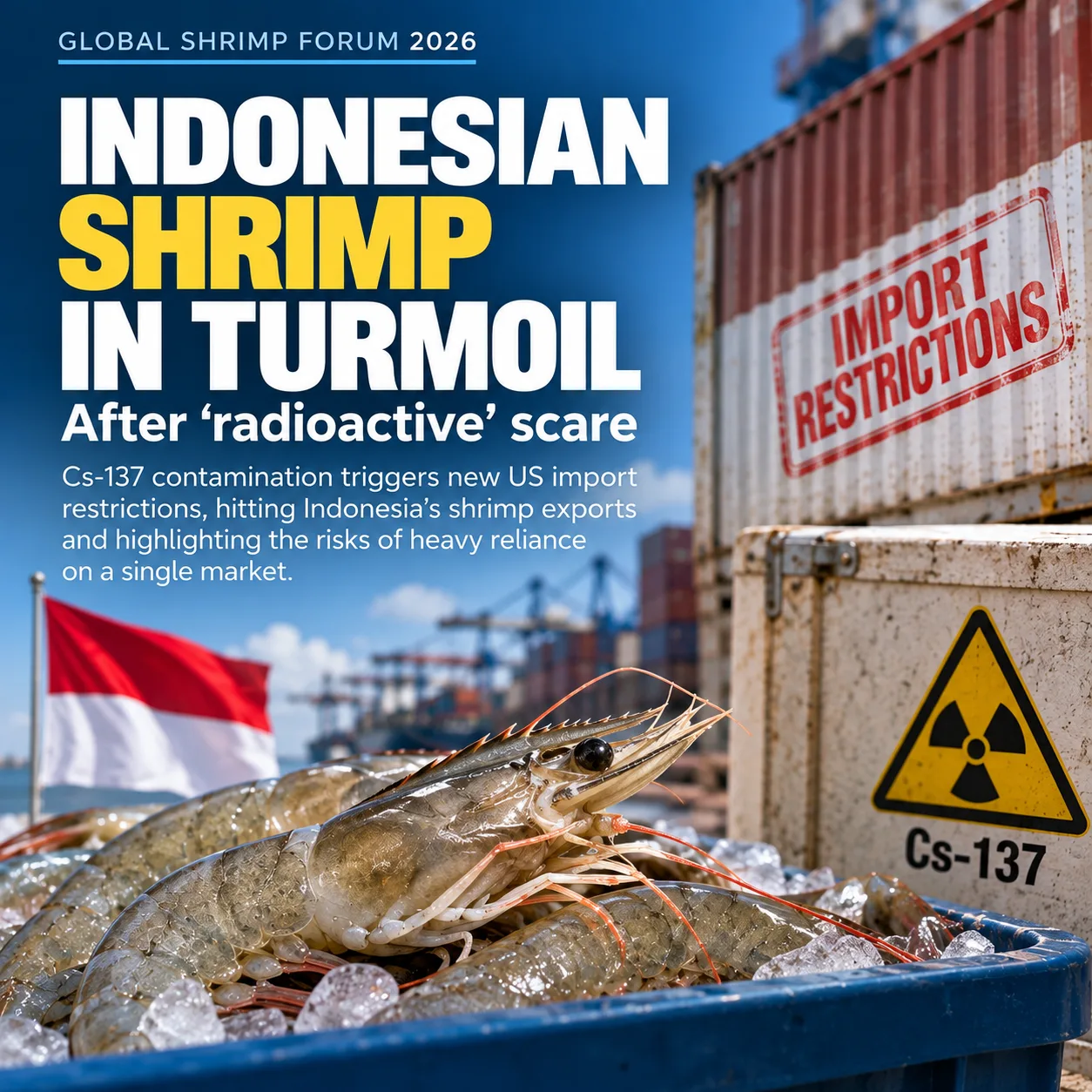
A cesium-137 (Cs-137) incident in late 2025 led the US to tighten imports, exposing the risks of an export industry that relies too heavily on a single market.

Source: The Fish Site • September 4, 2026 • Edited summary
Summary
Indonesia’s shrimp exports took a heavy blow in late 2025 after cesium-137 was detected in shipping containers from Indonesia. The US imposed new import alerts, while Indonesia’s shrimp industry normally depends on the US for 65–70% of its exports. Although trade gradually recovered in 2026, first-half export volumes were still 14% lower than a year earlier.
- 65–70% — US share of Indonesia’s shrimp exports
- −54% — Exports in October 2025, year on year
- −14% — Exports in the first half of 2026, year on year
- ~197,000 tonnes — Full-year 2026 export forecast
1. Cesium-137 detected in shipments from Indonesia
In early August 2025, US authorities detected cesium-137 (Cs-137) in shipping containers arriving from Indonesia. The first detection was recorded by US Customs and Border Protection (CBP) at the Port of Los Angeles. The FDA later confirmed Cs-137 in a sample of frozen shrimp processed by the Indonesian company BMS Foods.
Following the discovery, the FDA placed BMS Foods on the red list of Import Alert 99-51, barring the company’s shrimp from the US market. Cs-137 was subsequently found in containers arriving at several other US ports, and traces of contamination also turned up in some other Indonesian exports, notably footwear.
2. From one processing plant to an industry-wide shock
At first, Indonesia was unable to identify the source of the contamination. For shrimp farmers, the situation became far more serious in October 2025, when the FDA introduced Import Alert 99-52 and access to the US market became much more difficult.
According to Liris Maduningtyas, co-founder and CEO of JALA, the earlier alert mainly affected one processing plant and a limited geographic area. But the October measure, which applied to shrimp from Java and Lampung, rippled across Indonesia’s entire shrimp industry.
3. Contamination most likely traced to a scrap-processing facility
After an investigation, Indonesian authorities identified a scrap metal processing facility in the Cikande industrial estate as the center of the incident. Contaminated scrap metal is considered the most likely source.
An important clarification
According to the report, the contamination was linked to an industrial scrap-processing facility; there is no evidence that shrimp farming was the source of the radiation. However, when an incident occurs in the export chain, the whole industry can still suffer a heavy commercial impact.
4. The numbers show the scale of the damage
The impact was especially severe because Indonesia’s shrimp industry relies heavily on the US market. According to data presented at Global Shrimp Forum 2026, the US normally accounts for about 65–70% of Indonesia’s total shrimp exports.
After a relatively positive start to 2025, Indonesian shrimp exports fell 54% year on year in October. In November the decline narrowed to 15%, before shipments began to recover in December.
| Period | Note | Change |
|---|---|---|
| October 2025 | Compared with a year earlier | −54% |
| November 2025 | Compared with a year earlier | −15% |
| December 2025 | After the October–November shock | Recovery begins |
| January–June 2026 | Compared with the same period of 2025 | −14% |
| Full year 2026 | Forecast by Willem van der Pijl | ~197,000 tonnes |
5. Indonesia seeks to diversify its markets
To soften the blow from the US market, Indonesia increased exports to other markets, particularly the European Union and China. However, this trend began to reverse as trade with the US gradually recovered in late 2025 and early 2026.
The episode shows that market diversification is not just a growth strategy. In times of crisis, it is also a risk-management tool.
6. 2026 is still not back to normal
Although trade with the US has returned closer to normal, Indonesia’s shrimp exports in January–June 2026 were still 14% lower than in the same period a year earlier.
Willem van der Pijl, co-founder and managing director of Global Shrimp Forum, forecasts that Indonesia could export around 197,000 tonnes of shrimp in 2026. If that happens, it would be the first time since 2018 that Indonesia’s shrimp exports fall below 200,000 tonnes.
7. The lesson from Indonesia: risk in the shrimp industry is not confined to the pond
The Cs-137 incident is an exceptional case, but it reveals an important reality: farmers can manage seed, feed, the environment and disease well, yet the profitability of the whole industry can still be badly hit by an incident in processing, logistics, food safety or import control.
When 65–70% of shrimp exports depend on a single market, any change in safety requirements, control policies or buyer confidence can quickly travel back to processing plants, dealers, traders and, ultimately, the price farmers get for shrimp at the pond.
Farm economics perspective
Growing shrimp only solves the production side. A sustainable shrimp chain also needs food safety, traceability, control of risks beyond the farm and market diversification. The Indonesian story shows that the “market end” can become as big a risk as disease in the pond.
5 numbers to remember
- 65–70%: the US share of Indonesia’s shrimp exports under normal conditions.
- 54%: the year-on-year drop in Indonesia’s shrimp exports in October 2025.
- 15%: the continued decline recorded in November 2025.
- 14%: the drop in exports in the first half of 2026 compared with the same period of 2025.
- 197,000 tonnes: the full-year 2026 export forecast; if correct, it would be the first time below 200,000 tonnes since 2018.
Source
The Fish Site (September 4, 2026) – “Tough year for Indonesian shrimp after ‘radioactive’ scare”. Read the original article
This is an edited summary based on the original report and the figures presented at Global Shrimp Forum 2026. The “Lesson from Indonesia” and “Farm economics perspective” sections are editorial additions, kept separate from the original content.