The fish farming industry is developing widely with increasing stocking density and production levels. Dissolved nutrients available in the water environment are not sufficient for the growth of fish during limited culture periods. Therefore, providing additional nutrients through the fish's diet is essential. Among these, minerals play an extremely important role in various functions, growth, and development of fish. Adequate mineral supplementation for fish will help increase immunity, disease resistance, growth, and prevent fish from stress.
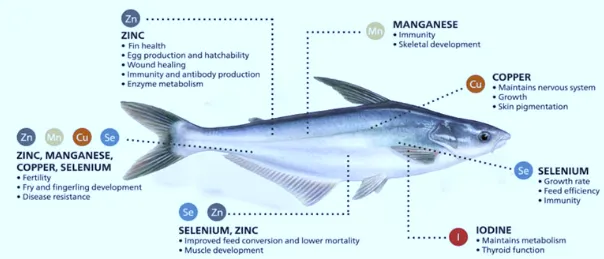
Especially during metabolic and physiological processes in the fish's body, minerals participate in respiration to convert oxygen and carbon dioxide, ensuring suitable conditions for the activity of enzymes in the stomach and intestines during digestion, maintaining the stability of osmotic pressure, and stable pH inside and outside cells. They also act as catalysts in metabolic activities, helping to increase the activity of hormones, vitamins...
CHARACTERISTICS AND ROLE OF MINERALS FOR FISH
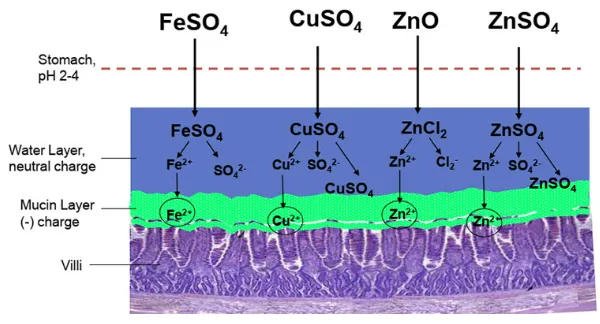
Mineral elements exist as inorganic salts (usually sulfate radicals) and are introduced into aquatic animals by mixing them into feed. Inorganic mineral salts are transported through the digestive tract, where a decrease in pH or acidification can break down bonds and release positively charged ions. These ions react with negatively charged components in the stomach, at which point the trace minerals are no longer available for absorption and are excreted from the animal, causing environmental pollution.
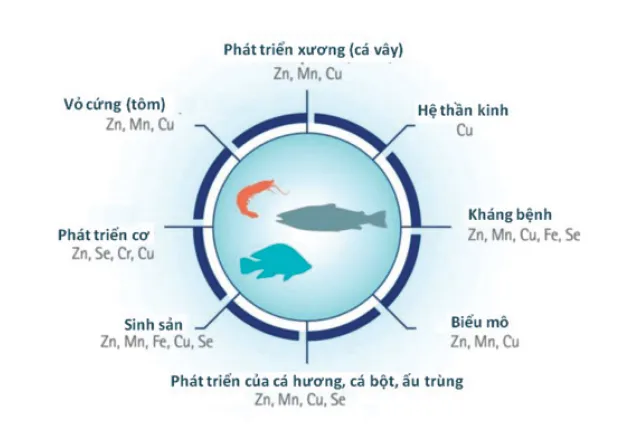
Today, scientific and technical research has led to the development of organic minerals, which is a solution to help fish bodies maximize nutrient absorption during farming, offering a new perspective on the effectiveness of organic multi-trace minerals in improving absorption and reducing discharge into the pond environment.
1. Lanthanide mineral group
The lanthanide group has the effect of minimizing and preventing the harmful effects of free radicals on the body. Compared to traditional mineral groups, lanthanide is a new element used in livestock and aquaculture and has brought positive results. It has a significant effect on Tra fish farmed in the Mekong Delta, with significantly reduced FCR and increased chemical recovery during processing. It also has very high efficacy in pigs (rapid weight gain, improved meat quality, reduced FCR).
2. Macromineral group
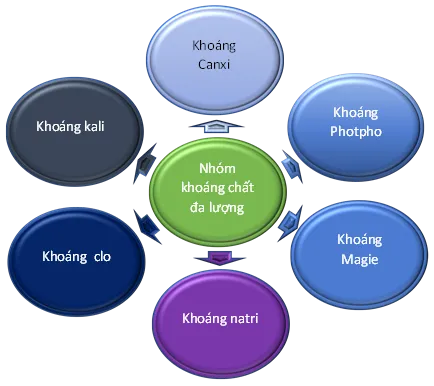

3. Trace mineral group
Fe, Cu, Zn, etc., are trace elements because they are present in very low concentrations but have a significant impact on the metabolic processes of aquatic animals.
Iron (Fe)
Fe in the body exists as organic compounds like Hemoglobin or in inorganic forms as stored Fe. Fe plays an important role in respiration. Fe deficiency in fish will lead to a decrease in red blood cells and yellow liver. In the feed, inorganic Fe is more easily absorbed than organic Fe, and Fe2+ is absorbed faster than Fe3+. Aquatic animals can absorb Fe from the environment. Animal-derived feed rich in Fe is suitable for absorption by aquatic animals.
Copper (Cu)
It is a component of many oxidative enzymes and plays an important role in respiration, is a component of black pigment (Melanin), stimulates the utilization of Fe, and acts as a catalyst for the formation of Hemoglobin (Hb). Cu deficiency in fish also affects growth and makes them susceptible to diseases.
Zinc (Zn)
Zn is a component of the enzyme Carbonic anhydrase (catalyzing hydration reactions), which increases CO2 transport capacity and stimulates HCl secretion in the stomach. When Zn is deficient, fish growth decreases and reproductive capacity is reduced.
Problems caused by mineral deficiency:

Benefits of using quick shell gold mineral:

- Balances the osmotic pressure of the fish's body.
- Promotes healthy metabolic activity in fish, leading to good growth.
- Prevents certain diseases in fish such as: depigmentation, deformities, etc.
- Increases reproductive rates and maturation rates in fish.
Mineral supplementation for farmed fish right from the early stages is extremely essential for the development of fish.
AUTHOR FISH TECHNICAL SPECIALIST - NGUYEN MINH DUC