Summary
An emerging disease called translucent post-larvae disease (TPD) in whiteleg shrimp Penaeus vannamei, caused by a new type of Vibrio parahaemolyticus (Vp TPD), has become an urgent threat to shrimp farming in China. To develop an effective disinfectant for its prevention and control, the clinical protective effects of polyhexamethylene biguanide hydrochloride (PHMB) against Vp TPD in whiteleg shrimp P. vannamei were studied by running acute toxicity tests of PHMB on P. vannamei post-larvae and trials of PHMB against Vp TPD infection.
The median lethal concentration (LC50) of the disinfectant PHMB for P. vannamei post-larvae after 24 h, 48 h, 72 h and 96 h of exposure was 16.13 mg/L (14.18–18.57), 10.77 mg/L (9.93–11.72), 9.68 mg/L (8.53–11.64) and 9.14 mg/L (7.70–10.99), respectively.
In addition, a clinical trial showed that PHMB at 1 mg/L had a strong protective effect on shrimp post-larvae challenged with 101–104 CFU/mL Vp TPD. The relative percent survival (RPS) of P. vannamei post-larvae given 1 mg/L PHMB and challenged with Vp TPD at 101, 102, 103 and 104 CFU/mL was 63.65% ± 6.81, 62.96% ± 5.56, 60.00% ± 3.75 and 66.67% ± 3.75, respectively, 96 hours after infection.
These results highlight the clinical protective effect of PHMB, so PHMB could be used as a preventive measure to control TPD infection early in shrimp farming. The study also provides useful information for preventing other bacterial diseases in shrimp farming.
Graphical abstract
The graphical abstract of the study shows three panels:
- A: post-larvae held in PHMB at 0.5, 0.75, 1.0, 1.25 and 1.5 mg/L, alongside a positive control and a negative control.
- B: survival rate (%) of the post-larvae from 0 to 96 hours after challenge with strain Js 4-2 at 104 CFU/mL, without PHMB and with PHMB at different concentrations.
- C: relative percent survival (RPS, %) at PHMB concentrations of 0.50, 0.75, 1.00, 1.25 and 1.50 mg/L; the highest RPS is at 1.00 mg/L.
Introduction
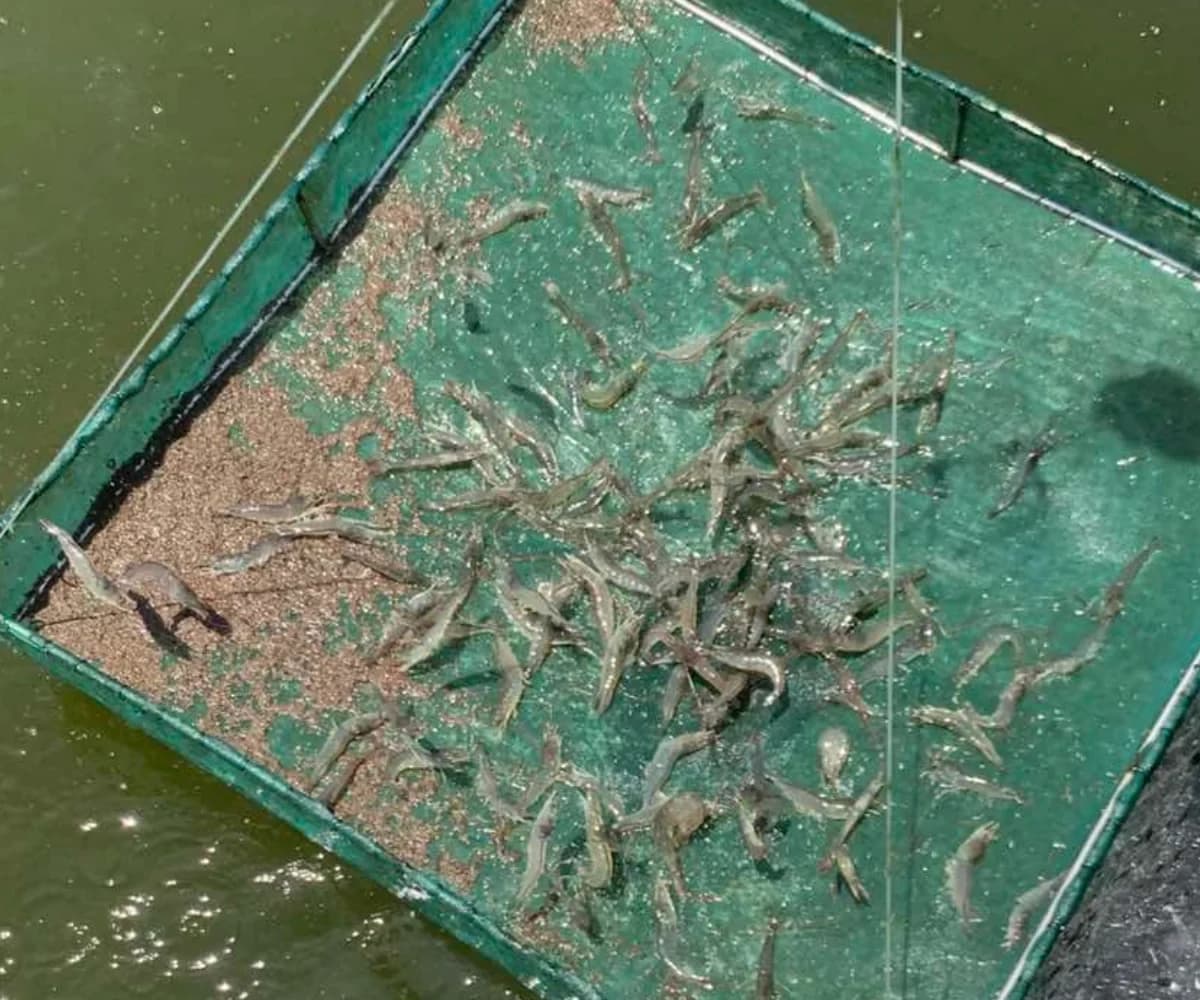
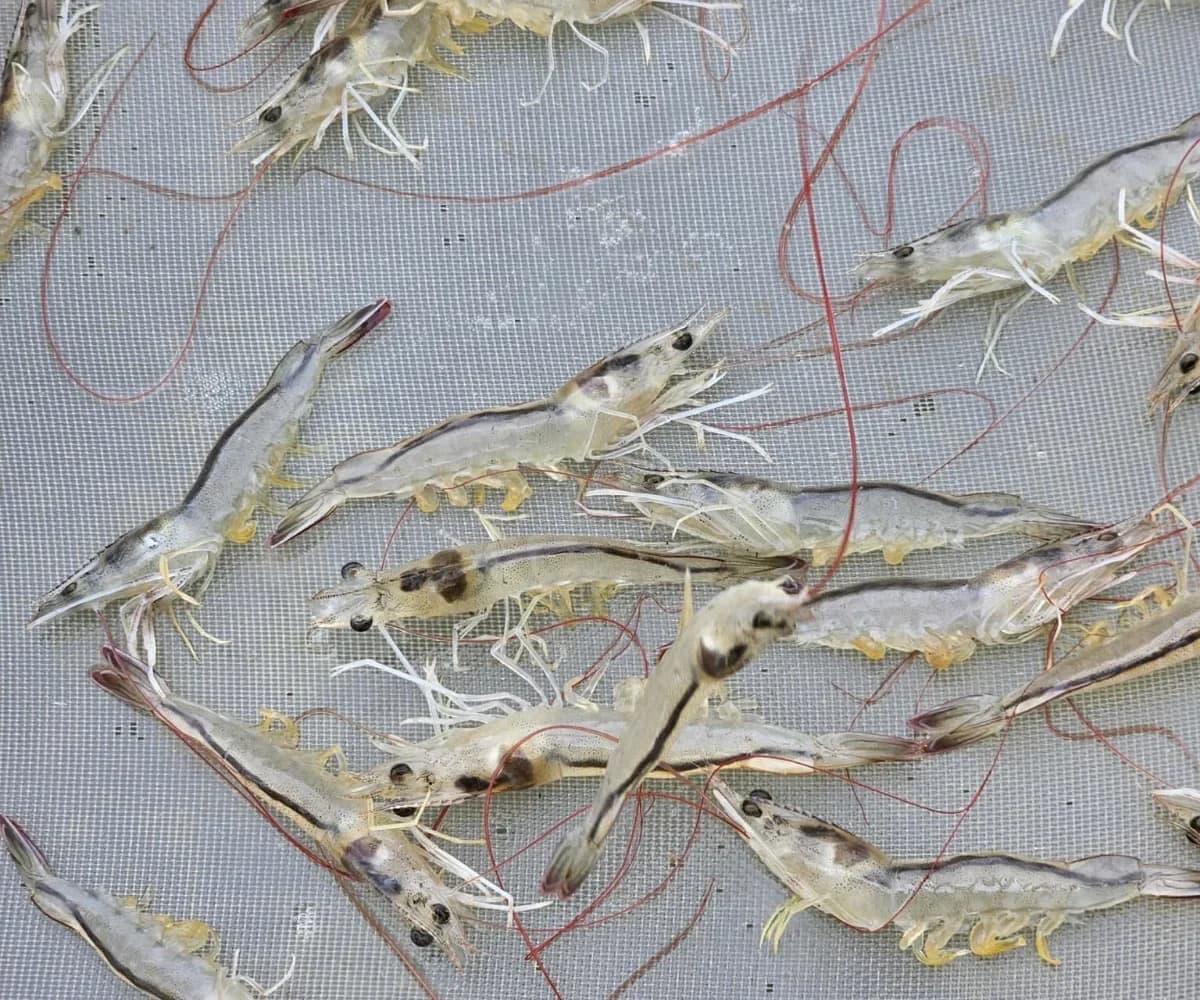
Since October 2019, an extremely dangerous disease of whiteleg shrimp (Penaeus vannamei) post-larvae has occurred in several local hatcheries in Guangdong and Fujian provinces, China. It mainly affects P. vannamei post-larvae aged 6–12 days (PL6–12) (He, 2020; Huang, 2020; Zou et al., 2020b). Diseased shrimp show typical clinical signs such as an empty digestive tract and a pale or colourless hepatopancreas (Wang et al., 2021; Zou et al., 2020b). Mortality in affected populations can reach 90%–100%, usually within 72 hours after the first abnormal individual appears. Local farmers named the disease "translucent post-larvae disease" (TPD) or "glass post-larvae disease" (GPD) (Zou et al., 2020b).
From April to May 2020, TPD spread rapidly through the main shrimp-farming regions of China. As a result, 80% of hatcheries in China's main coastal shrimp-farming regions stopped producing P. vannamei post-larvae in 2020, and the spread of TPD became a new threat to the development of the shrimp industry (Harkell, 2020b; Harkell, 2020a; Yang et al., 2022). Studies have shown that this new disease is caused by a new, highly lethal type of Vibrio parahaemolyticus, named Vp TPD (Zou et al., 2020b; Yang et al., 2022).
Polyhexamethylene biguanide (PHMB) is a cationic polymer and water-soluble fibroblast material with broad-spectrum, effective antibacterial activity (To et al., 2016; Chan et al., 2023). Its bactericidal mechanism differs from that of chlorine-based disinfectants, which are the most widely used (Park et al., 2019; Jones and Joshi, 2021). Chlorine destroys bacteria by oxidising proteins, lipids and carbohydrates (Ingols et al., 1953; Huang et al., 1997). PHMB, on the other hand, exerts its bactericidal activity through electrostatic interaction with negative sites on the lipopolysaccharide component of the bacterial cell membrane (Khunkitti et al., 1999; Wallace, 2003).
Specifically, the rapid attraction of PHMB to negatively charged phospholipids on the bacterial cell surface breaks down the membrane structure and weakens membrane function. This leads to leakage of the cell contents, loss of potassium ions and precipitation of intracellular components, and finally to lysis of the bacterial cell (Shaarawy et al., 2014; Efron, 2016; Ittoop et al., 2015). Because of its excellent antibacterial properties, PHMB has been widely and safely used as a disinfectant and fungicide in medicine, the food industry and environmental disinfection (Kusnetsov et al., 1997; Messick et al., 1999; Rita et al., 2017; Yim et al., 2023).
Polyvinylpyrrolidone iodine and chlorine dioxide are disinfectants commonly used in aquaculture in China (Zhang et al., 2004), and there are very few reports on the use of PHMB (Qin et al., 2006). In recent years, PHMB has been used in aquaculture (Wang et al., 2009) and has shown highly effective bactericidal activity in vitro and a clinical protective effect against the Vibrio that causes acute hepatopancreatic necrosis disease (AHPND) in Pacific whiteleg shrimp (Zou et al., 2020a). In this study, the authors evaluated the safety of PHMB and its protective effect against Vp TPD infection in P. vannamei post-larvae, aiming to provide useful information for preventing TPD and for the rational use of PHMB in aquaculture.
Figure in the original (source: Yang et al., 2022): tissue sections of the hepatopancreas and midgut of normal shrimp compared with TPD-infected shrimp.
Excerpt
Bacterial strains and growth conditions
- The V. parahaemolyticus strain that causes TPD, Vp20200408004-2, was isolated by the authors' laboratory from moribund shrimp in April 2020.
- The isolated strain was stored at −80 °C in 20% glycerol for long-term preservation.
Experimental shrimp
Specific-pathogen-free (SPF) whiteleg shrimp P. vannamei larvae (PL10), 9–10 mm in body length, were bought from BLUMP Seed Industry Technology Co., Ltd. in Weifang, Shandong Province, and kept in sterile seawater at 21 °C for two days before use in the experiments.
Discussion
Vibrio species are normal bacteria living in both freshwater and marine aquaculture environments and in aquatic animals, and they can also act as opportunistic pathogens (Vandenberghe et al., 2003; Möller et al., 2020; Li et al., 2019; Lee et al., 2015). The pathogenicity of different Vibrio species varies during the culture of aquatic animals (Moriarty, 1998; Arunkumar et al., 2020). Vibrio species isolated from diseased shrimp include V. alginolyticus and V. anguillarum.
Toxicity test
Based on observation, P. vannamei post-larvae showed abnormal behaviour such as jumping, irritability and collisions in PHMB solutions at concentrations above 4 mg/L. Shrimp in the low-concentration PHMB groups swam slowly and showed no particular reaction. No dead shrimp were found in any of the blank control groups throughout the experiment. In the early stage of the toxicity tests, the signs of poisoning in P. vannamei were mainly fast swimming, jumping and collisions.
Figure in the original (source: Yang et al., 2022): normal shrimp compared with diseased shrimp.
Author contributions
Qingli Zhang conceived and designed the study. Tianchang Jia, Tingting Xu, Wenqiang Li and Ruidong Xu carried out the experiments and analysed the samples. Tingting Xu and Shuang Liu contributed to sampling naturally infected shrimp. Tianchang Jia, Wenqiang Li and Ruidong Xu helped carry out the artificial challenge experiment and sampling. Jie Kong provided the SPF shrimp. Jitao Xia helped prepare the histological sections and run the histopathological examinations. Tianchang Jia carried out the work.
Declaration of competing interest
The authors declare that they have no competing financial interests or personal relationships that could have influenced the work reported in this paper.
Acknowledgements
The authors thank Dr Liang Yao for generously helping to check the English grammar of the manuscript. This work was supported by the Central Public-interest Scientific Institution Basal Research Fund, YSFRI, CAFS (No. 20603022021012; 20603022022020), the Central Public-interest Scientific Institution Basal Research Fund, CAFS (No. 2020TD39; 2021XT0602) and the China Agriculture Research System of MARA (CARS-48).
English text adapted from Than Vuong's original Vietnamese infographic.