Working hours: Mon - Fri | 08:00 - 17:00HOTLINE: 0867 95 7568
Technical Article

TPD Management Protocol and Shrimp Recovery

TPD causes very rapid collapse, but with proper intervention during the 3 golden days, shrimp have a chance to recover. Most important: do it right – do it sufficiently – do not give up halfway.

Technical NoteShrimpDecember 12, 2025👁 364 views
Click to listen to an AI-narrated summary
AI Summary

Generate an English summary for TPD Management Protocol and Shrimp Recovery

AI-generated summary based on the full article content below.

Editorial Framing

Why this article matters

    Full Article
    TPD Management Protocol and Shrimp Recovery

    TPD management protocol and shrimp recovery

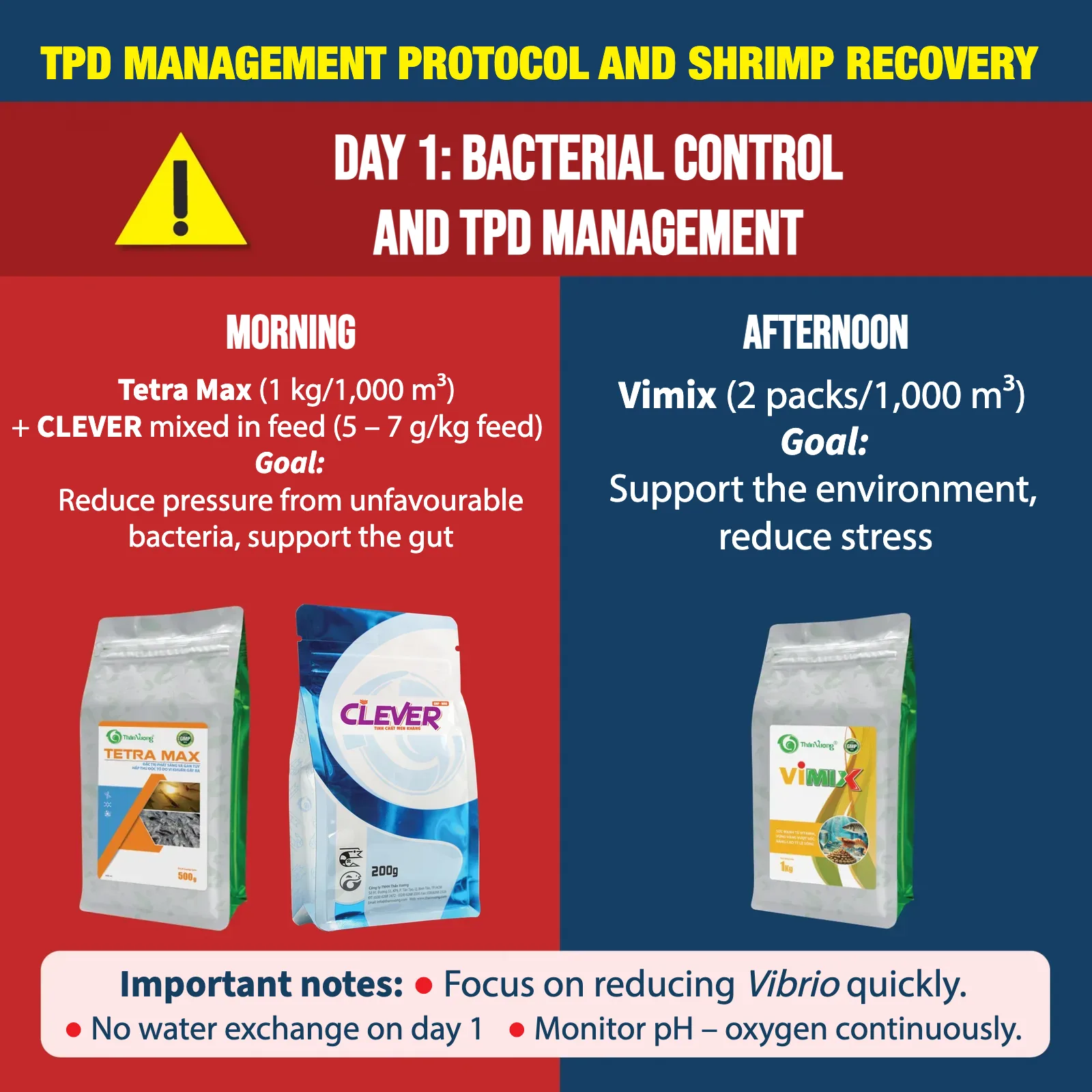
    Day 1: bring bacteria under control and contain TPD

    TimeProducts and doseGoal
    MorningTETRA MAX (1 kg/1,000 m³) + CLEVER mixed into feed (5–7 g/kg feed)Cut off the source of infection; support gut health
    AfternoonVIMIX (2 packs/1,000 m³)Support the pond environment and help the shrimp cope with shock

    Important notes:

    • Focus on bringing Vibrio down quickly.
    • Do not change water on day 1.
    • Monitor pH and oxygen continuously.

    Day 2: consolidate and keep pathogens locked down

    TimeProducts and doseGoal
    MorningTETRA MAX (1 kg/1,000 m³) + CLEVER mixed into feed (5–7 g/kg feed)Reduce the Vibrio load a second time; support gut health
    AfternoonVIMIX (2 packs/1,000 m³)Support the pond environment and help the shrimp cope with shock

    Important note: keep pH stable.

    Day 3: restore the hepatopancreas and stabilise the environment

    TimeProducts and doseGoal
    MorningApply the probiotic SOILMAX or MAX 4000 New (1 pack/1,000 m³)Supply beneficial microbes; help absorb NH₃/NO₂ and reduce their formation
    NoonHERB GUARD (2 bottles/500 m³)Support the hepatopancreas
    AfternoonCELL CALPHOS GOLD (2 litres/1,000 m³)Help muscle recovery and shell hardening

    Notes:

    • Fast hepatopancreas recovery.
    • Harder shells, muscle recovery.
    • Water exchange: only a light change of 2–3 cm of water (if needed). Do NOT change water if the shrimp are not yet due for a scheduled exchange.

    Important notes and recovery protocol

    1. Target pH when applying probiotics

    • Morning pH: 8.0
    • Afternoon pH: 8.3
    • Important: do not let pH rise more than 0.5 units within a day.

    2. When can the shrimp be fed again?

    Give only a light trial feed when:

    • the hepatopancreas has turned dark again;
    • the shrimp swim well and have good reflexes.

    Rule: feed a little, then increase gradually according to the shrimp's strength.

    3. Recovery feed-mix protocol after the disease-management course (at least 3 feedings/day)

    FeedingMain productsGoal
    Feeding 1(The prescribed veterinary medicine)Keep gut and hepatopancreas pathogens locked down.
    Feeding 2CLEVER (5–7 g/kg feed)Help reduce pressure from unfavourable gut bacteria.
    Feeding 3HEPA PRO, PRO GUT, AQUAMOS, QUICKSHELL GOLDHelp restore the hepatopancreas + nourish the gut + boost overall resistance.

    English text adapted from Than Vuong's original Vietnamese infographic.
    Quick Q&A

    Frequently asked questions on this topic

    What does "TPD Management Protocol and Shrimp Recovery" cover?

    TPD causes very rapid collapse, but with proper intervention during the 3 golden days, shrimp have a chance to recover. Most important: do it right – do it sufficiently – do not give up halfway.

    Day 2: consolidate and keep pathogens locked down — what are the details?

    TimeProducts and doseGoal MorningTETRA MAX (1 kg/1,000 m³) + CLEVER mixed into feed (5–7 g/kg feed)Cut off the source of infection; support gut health AfternoonVIMIX (2 packs/1,000 m³)Support the pond environment and help the shrimp cope with shock Important notes: Focus on bringing Vibrio down quickly. Do not change water on day 1. Monitor pH and oxygen continuously.

    Day 3: restore the hepatopancreas and stabilise the environment — what are the details?

    TimeProducts and doseGoal MorningTETRA MAX (1 kg/1,000 m³) + CLEVER mixed into feed (5–7 g/kg feed)Reduce the Vibrio load a second time; support gut health AfternoonVIMIX (2 packs/1,000 m³)Support the pond environment and help the shrimp cope with shock Important note: keep pH stable.

    1. Target pH when applying probiotics — what are the details?

    TimeProducts and doseGoal MorningApply the probiotic SOILMAX or MAX 4000 New (1 pack/1,000 m³)Supply beneficial microbes; help absorb NH₃/NO₂ and reduce their formation NoonHERB GUARD (2 bottles/500 m³)Support the hepatopancreas AfternoonCELL CALPHOS GOLD (2 litres/1,000 m³)Help muscle recovery and shell hardening Notes: Fast hepatopancreas recovery. Harder shells, muscle recovery. Water exchange: only a light change of 2–3 cm of water (if needed

    Which species does this article apply to?

    Shrimp

    Related Products

    Products linked to this topic

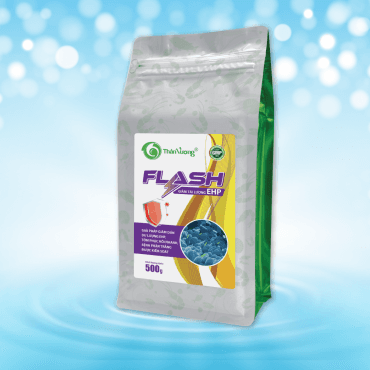
    FLASH
    ShrimpThan Vuong Blue

    FLASH

    Supports gut and hepatopancreas health — shrimp recover quickly, lower risk of white […]

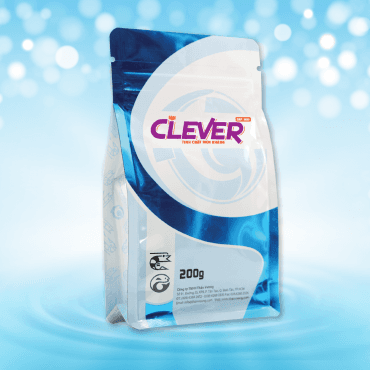
    CLEVER
    ShrimpThan Vuong Blue

    CLEVER

    Yeast-extract protein concentrate that supports shrimp gut microbiota balance and gu […]

    More Reading

    Related technical articles

    THE ROLE OF ELECTROLYTE SUPPLEMENTATION FOR SHRIMP
    Protocol•Shrimp•November 22, 2018

    THE ROLE OF ELECTROLYTE SUPPLEMENTATION FOR SHRIMP

    A recent report published in the journal Aquaculture International has provided further insight into the role of electrolyte supplem[...]

    Global Shrimp Market 2025 Overview — Shrimp Insights Bulletin February 2026
    Technical article•Shrimp•April 9, 2026

    Global Shrimp Market 2025 Overview — Shrimp Insights Bulletin February 2026

    Full-year 2025 global shrimp trade summary: Ecuador leads exports at 1.39M MT (+15%), EU imports surge 21%, US tariff shifts reshape[...]

    CHANGES IN GUT MICROBIOTA DUE TO GLOBAL WARMING. REGULATING HOST HEALTH AND DISEASE STATUS IN POIKILOTHERMIC ANIMALS
    Research Insight•Shrimp•February 28, 2026

    CHANGES IN GUT MICROBIOTA DUE TO GLOBAL WARMING. REGULATING HOST HEALTH AND DISEASE STATUS IN POIKILOTHERMIC ANIMALS

    Global warming alters the gut microbiota of Pacific whiteleg shrimp by restructuring enterotypes, increasing the risk of diseases su[...]

    Ask Than Vuong

    Aquaculture technical assistant

    Hello there 👋

    Describe your pond issue or pick a question below.