Working hours: Mon - Fri | 08:00 - 17:00HOTLINE: 0867 95 7568
Technical Article

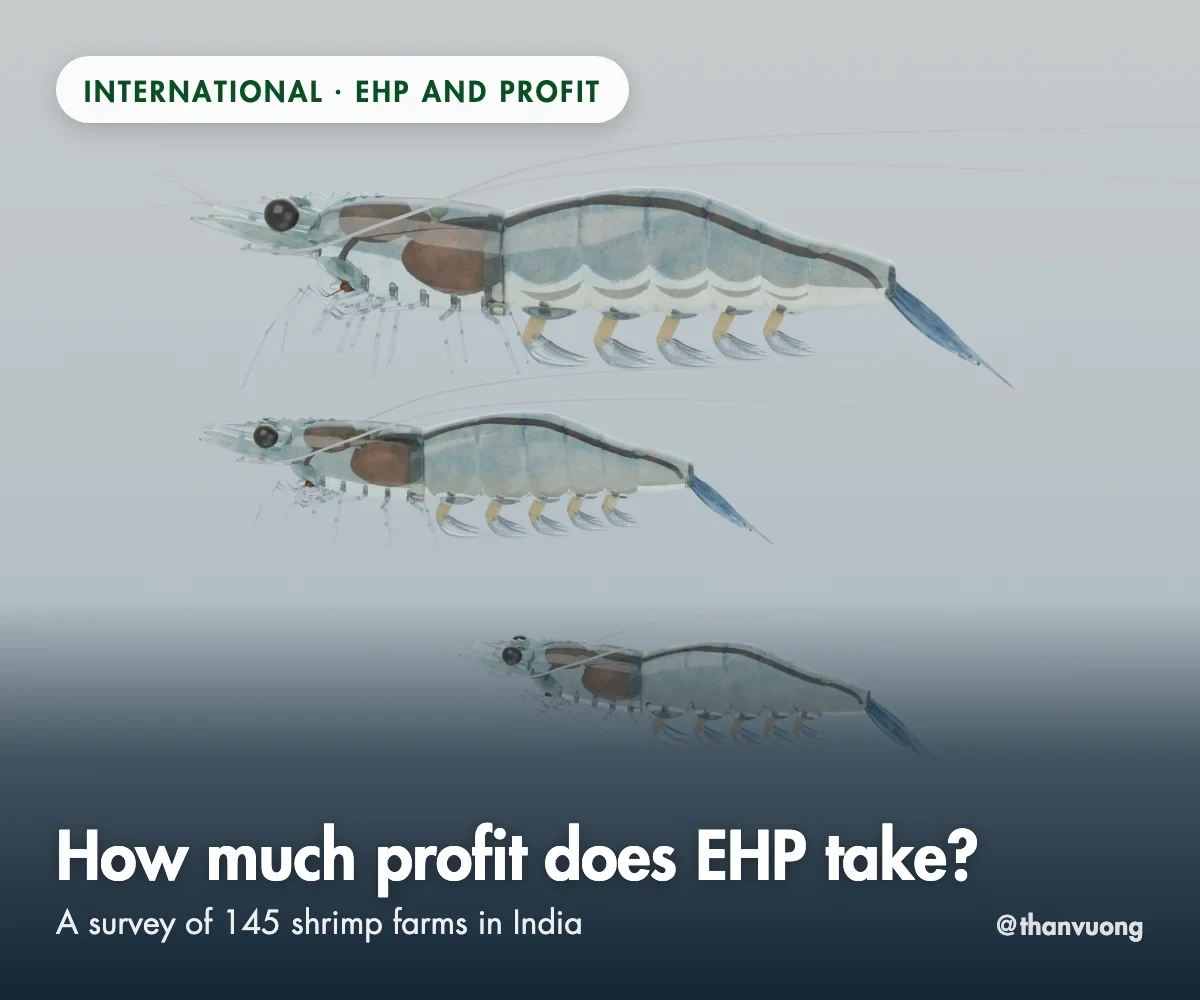
How much profit does EHP take? A survey of 145 shrimp farms in India

A one-year survey in Andhra Pradesh, India: 64% of farms had EHP, pond preparation cost 15–28% more, and losses can exceed 20–30% of a typical profit margin. Moderately and severely infected ponds lost money at 100 shrimp/kg.

Technical articleShrimpNovember 10, 2026
Click to listen to an AI-narrated summary
Full Article
How much profit does EHP take? A survey of 145 shrimp farms in India

A survey in Andhra Pradesh, a major whiteleg shrimp region of India, found EHP on 64% of farms within one year. Losses can exceed 20–30% of a crop’s typical profit margin.

No mass mortality, but steady profit erosion

EHP (Enterocytozoon hepatopenaei) is a microsporidian parasite of the shrimp hepatopancreas. Infected shrimp grow slowly, sizes spread out and feed conversion gets worse. Because shrimp do not die all at once, many farmers only notice at a loss-making harvest.

How the survey was done

The team followed more than 145 farms for one year in the Krishna, East Godavari and West Godavari districts, where farms run 2–4 crops a year. Ponds were checked in three steps: looking at the shrimp in the pond, wet-mount microscopy of the hepatopancreas and RT-PCR.

Infection level was graded by the PCR CT value. The lower the CT, the more parasite:

  • Healthy pond: no EHP detected.
  • Moderately infected: CT above 25.
  • Severely infected: CT below 25.

Main results

64%
of farms showed signs of EHP during the year (93/145)
+15–28%
pond preparation cost, infected vs healthy ponds
>20–30%
loss relative to a typical profit margin
Four-panel chart: 64% of 145 farms infected with EHP; pond preparation cost 115–128 for infected ponds against 100 for healthy ponds; losses of 20–30% of profit margin, possibly more; moderate and severe ponds lose money at 100 shrimp/kg and make a profit at 60 shrimp/kg
Survey of 145 farms in Andhra Pradesh (redrawn by Than Vuong from Aqua Culture Asia Pacific, Feb 2026).

The most striking finding concerns harvest size. Moderately and severely infected ponds lost money when harvested at 100 shrimp/kg. Only by growing on to 60 shrimp/kg, helped by a higher price, did the crop turn a profit. EHP therefore pushes farmers into longer crops, with more cost and more risk.

Reading the numbers correctly: this is a questionnaire survey on farms, not a controlled trial. The article gives no confidence intervals and no money figures for profit or loss by harvest size.

What farmers should do

The article recommends integrated management rather than relying on any single solution:
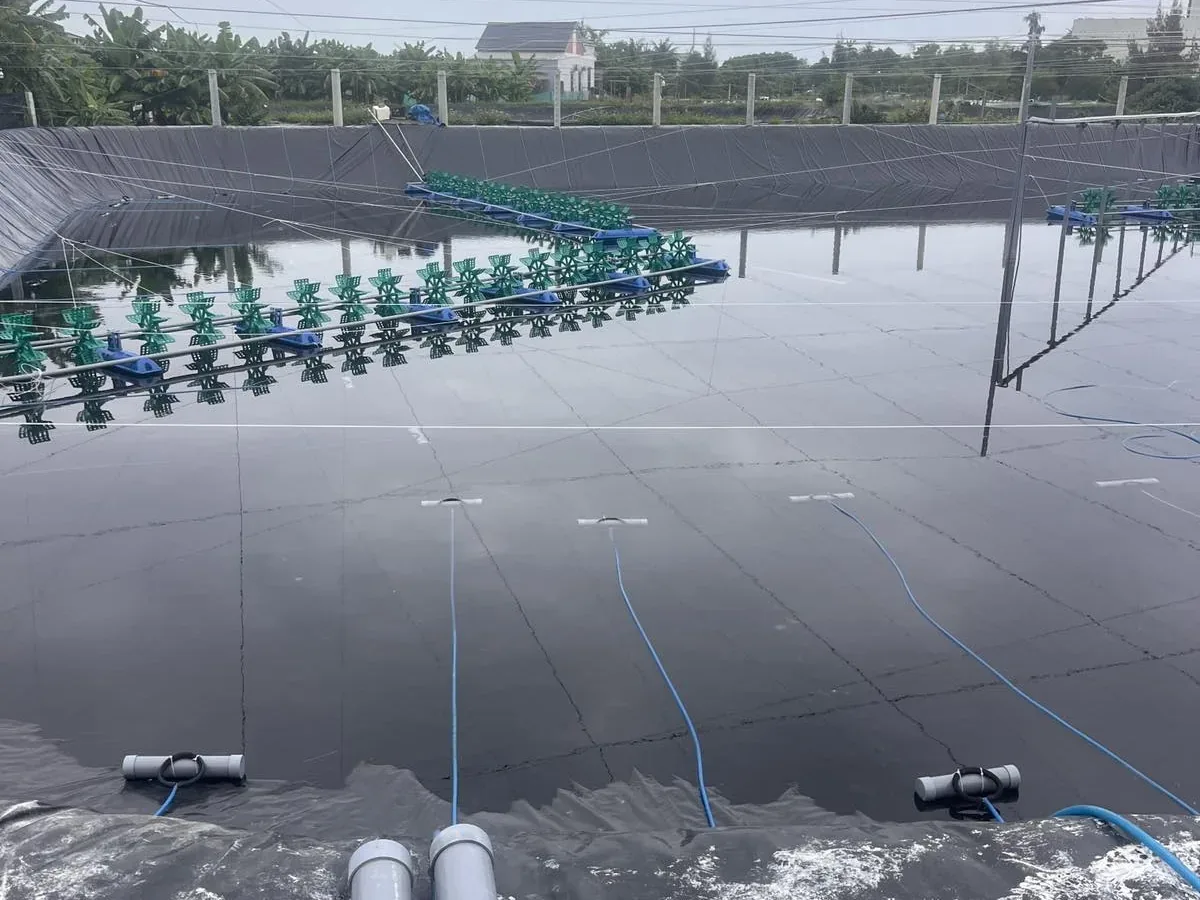
Lined pond prepared for stocking
A lined pond prepared for stocking, first crop of 2026. Photo: Than Vuong.
  1. Thorough pond preparation: dry the bottom completely in the sun, apply lime and suitable disinfectants.
  2. Biosecurity: restrict access, do not share equipment between ponds, use filtered or treated water.
  3. Regular monitoring: watch growth rate and size uniformity, take hepatopancreas samples for wet mounts and PCR on a schedule.
  4. Stable water: keep water quality within range and use probiotics for water and pond bottom.
  5. Nutrition: support immunity and gut health through the diet, as part of the overall plan.
Need help with an EHP prevention plan for your ponds? Contact Than Vuong’s technical team, hotline +84 867 957 568.

Sources

  1. The economic toll of EHP outbreaks in shrimp farming. Aqua Culture Asia Pacific, published online 27 February 2026 (print issue November/December, pp. 40–43).

This article is a synthesis and interpretation by Than Vuong, not a translation. Numbers come from the original articles; product promotion in the originals has been left out. Charts were redrawn by Than Vuong from the numbers and the 3D models were built by Than Vuong; the originals’ own figures and tables are not reproduced.

Quick Q&A

Frequently asked questions on this topic

What does "How much profit does EHP take? A survey of 145 shrimp farms in India" cover?

A one-year survey in Andhra Pradesh, India: 64% of farms had EHP, pond preparation cost 15–28% more, and losses can exceed 20–30% of a typical profit margin. Moderately and severely infected ponds lost money at 100 shrimp/kg.

Which species does this article apply to?

Shrimp

Related Products

Products linked to this topic

GRO C30
ShrimpThan Vuong Blue

GRO C30

Supplies vitamin C to increase resistance and reduce stress

MIX 400
ShrimpThan Vuong Nutrition

MIX 400

Supply minerals, stabilize alkalinity and pH

AQUA PRO4000X
ShrimpThan Vuong Nutrition

AQUA PRO4000X

Microbial control of algae and harmful bacteria in water

BACWAT New
ShrimpThan Vuong Nutrition

BACWAT New

Comprehensive microbial solution for super-intensive ponds

More Reading

Related technical articles

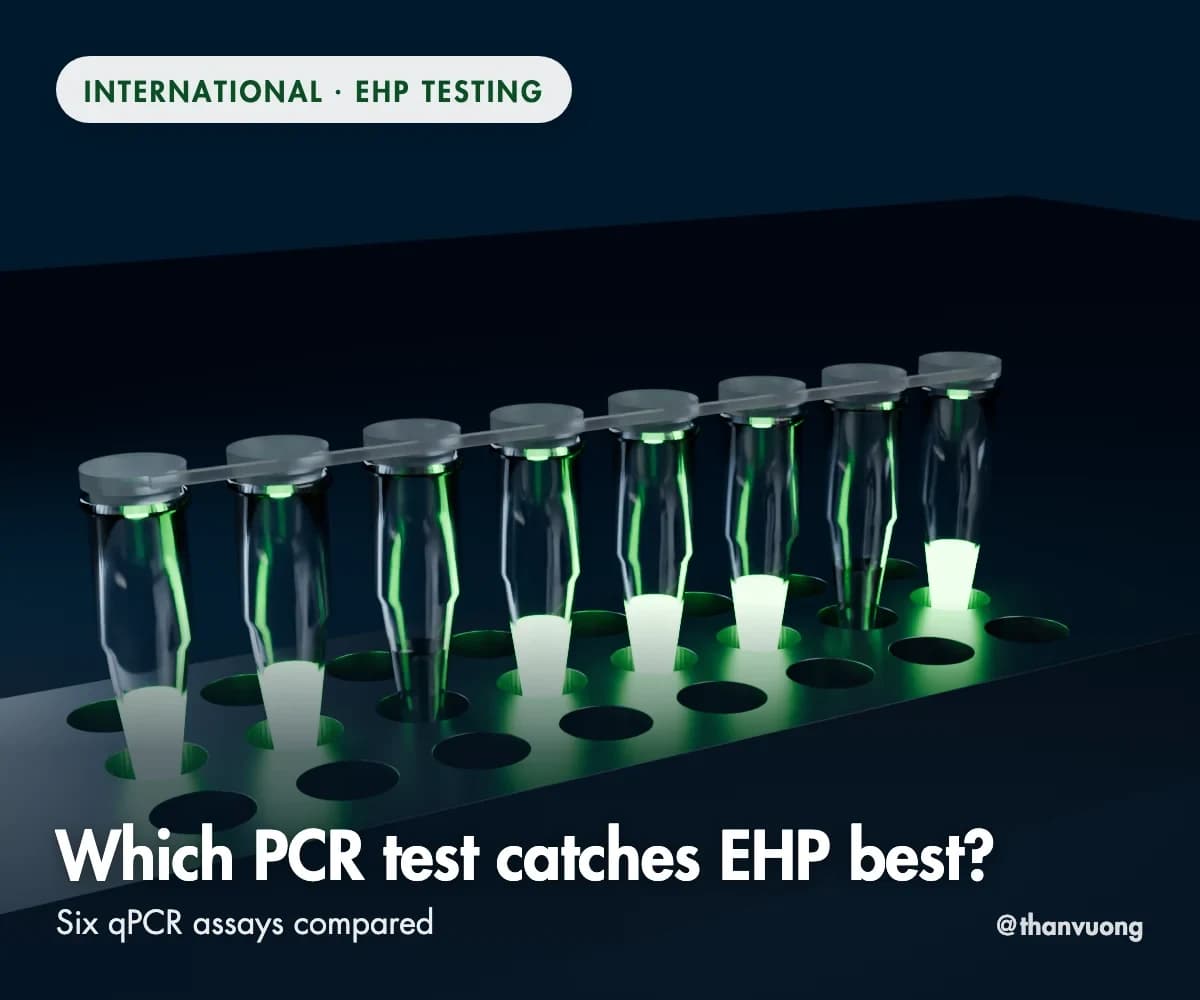
Which PCR test catches EHP best? Six assays compared by the University of Arizona
Technical article•Shrimp•November 10, 2026

Which PCR test catches EHP best? Six assays compared by the University of Arizona

A Scientific Reports study (5 May 2026) compared six real-time PCR assays for EHP head to head: four reached 100% sensitivity, two m[...]

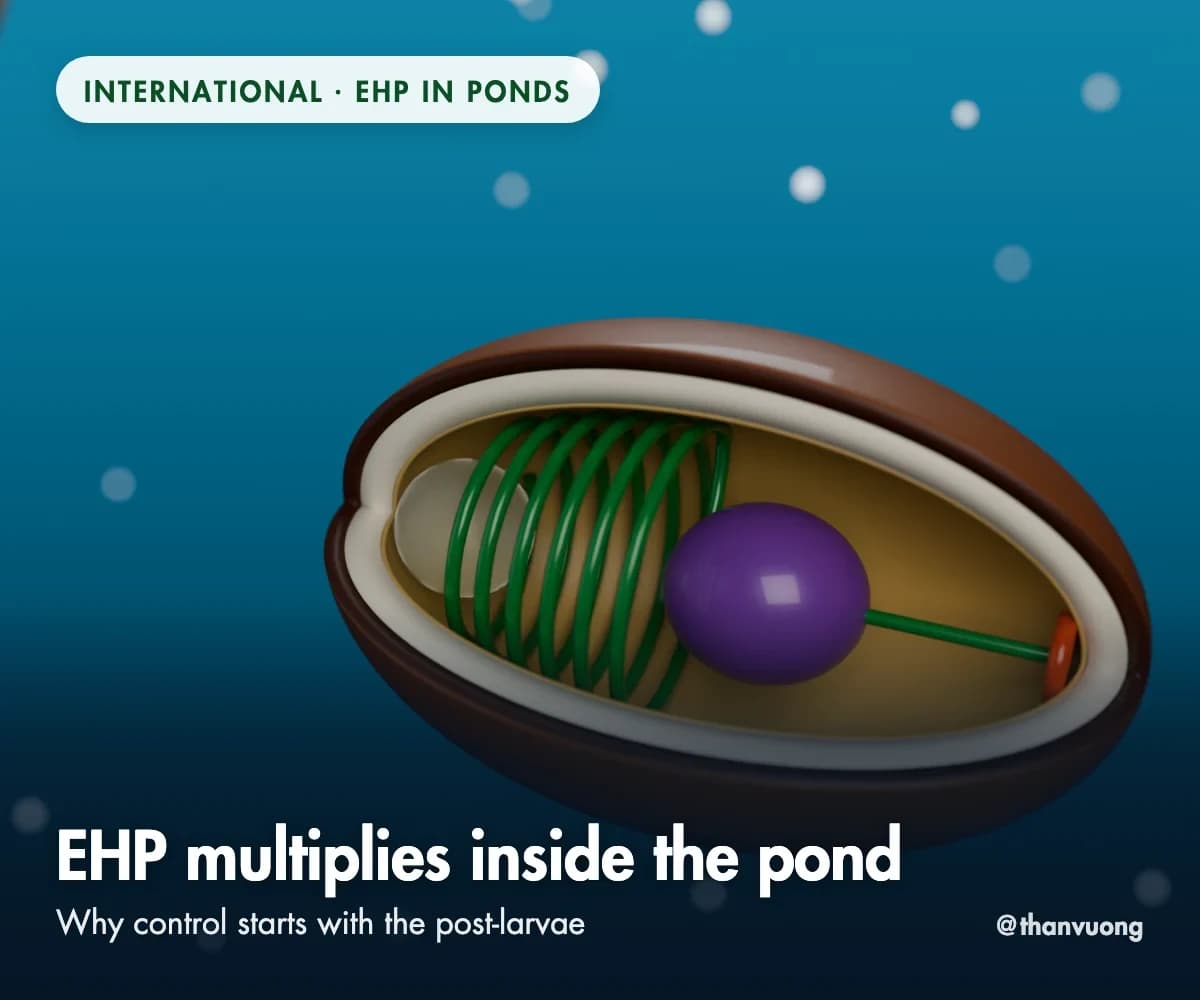
EHP multiplies inside the pond: why control must start with the post-larvae
Technical article•Shrimp•November 10, 2026

EHP multiplies inside the pond: why control must start with the post-larvae

Measurements of EHP spores in pond water from Thailand and Vietnam: on the Vietnamese farms tested, intake water was fairly clean bu[...]

White feces in whiteleg shrimp: the latest research points to EHP, Vibrio and water temperature
Technical article•Shrimp•November 1, 2026

White feces in whiteleg shrimp: the latest research points to EHP, Vibrio and water temperature

A review of 2021–2026 research: in Chinese outbreaks the white strings were mostly EHP spores; in Indonesia and China some Vibrio sp[...]

Ask Than Vuong

Aquaculture technical assistant

Hello there 👋

Describe your pond issue or pick a question below.