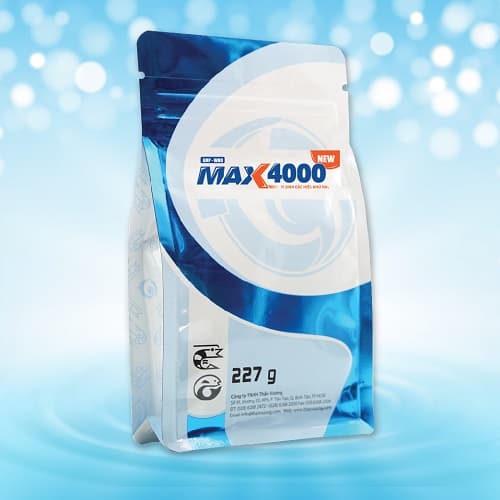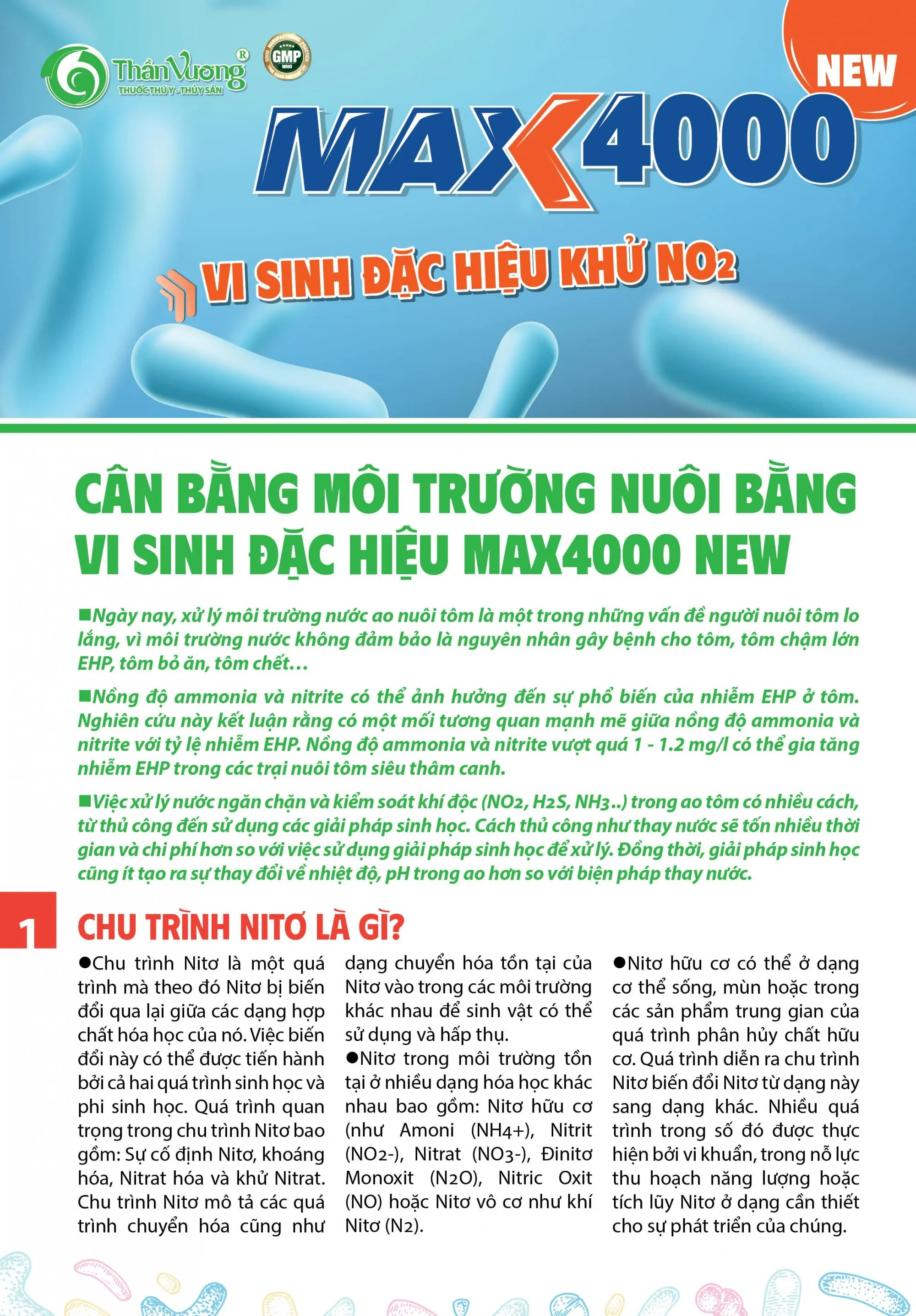
MAX 4000 NEW – a specific probiotic that helps reduce NO2.
- Today, managing the water in shrimp ponds is one of farmers' main worries, because poor water quality leads to disease, slow growth, EHP, feed refusal and mortality in shrimp.
- Ammonia and nitrite concentrations can affect how common EHP infection is in shrimp. One study concluded that there is a strong correlation between ammonia and nitrite concentrations and the rate of EHP infection. Ammonia and nitrite concentrations above 1–1.2 mg/L can increase EHP infection on super-intensive shrimp farms.
- There are many ways to prevent and control toxic gases (NO2, H2S, NH3…) in shrimp ponds, from manual methods to biological solutions. Manual methods such as water exchange take more time and cost more than biological solutions. Biological solutions also cause smaller changes in pond temperature and pH than water exchange.
1. What is the nitrogen cycle?
- The nitrogen cycle is the process by which nitrogen is converted back and forth between its chemical compounds. These conversions can be carried out by both biological and non-biological processes. The key processes in the nitrogen cycle are nitrogen fixation, mineralisation, nitrification and denitrification. The nitrogen cycle describes these conversions as well as the forms in which nitrogen exists in different environments, so that living organisms can use and absorb it.
- Nitrogen in the environment exists in many chemical forms, including organic nitrogen, ammonium (NH4+), nitrite (NO2−), nitrate (NO3−), nitrous oxide (N2O), nitric oxide (NO) and inorganic nitrogen gas (N2).
- Organic nitrogen can be found in living organisms, in humus or in the intermediate products of organic matter breakdown. The nitrogen cycle converts nitrogen from one form to another. Many of these steps are carried out by bacteria, either to gain energy or to store nitrogen in the form they need for growth.
1.1 Denitrification
- The nitrogen cycle ends with denitrification: the reduction of nitrate to nitrogen gas (N2), which completes the cycle.
- This process is carried out by specialised bacteria in anaerobic conditions. They use nitrate instead of oxygen as the electron acceptor in respiration, breaking the N–O bonds and forming stable N–N bonds. This produces N2 gas, which escapes from the water. These facultative anaerobic bacteria can also live in aerobic conditions.
Diagram in the original – how ammonia is converted and nitrogen is released: feed (organic nitrogen) and shrimp waste are converted to ammonium (NH4+) by ammonification, with heterotrophic bacteria and algae involved; depending on pH, NH4+ shifts to toxic NH3; nitrification by autotrophic bacteria turns NH3 into NO2− and then NO3−; in the pond bottom, anaerobic/microaerophilic bacteria reduce NO3− through NO2− (denitrification), and N2 is released from the water.
1.2 Why the nitrogen cycle matters for water quality
- The nitrogen cycle plays an important role in removing nitrogen in wastewater systems. In particular, nitrification and denitrification play a direct role in bringing discharged wastewater within the nitrogen standards.
- Although the N cycle is a natural process, the high artificial inputs in aquaculture (such as feed) mean the system often becomes overloaded.
- Probiotics can be used to speed up these processes and systems; this is called bioremediation. For nitrification and denitrification to happen quickly, specialised microbial strains are needed.
2. The structure of H2S gas
- H2S gas (hydrogen sulfide) is a chemical compound with distinctive, easily recognised features: a very characteristic rotten-egg smell, and it is acidic, so it turns blue litmus paper red. H2S has a structure similar to the water molecule: it combines two H atoms and one S atom, with S as the central atom and the 2 hydrogen atoms each attached by a single bond.
- However, sulfur is not as electronegative as oxygen, so H2S is not as polar as water. As a result, the intermolecular forces in H2S are relatively weak, and its boiling and melting points are much lower than those of water.
- H2S is most commonly formed when microorganisms break down organic matter without oxygen (anaerobic decomposition). Hydrogen sulfide is also found in volcanic gas, crude oil, natural gas and some well water or hot springs. Interestingly, the human body also produces small amounts of H2S, which it uses as a signalling molecule.
2.1 How H2S harms farmed shrimp
- The soft tissues of shrimp – gills, stomach wall, intestine and hepatopancreas – are easily damaged. Too much H2S therefore stops shrimp from using the oxygen in the pond. Even short exposure weakens shrimp, lowers their resistance and raises the risk of disease. Exposure to very high H2S levels can cause mass mortality.
- In clear-water ponds (before stocking), light reaches the bottom, so benthic algae and lab-lab grow on the pond bottom. After a while, the algae bloom and block light from reaching the bottom, and the algae die off. Ponds with sandy or loose soil bottoms and deep water under anaerobic conditions will produce H2S.
- Long-term exposure to H2S inevitably stresses shrimp and reduces their feed intake. In practice, H2S is much harder to detect than ammonia (NH3) or nitrite (NO2); most farmers can only easily measure NH3 and NO2, because the safe threshold of H2S is lower than those of the other two. In fact, H2S is many times more dangerous than NH3 and NO2.
3. Using MAX 4000 NEW as a water-quality product
Applied directly, MAX 4000 NEW can help prevent the build-up of nitrogen waste (nitrite and nitrate), H2S and NH3 in the pond, compared with the comparison product in the trial.
Charts in the original: nitrate (NO3, ppm, scale 0–30) and nitrite (NO2, ppm, scale 0–10) over weeks 1–21.
4. Keeps total beneficial bacteria at 3 times the Vibrio count
- By supplying specific bacterial strains – Pediococcus sp., Paracoccus sp., Enterococcus sp.… – MAX 4000 NEW helps address the problems above and reduce stress in shrimp. Stress also makes diseases worse, such as EHP, black spot, moulting without forming a new shell, and scattered shrimp deaths on the pond bottom…
- The blend of specially selected bacterial strains helps improve water quality and the microbial ecosystem in the pond, helps reduce the risk of Vibrio growth, and releases specific enzymes that help reduce the build-up of organic matter and of nutrients that Vibrio could use.
- Hepatopancreas cells break down and gradually slough off, which seriously impairs hepatopancreas function. During infection, shrimp are also more easily attacked by opportunistic pathogens such as Vibrio bacteria or viruses.
Charts in the original: total bacteria (×102 CFU/mL, scale 0–20) and total Vibrio (×102 CFU/mL, scale 0–5), sampled weekly from 25 August 2020 to 27 October 2020.
5. What MAX 4000 NEW does
- Helps quickly push back and reduce the toxic gases NH3 and H2S.
- Helps control algae and reduce foul odours in the water.
- Helps break down organic matter in the water, so less water exchange is needed.
- Supports strong nitrification, which works against NO2 formation.
Using MAX 4000 NEW not only helps reduce yellow gills and high NO2 levels but also creates favourable conditions for shrimp to grow better, supporting quality and yield over the crop.
Pack size: 227 g.
6. How to use
| When to use | Dose | Note |
|---|---|---|
| Before stocking | 1 pack/1,000–2,000 m³ of water | 2–3 days before stocking |
| During the nursery stage | 1 pack/1,500–2,000 m³ of water | Daily |
| During grow-out | 1 pack/1,000–2,000 m³ of water | Every 3–5 days |
Two ways to apply
- Tablet form: scatter the tablets directly onto the areas that need attention.
- Direct use: mix the product with 30 litres of water and broadcast it directly over the pond.
Note: increase or reduce the dose to suit the actual condition of the pond. The product works best when applied at 10–11 a.m.; to cut back blue-green, green and red algae, apply at 9–10 p.m. Run all aerators while using the product.
7. Stabilising the pond
- Detoxification support: helps quickly reduce toxic gases such as NH3, which indirectly limits the build-up and impact of H2S. When NH3 is under control, the water becomes more stable and less H2S forms.
- Holding back NO2: helps prevent NO2 from forming in the pond for an extra 20 days, helping reduce high NO2 in the late stage of the crop.
- Balancing the microbial community: with its specific bacterial strains, MAX 4000 NEW helps maintain beneficial microbes in the pond, reduce toxic gases and keep the water cleaner.
- Supporting shrimp health: lower toxic gas levels help shrimp avoid yellow gills and other health problems linked to an unbalanced water environment.
8. Benefits of using MAX 4000 NEW
- Helps quickly improve water quality and reduce toxin levels, supporting shrimp health.
- Extends the period of NO2 control, giving farmers more peace of mind in pond management.
- Easy to combine with other water-management measures for an all-round result.
English text adapted from Than Vuong's original Vietnamese infographic.