Introduction
In aquaculture systems, feed cost remains the main obstacle, accounting for approximately 60%, with protein being the most important and expensive nutrient in shrimp diets.
Among several microalgae species, S. platensis has shown greater nutritional potential as a source of protein, vitamins, polyunsaturated fatty acids, in addition to a natural mixture of functional bioactive elements in the diets of various aquatic animals, mainly fish, leading to significant effects on growth, survival rate, immune system, and coloration after feeding.
Based on these data, this study evaluated the efficacy of Spirulina platensis at different dietary concentrations on the performance of whiteleg shrimp L. vannamei.
Research Methods
EXPERIMENTAL DESIGN
The experiments were conducted at the Center for Food Research and Processing (NUPPA) Brazil for 45 days. 30L polyethylene boxes were used in an open system with continuous aeration from an air compressor connected to a hose and distributed to each tank with air stones for oxygen dispersion and artificial lighting, with a 24-hour photoperiod. A randomized design was used, consisting of 5 treatments with 3 replicates. Shrimp with an average weight of 1.42 ± 0.23g, gradually acclimated to a salinity of 2.5%, were distributed into the respective treatments at a density of 10 individuals/treatment.
DIET FORMULATION
Five isoproteic (35% crude protein) and isoenergetic (3,400 kcal DE/kg) diets were formulated using software (CRAC version 4.0) with different inclusion levels of S. platensis (SPLF): F (0%), F (10%), F (20%), F (30%), and F (40%). The ingredients were incorporated into a pelleting process, where dry ingredients were crushed, weighed, and mixed in an industrial mixer along with vitamin supplements (Premix) and oil, adding water at 60°C until the appropriate moisture content was achieved. This mixture was then fed into a manual grinder to form pellets with a diameter of 2 mm, which were subsequently dried in an oven at 80°C for 24 hours and stored in paper bags at room temperature.
FEEDING
The experimental diets were provided 3 times/day, and a commercial diet (CF) was used as a control. Waste siphoning was performed every 2 days to remove uneaten feed and feces.
WATER PHYSICOCHEMICAL ANALYSIS
Dissolved oxygen and temperature were measured weekly using a digital oxygen meter (QUIMISQ758P). pH was measured with a digital QUIMIS pH meter, and salinity was measured twice/week using a BR11 type refractometer from 0 - 3.5‰. Water quality was maintained by daily 10% water exchange.
DIET COMPOSITION
The proximate composition of the diets was determined in triplicate by analyzing moisture, ash, fat, and protein according to the methods described by AOAC (2000).
SHRIMP AMINO ACID COMPOSITION
The amino acid levels of shrimp were determined by the method of White et al. (1986) in samples previously hydrolyzed in redistilled 6N chloric acid, forming pre-column derivatives of free amino acids with phenylisothiocyanate (PITC). The determination of phenylthiocarbamyl amino acid (PTC-aa) derivatives was performed using liquid chromatography (VARIAN, Waters 2690, California, USA).
GROWTH PERFORMANCE
Survival rate (%) = (Final number of shrimp / Initial number of shrimp) × 100
Weight gain (%) = (Final average weight - Initial average weight)
SGR (%/day) = ln final weight - ln initial weight × 100t
Feed conversion ratio = (Feed consumed / Weight gain)
STATISTICAL ANALYSIS
Shrimp growth variables and water quality parameters were analyzed using analysis of variance (ANOVA) to determine the effect of protein replacement levels and the effect of treatments on growth, considering a significance level of 5%.
Results and Discussion
WATER QUALITY
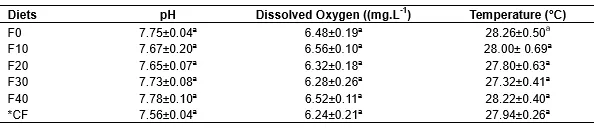
Water quality did not change significantly throughout the experimental period (Table 1) with temperatures ranging from 28 - 30°C, pH from 6 - 9, and DO above 4 mg/L according to Boyd (2002). Boyd also recommended a salinity of 2.5% as ideal for achieving optimal growth rates, while emphasizing that this species adapts to lower salinity levels.