Authors: Dr Dean M. Akiyama and Dany Yukasano
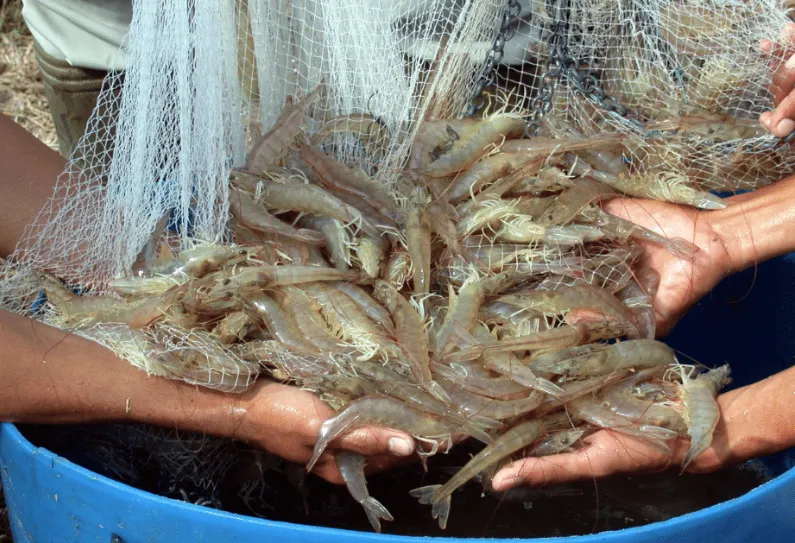
Uniform, clean, good-quality shrimp at harvest, Indonesia
Feed is the highest variable cost in shrimp production, and feed management has a greater impact on the feed conversion ratio (FCR) at harvest than even feed quality.
It is generally understood that successful shrimp production depends on: dedicated farm management (50–60%), post-larvae quality and handling (20–25%) and consistent feed quality (20–25%). In addition, a key to shrimp farming is the motivation and dedication of the farm staff: it is important that all staff carry out and complete their tasks correctly and without delay when required.
Feed management accounts for 65–75% of the variation in the feed conversion ratio (FCR) at harvest. This is because the amount of feed per meal, the number of meals per day, the distribution of feed in the pond and the adjustment of feed amounts affect harvest FCR more than feed quality alone.
A standard growth curve should be developed for each shrimp production site, adjusted when necessary and maintained for proper pond and feed management. The daily growth rate of each pond should be monitored and compared with the standard curve. If the growth rate is within ±10% of the standard, pond conditions and feed management are acceptable. If growth is below the standard, farmers should check whether water quality, the pond bottom and animal health are at acceptable levels. If these factors are good, increase the feeding rate. If the growth curve is above the standard, pond conditions are good but survival may be lower than expected. Consider reducing the feeding rate to keep FCR at an acceptable level.
Figure 1. Every shrimp farm should develop a standard growth curve, adjusted when necessary and maintained regularly, to ensure effective pond and feed management. DOC = days of culture
Variable production costs
Feed is the highest variable cost in shrimp production, accounting for 50–60% of total production costs. This share varies by country or region because of differences in the cost of labour, electricity, post-larvae and supplies. However, proper shrimp feed management keeps total feed costs at an acceptable level, with more stable production costs, making shrimp production more viable.
Proper feed management also improves the stability of water quality and reduces deterioration of the pond bottom. Less feed is wasted, and this directly affects water quality and the cleanliness of the pond bottom.
Recommended shrimp feed sizes
Today's small-diameter feed sizes are driven by market demand rather than technical requirements. Shrimp do not swallow whole pellets when they eat; they first cut and crush the pellet and then eat it. Pellet size is therefore less important. However, smaller pellets mean more pellets per kg, which is an advantage. Water-soluble attractants, vitamins and minerals leach out faster from small feed. Small feed particles are also more easily lost into the pond sediment.
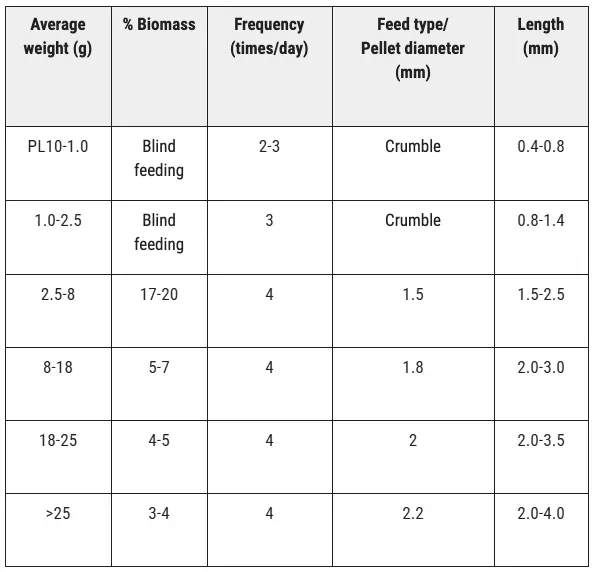
Table 1. General recommendations on feed type and pellet size in shrimp farming by average body weight (ABW)
Feeding times and amounts
For shrimp under 4 g, a minimum amount of feed should be allocated to each feeding according to pond area, and not necessarily according to a biomass-based feeding rate. A "blind feeding" programme is recommended until the shrimp reach an average of about 3.5 g and start to appear on the feeding trays.
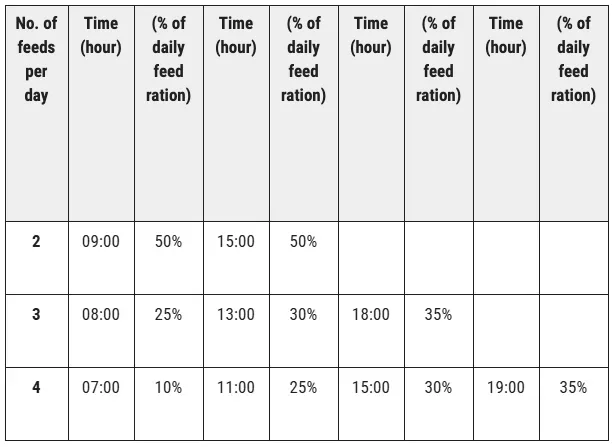
Table 2. Feed allocation by number of meals per day
Monitoring daily feed consumption
Many systems have been developed to monitor daily feed consumption. However, the most common and widely practised system uses feeding trays. Using trays properly depends on dedicated, experienced farm technicians. These technicians must interpret data on tray consumption, shrimp size, estimated biomass/survival, weather conditions and water quality at the time of feeding.
Feeding trays are usually square or round, with 10 cm high sides. This matters because when a tray is lifted slowly, the shrimp stay in it, so their health and size uniformity can be observed. Weights are attached to the trays so that they sink evenly without the feed drifting out.
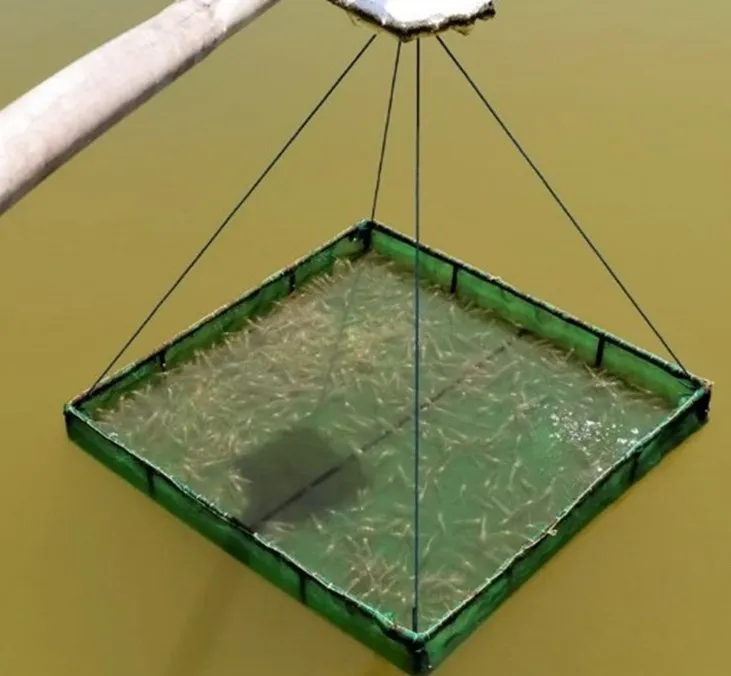
Lifting the tray slowly makes it possible to observe shrimp health and size uniformity, Indonesia
Trays are attached at the ends of catwalks in the pond. Catwalks should extend at least 2 m from the bank. Trays should be placed 30–50 cm from the pond bottom. Catwalks should be built sturdily so that technicians can easily work and observe the shrimp.
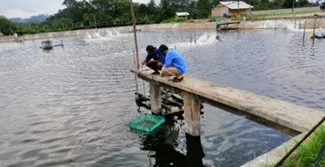
A solid concrete walkway for checking feeding trays, Indonesia
There should be at least 4 trays for a 0.5 ha pond (one on each side). Larger ponds need more trays: 1 ha needs 6–8 trays; 2–3 ha need 8–10 trays. To calculate the daily feed amount accurately, you need an accurate shrimp size (sampled with a cast net) and an accurate pond biomass (survival x stocking density x size, although this is hard to estimate accurately).
Actual survival can range from 80% (due to poor transport and acclimation) to 120% (due to extra post-larvae given as a bonus). Estimating survival from tables is unreliable. Biomass estimates should be based on the average feed consumption over the last 3 days, to even out day-to-day fluctuations. A good technician can estimate biomass to within 10% of the actual figure. This is very important for keeping FCR low, especially when survival is low.
Feed consumption levels on the feeding trays
This is a tool for estimating biomass and survival, combined with sampling shrimp weight with a cast net. Biomass estimates are also important at harvest, to work out the number of transport containers and the amount of ice needed.
The pond technician will need the average consumption over the last 3 days, the initial stocking density, the average body weight (ABW) of the shrimp and the feeding table to make the following calculations:
Biomass (kg) = 3-day average consumption (kg) / % feeding rate for the shrimp size.
Number of shrimp = Biomass (kg) / Average body weight (g).
Survival (%) = (Number of shrimp / Stocking density) x 100.
Example
ABW = 14 g
3-day average feed = 65 kg
Stocking density = 200,000 shrimp
Feeding rate for 14 g shrimp = 2.7%
65 kg / 0.027 = 2,407 kg biomass
2,407 kg / 14 g = 146,214 shrimp
146,214 shrimp / 200,000 shrimp = 73.1%
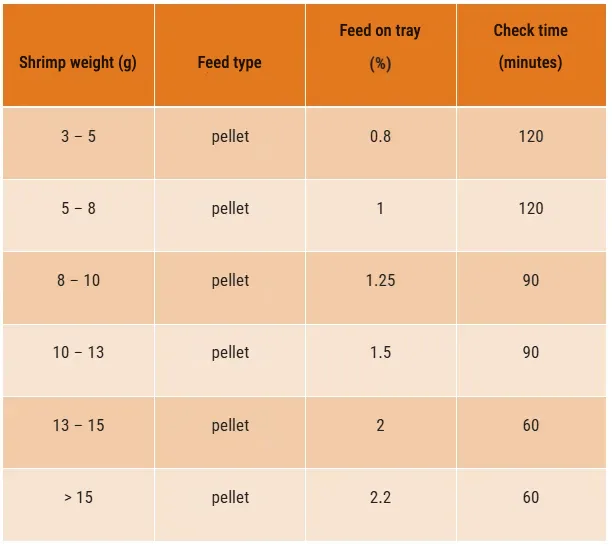
Table 3. Observing and monitoring the feeding trays
Good feed management requires checking actual consumption after each feeding, or at least daily. Feeding rates can usually be adjusted within a range from a 5% increase to a 10% decrease. Pay attention to reducing the feeding rate to maintain good water quality and a low FCR at harvest.
However, if shrimp growth stays below the standard curve while water quality remains good, consider increasing the feed amount.
Table 4. Scoring and feed adjustment based on the feed left on the trays
At least 75% of the trays (i.e. 3 out of 4 trays) must be scored before the feed amount is adjusted.
Table 5. Monthly feed consumption over 90-day and 120-day culture cycles
Most of the feed is consumed in the last 2 months of the crop (Table 5). Proper feeding management is therefore especially important during this period.
In the first 30 days, feed use is still low, so a “blind feed” system should be used (feeding to a set ration, not yet based on tray checks).
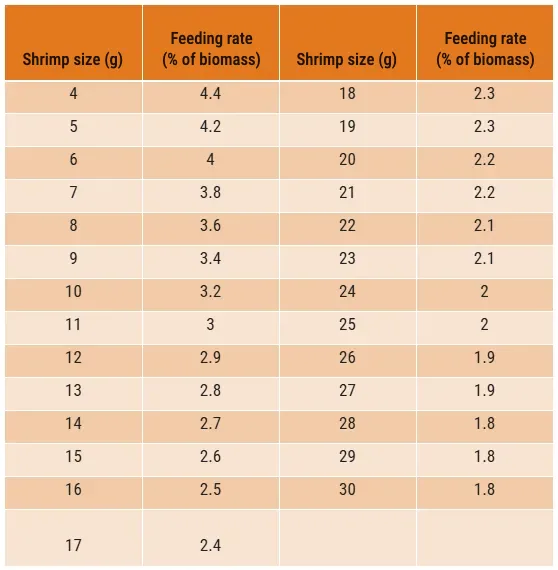
Table 6. Feeding rates
Feed management concepts
Feeding tables are only a guide. Under normal conditions, actual daily consumption will fluctuate by 5–20%. This is mainly due to changing pond conditions, temperature, dissolved oxygen, the pond bottom, shrimp health and other factors. So a detailed feeding table may look good but is of little value if daily consumption is not measured accurately (Table 6).
Splitting the daily feed into many meals with small amounts is better than feeding a few large meals. Shrimp eat more when they are fed more often, which leads to faster growth and a lower FCR. An added benefit is more stable water quality, because nutrient leaching and feed waste are spread more evenly through the day. However, each feeding should be at least 5 kg of feed, regardless of stocking density. So if you feed 2 meals a day, the minimum is 10 kg of feed per day.
To achieve the lowest FCR, it is recommended to feed slightly below satiation. Shrimp can forage for food on the pond bottom, but if too much sludge/organic detritus is observed, farmers should reduce the feeding rate (Table 7).
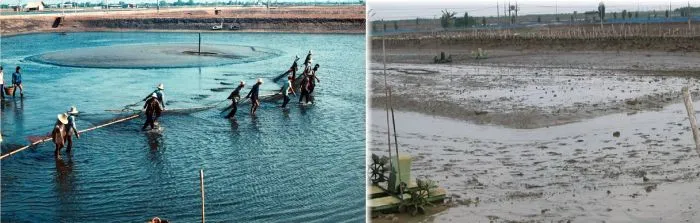
Sludge and waste accumulate in the centre of the pond because of the circular water current, Indonesia
Water quality and pond bottom conditions seriously affect growth rate, survival and FCR. Overfeeding is the main cause of declining pond conditions. If pond conditions are poor, the farm should exchange water and reduce the daily feed until they improve.
Low dissolved oxygen (DO) and low water temperature directly reduce shrimp appetite and feed intake. Shrimp are cold-blooded animals: their appetite and growth are governed by the surrounding water temperature. Every 1°C difference in temperature means an 8–10% difference in growth (at 30°C shrimp grow 15% faster than at 28°C).
In the morning, shrimp usually eat less than in the afternoon. Water temperature fluctuates during the day with weather and local conditions such as wind, rain and cloud cover, which makes it harder to estimate actual feed consumption at each feeding.
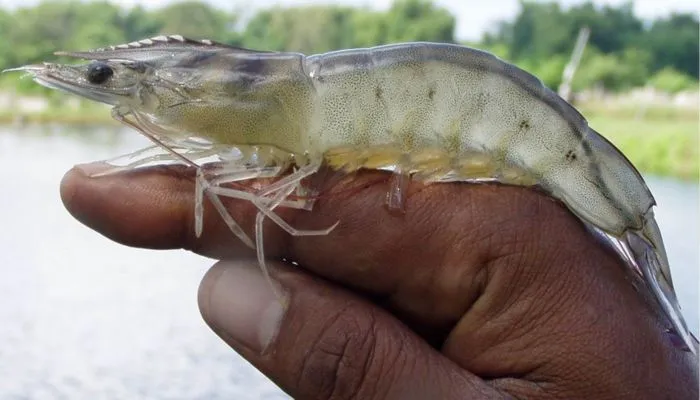
Healthy shrimp with full guts 1 hour after feeding, Indonesia
Shrimp are nocturnal and more active at night. They usually consume 50–60% of their feed at night. However, this behaviour is complicated by the fact that temperature and dissolved oxygen usually drop at night. Oxygen levels keep falling until sunrise and only start to rise about 2 hours later. Shrimp need a stable dissolved oxygen level of at least 6.0 ppm. Below this level, shrimp may not die, but they will not grow at their optimum rate.
Proper aeration is needed not only to maintain dissolved oxygen (DO) but also to mix the cold bottom water with the warmer surface water. In a pond about 1 m deep, without proper mixing, the temperature difference between the surface and bottom layers can reach 2°C. Higher DO and warmer temperatures at the bottom help improve shrimp growth performance.
In outdoor systems, with unpredictable weather and fluctuating water quality, there is no fixed daily nutritional requirement or feed intake for shrimp. Shrimp eat more or less depending on their physiological needs at any given time. If no feed is available, shrimp will look for natural food in the pond environment.
During periods when shrimp are stressed by poor water quality, it is recommended to cut feed by 50% or stop feeding completely for 2–4 days. During this time, the shrimp will forage for natural food, at the same time “cleaning” the pond bottom and reducing excessive algal growth.
When changing pellet size, allow a 2–3 day transition period, mixing the 2 feeds 50:50. This makes the change of feed size smoother and does not reduce feed intake. If the feed size is changed abruptly, feed intake may drop for 2–3 days, as shrimp need time to adapt to the new feed. This is mainly because the level and type of attractants can vary slightly with the feed formula or manufacturing process.
Avoid feeding in the centre of the pond, where bottom sludge and waste accumulate because of the current from the paddlewheel aerators. This area often builds up toxic gases such as H₂S produced by the breakdown of organic matter. A layer of oxidised material usually covers the surface of the bottom sludge; if this layer is disturbed, toxic gases are released into the pond water and put the shrimp at risk.
Table 7. Days of culture (DOC) and estimated survival (%) based on ±70% survival at harvest
Source: aquaasiapac
Translated by: Than Vuong Marketing Department