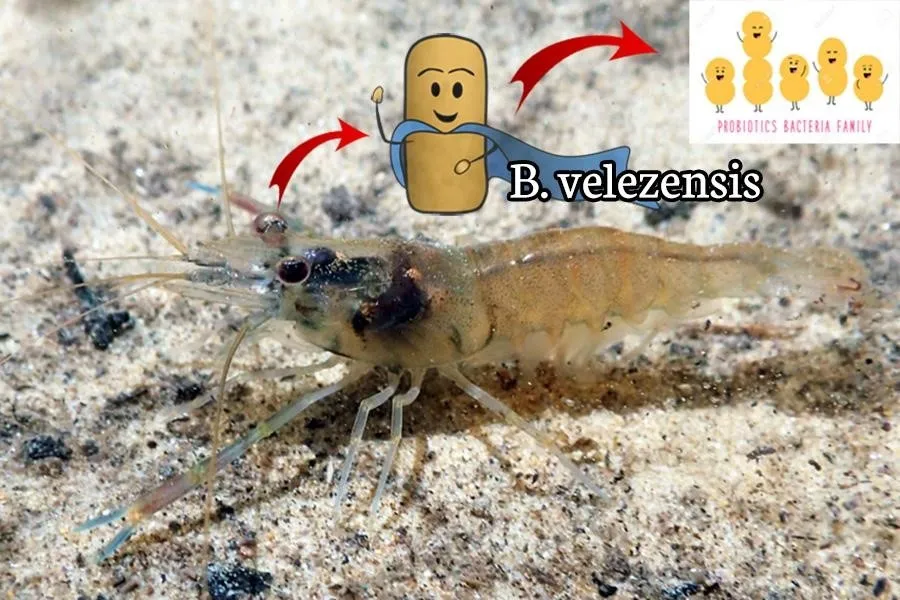
Bacillus velezensis isolated from giant freshwater prawn joins the Bacillus group commonly used in aquaculture
New Bacillus strain improves water quality and stabilizes farmed animal health
Bacteria are the most dangerous and common pathogens in aquaculture production. Diseases caused by these bacteria often severely impact the efficiency and profitability of farming systems. Furthermore, many bacterial species not only affect aquatic animals but also human health, leading to disease outbreaks in many regions. Among them, some species include Vibrio parahaemolyticus, which causes hepatopancreatic disease in black tiger shrimp, whiteleg shrimp, and giant freshwater prawn. Aeromonas hydrophila causes mass mortality in freshwater fish species. And many, many other bacteria whose names alone can make people "shudder" at the consequences they inflict on aquatic animals.
Although many prevention and treatment measures have been applied, such as antibiotics, farmed animals gradually develop drug resistance. Therefore, people are gradually shifting towards disease prevention using safer and more effective methods. Probiotics are one such method; it has been clearly demonstrated that probiotics can regulate the physiological functions of shrimp and fish, improve reproductive capacity, inhibit the growth of harmful bacteria, and contribute to environmental improvement. Additionally, they support digestive system function and immunity. Consequently, the use of probiotics has become a "guiding principle" in aquaculture.
Probiotics are increasingly popular today, with growing applications and new research on beneficial bacterial species. Bacillus velezensis is a new species, discovered in 2005, but has demonstrated its important role in agriculture and animal husbandry. Some trials of this bacterium on aquatic animals have also been very promising, resisting the adverse effects of Vibrio spp, Aeromonas Hydrophila, and Streptococcus spp. Many studies have shown that B. velezensis is a species with great potential for biological control, prevention, and definitive treatment of certain diseases in aquatic animals. A large number of strains of this bacterium have been isolated from giant freshwater prawns, a very common species in Vietnam. This will be a new resource for biological control in aquaculture and lay a theoretical foundation for further research.
Regarding the characteristics of this bacterial strain, culturing was performed, and the results showed that the colonies formed were white. Gram staining showed a purple-blue color, indicating they are Gram-positive bacteria with a rod shape. They grow well at temperatures from 25-37oC, at various salinities, and adapt faster at neutral pH (pH=7).
The inhibitory concentration of the bacteria has also been demonstrated. Specifically, to inhibit the activity of A. hydrophila, 106-108 CFU/ml of B. velezensis is required, and 105-108 CFU/ml for V. parahaemolyticus; higher concentrations better inhibit the growth of harmful bacteria.
Successful disease management is the key to success in farming cycles. And probiotics are the "material" that creates this key; this "material" is also widely used for treating and controlling diseases in aquaculture systems. More importantly, this "material" does not cause drug resistance like antibiotics. The B. velezensis strain isolated from giant freshwater prawns shows better effects than those isolated from other sources, producing more types of antibacterial proteins and inhibiting many harmful bacteria in various aquatic species.
B. velezensis produces an excellent antibacterial spectrum and has great potential for biological control technology applications. They produce various lipopeptides, polyketides, and antibacterial proteins. Furthermore, this strain also combats the activity of some low-virulence viruses, is highly resistant to high temperatures, and possesses strong organic decomposition capabilities in ponds. Further research shows that the bacterium contains 3 antifungal metabolites and 8 antibacterial substances, leaving no doubt about its effectiveness when used.
Overall, not only B. velezensis but almost all bacterial species belonging to the Bacillus group have been proven to proliferate extremely rapidly, possess very strong biological control capabilities, and resist adverse environmental conditions. The important thing when using this B. velezensis strain is to balance the application density for each harmful bacterial species. The results are very promising as no side effects have been found in aquatic animals. Therefore, the B. velezensis strain can be used to produce probiotics and is expected to be developed into many products for disease prevention, supporting the health of farmed animals to combat pathogens.
Source: https://tepbac.com/