Working hours: Mon - Fri | 08:00 - 17:00HOTLINE: 0867 95 7568
Technical Article

Researching how shrimp respond to high-temperature stress

A new study has discovered exactly how shrimp react to heat stress - a breakthrough that could help reduce mortality rates of farmed shrimp during periods of high water temperatures.

Solution TrackShrimpMay 24, 2022👁 242 views
Click to listen to an AI-narrated summary
AI Summary

Generate an English summary for Researching how shrimp respond to high-temperature stress

AI-generated summary based on the full article content below.

Editorial Framing

Why this article matters

    Full Article
    Researching how shrimp respond to high-temperature stress

    A new study has discovered exactly how shrimp respond to heat stress – a breakthrough that could help reduce mortality rates in farmed shrimp during periods of high water temperatures.
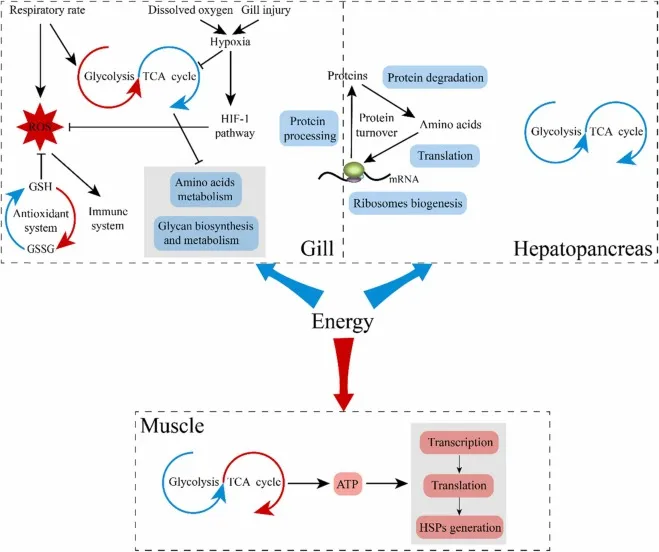


    STRESS_NHIYT_-_TOM_THE


    Diagram illustrating the distinct responses and energy redistribution among three tissues (gills, hepatopancreas, muscle) under heat stress.


    Pacific white shrimp ( Litopenaeus vannamei ), a species with high economic value and superior breeding characteristics, has become one of the world's major aquaculture species.


    However, continuous water temperatures above 35 °C lead to high shrimp mortality rates. As a result, a research team led by Professor LI Fuhua from the Institute of Oceanology, Chinese Academy of Sciences (IOCAS), recently investigated the mechanisms of L. vannamei's response to such high temperatures. They state that their study has provided new insights into the energy redistribution strategy in Pacific white shrimp to cope with heat stress.


    According to the researchers, most previous studies on heat stress were limited to single tissues or a few indicators. However, the spatial network of cooperation among different tissues and its relationship with energy in response to heat stress remained unclear.


    In this study, the researchers conducted comparative and transcriptomic analyses on three tissues of heat-stressed shrimp, including the hepatopancreas, gills, and muscle. They found that energy-related genes were the main altered genes, which infers that energy flow can be redistributed among different tissues when subjected to heat stress.

    This research not only provides a comprehensive understanding of the molecular mechanisms of L. vannamei's response to high temperatures but also lays the foundation for exploiting heat-tolerant genes and proposing effective strategies to cope with high-temperature environments.


    Dr. Zhang Xiaoxi, the first author of the study, stated: “Understanding the cooperation of different animal tissues in response to heat stress is the basis for clarifying the regulatory mechanisms of various species under heat stress.”


    We found that different tissues can cooperate simultaneously through energy redistribution to respond to heat stress. Professor Zhang Xiaojun, co-author, stated: “Less energy is transferred into protein turnover in the gills and hepatopancreas to maintain minimal survival, and more energy is needed for the muscle mass to escape adverse conditions.”


    This work not only provides a comprehensive understanding of the molecular mechanisms of Pacific white shrimp (L. Vannamei) response to high temperatures but also lays the foundation for exploiting heat-tolerant genes and proposing effective strategies to cope with high-temperature environments.

    Source: thefishsite


    For more details on the original article: https://www.sciencedirect.com/science/article/pii/S0147651322004407

    Quick Q&A

    Frequently asked questions on this topic

    What does "Researching how shrimp respond to high-temperature stress" cover?

    A new study has discovered exactly how shrimp react to heat stress - a breakthrough that could help reduce mortality rates of farmed shrimp during periods of high water temperatures.

    Which species does this article apply to?

    Shrimp — Hepatopancreas, Stress, Water & Environment

    Related Products

    Products linked to this topic

    Product reference for CANFORTA
    shrimpThần Vương Blue

    CANFORTA

    High-absorption vitamin form helps shrimp gain weight quickly

    Product reference for HERB GUARD
    shrimpThần Vương Blue

    HERB GUARD

    Enhance liver function, improve color of hepatopancreas

    Product reference for LALPACK IMMUNE
    tom / ca / ocHealth & Biosecurity

    LALPACK IMMUNE

    Immune stimulation for better disease resistance — a synergistic blend of inactivate […]

    More Reading

    Related technical articles

    VAI TRÒ CỦA BỔ SUNG NƯỚC ĐIỆN GIẢI CHO TÔM
    Protocol•Shrimp•November 22, 2018

    THE ROLE OF ELECTROLYTE SUPPLEMENTATION FOR SHRIMP

    A recent report published in the journal Aquaculture International has provided further insight into the role of electrolyte supplem[...]

    Toàn cảnh thị trường tôm thế giới 2025 — Dữ liệu từ Shrimp Insights (Tháng 2/2026)
    Technical article•Shrimp•April 9, 2026

    Global Shrimp Market 2025 Overview — Shrimp Insights Bulletin February 2026

    Full-year 2025 global shrimp trade summary: Ecuador leads exports at 1.39M MT (+15%), EU imports surge 21%, US tariff shifts reshape[...]

    SỰ THAY ĐỔI CỦA HỆ VI SINH ĐƯỜNG RUỘT DO SỰ NÓNG LÊN TOÀN CẦU. ĐIỀU HÒA SỨC KHỎE VẬT CHỦ VÀ TÌNH TRẠNG BỆNH Ở ĐỘNG VẬT BIẾN NHIỆT
    Research Insight•Shrimp•February 28, 2026

    CHANGES IN GUT MICROBIOTA DUE TO GLOBAL WARMING. REGULATING HOST HEALTH AND DISEASE STATUS IN POIKILOTHERMIC ANIMALS

    Global warming alters the gut microbiota of Pacific whiteleg shrimp by restructuring enterotypes, increasing the risk of diseases su[...]

    Ask Than Vuong

    Aquaculture technical assistant

    Hello there 👋

    Describe your pond issue or pick a question below.