Less pressure from harmful bacteria
Limits pathogenic bacteria from invading the digestive tract, lowering the risk of white feces and gut damage.

Stimulates natural immunity, helping shrimp and fish build stronger disease resistance.
High-potency multi-strain yeast, Melofeed® (SOD from melon) and organic selenium working in synergy — activating phagocytosis, blocking free radicals and completing the antioxidant chain.
Not an antibiotic, and it does not kill bacteria. LALPACK IMMUNE keeps the gut clean, the hepatopancreas healthy and the immune system ready before pathogens strike.
Limits pathogenic bacteria from invading the digestive tract, lowering the risk of white feces and gut damage.
SOD from Melofeed® captures free radicals; organic selenium clears what remains through GPx in the hepatopancreas.
Raises resistance when conditions change — pond transfers, salinity shifts, heavy rain, water exchange.
Each ingredient handles a different step, but none of them works alone — they act in synergy, each one helping the others do their job.
Activates phagocytosis
Cell walls from several selected yeast strains, carrying β-glucan and mannan-oligosaccharide. The innate immune system recognizes β-glucan as a pathogen signal; MOS binds bacteria that attach via mannose and pulls them away from the gut wall.
Natural SOD enzyme from melon
Dried melon concentrate, naturally rich in the SOD enzyme. A protective coating lets the enzyme reach the small intestine before it breaks down — something rare on the market.
Building block of the GPx enzyme
Declared minimum 60 mg/kg. The organic form is absorbed better than inorganic selenium and is built into the GPx enzyme — the second link in the antioxidant chain.
Technology from the Lallemand group (France), packed at Thần Vương's GMP-WHO certified plant — so the price is more reasonable than fully imported finished packs.
Each one still works on its own, but much less. The strength lies in how the three back each other up — every pair creates an effect that neither has alone.
High-potency multi-strain yeast
Recognition receptors in shrimp and fish “read” β-glucan as a pathogen signal. Blood cells switch to alert, ready for phagocytosis. MOS binds bacteria that attach via mannose and carries them out with the feces.
Melofeed® · SOD enzyme
SOD is a primary antioxidant — it neutralizes superoxide radicals as soon as they form, before they can damage cell membranes. Vitamins C and E, by contrast, only clean up the aftermath.
Organic selenium ≥ 60 mg/kg
SOD turns superoxide into hydrogen peroxide — which is still toxic. Selenium is built into GPx, which turns it into water. Without selenium, the chain breaks at the last link.
Phagocytes kill pathogens by releasing a burst of free radicals. Stimulate immunity without SOD and that same defense damages the shrimp’s own tissue. Melofeed clears the radicals on the spot, so the immune response stays strong without the shrimp paying the price.
SOD turns superoxide into hydrogen peroxide — still toxic. GPx (which needs selenium) takes it the rest of the way to water. The two enzymes work hand in hand; without one of them, the chain stops at a form that is still harmful.
Immune cells need selenium to function. At the same time, GPx protects the hepatopancreas — a frequent target of pathogens — from being worn down while the shrimp is under strain.
The shrimp can kill pathogens, avoid harming itself with that same response, and keep its hepatopancreas intact. That is what you cannot get by simply adding up each active on its own.
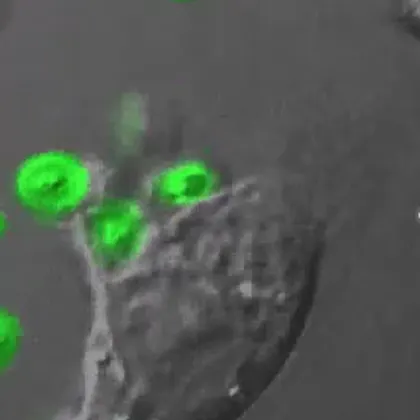
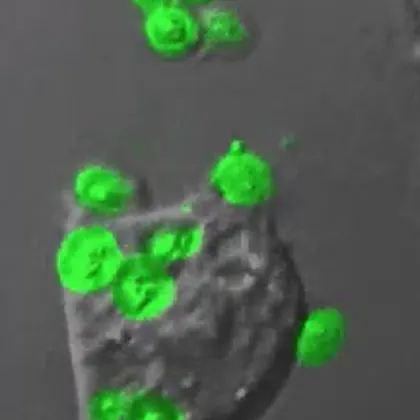
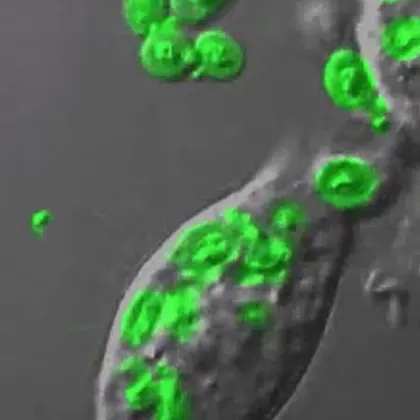
Microscope images of phagocytosis — a blood cell (hemocyte) engulfing fluorescently labeled pathogens. Source: Lallemand Animal Nutrition technical documentation.
Below are published studies on the same groups of actives found in this product — β-glucan, yeast MOS, SOD and organic selenium — in whiteleg shrimp and, for SOD, Nile tilapia.
2.02 g shrimp were fed for 60 days at 5 inclusion levels (0–0.8%). The 0.4% group had the highest survival after the challenge — 100% up to hour 36 — along with higher phagocytic activity, more blood cells and an intact hepatopancreas structure.
Fed for 30 days at two levels, 0.1% and 0.4%. Both raised phenoloxidase activity; the 0.4% group had significantly higher survival on day 7 — while the control group was down to 16.7%. Eight related immune genes were upregulated.
Assessed the effect of an SOD-rich melon product — the same ingredient group as Melofeed® — on the growth and antioxidant status of tilapia under heat stress and low dissolved oxygen, two conditions common in the hot season.
Supplementing L-selenomethionine at 0.84 mg/kg — twice the usual recommended level — improved survival and weight gain of shrimp under low-salinity stress, and raised the antioxidant capacity of the hepatopancreas.
Vibrio, EHP and parasites are almost always present in the pond. As long as the microbiota and the shrimp’s resistance stay deep in the stable zone, they can’t do much. Disease breaks out when the pond slides into the unstable zone.
The pond is in the unstable zone
Heavy rain, algae crash, oxygen drop, pond transfer — the pond is pushed off solid ground.
The microbiota loses its balance and resistance drops with it. One small push is enough to tip it over — and there is no telling which way it will fall. This is when the pathogens that are always in the pond make their move.
Outcome: slow growth, more bacterial infections, falling survival — and fixing the problem costs many times more than preventing it.
Adapted from a Lallemand Animal Nutrition technical diagram on microbiota stability in shrimp.
Situations where the shrimp’s gut microbiota and immunity are under the heaviest pressure, according to Lallemand technical documentation. Preventing problems always costs less than fixing them.
When one of the situations above comes up: how to feed it, when to start and how long to keep going.
Watch on YouTubeSource: Lallemand Animal Nutrition technical seminar material — “Can we reduce the risk linked to an unstable microbiota?”. These are situations where supplementation is recommended, not a promise that it will resolve disease.
| Parameter | Value |
|---|---|
| Protein | max. 15% |
| Moisture | max. 8% |
| Total ash | max. 65% |
| Selenium Organic | min. 60 mg/kg |
Added by top-coating. The 5 g/kg (0.5%) rate sits right in the dose range where the studies above showed the best results.
Selenium is calculated from the declared minimum of 60 mg/kg product. Figures are for reference when sizing orders and balancing formulas — they do not replace guidance from a technical specialist.
No. It is a functional ingredient added to feed. It works by stimulating natural immunity and supporting antioxidant defenses. The product does not kill bacteria directly and leaves no antibiotic residues.
Yes, and each one still works — but you lose the synergy. Stimulating immunity without SOD means the free radicals released during phagocytosis end up damaging tissue; SOD without selenium leaves the antioxidant chain stuck at a form that is still toxic.
Melofeed is a dried melon concentrate naturally rich in SOD. The difference is the order in which they act: SOD is a primary antioxidant that neutralizes superoxide radicals the moment they form. Vitamins C and E are secondary antioxidants that clean up what remains. The two groups complement each other; one does not replace the other.
The technology and raw materials come from the Lallemand group (France); packing is done at Thần Vương’s GMP-WHO certified plant. This keeps the price more reasonable than fully imported finished packs, while the quality of the raw materials stays the same.
Yes. It is a coating powder and can go into the same feeding as other feed-mixed products. If you are using several products, call our technical team to streamline the feeding schedule and avoid unnecessary overlapping doses.
Because it is a preventive product — the benefit comes from preparing in advance — starting early and keeping it going works better than waiting until shrimp or fish already show signs of disease. Prioritize high-risk points: after stocking, stage transitions, seasonal changes, prolonged rain and fluctuating salinity.
The immune response builds up over time; it is not instant. In studies on this group of actives, immune indicators and survival were assessed after 30–60 days of continuous feeding.
Yes. The declared target species are shrimp, fish and babylon snails, all at 5 g/kg feed applied by coating.
Call our hotline +84 867 957 568 directly for volume-based pricing, together with the technical dossier and quality certificates needed for formula registration.
The Thần Vương technical team helps you choose the dose, plan the feeding schedule and combine products to suit your culture stage and pond conditions.