The experiment was conducted to evaluate the effect of oxytetracycline on immune parameters and the susceptibility of whiteleg shrimp to Acute Hepatopancreatic Necrosis Disease (AHPND). Histopathological analysis of the hepatopancreas of infected shrimp revealed typical pathological signs of AHPND. Total hemocyte count, phenoloxidase (PO) activity, superoxide dismutase (SOD) activity, and reactive oxygen species (RBs) release decreased in NT2, NT3, NT4 after 36h of infection.
Acute Hepatopancreatic Necrosis Disease (AHPND), caused by the bacterium Vibrio paraheamolyticus, has caused significant damage to shrimp farmers. The disease spreads rapidly, and infected shrimp have a high mortality rate. Prevention and treatment measures for AHPND primarily involve antibiotics, with oxytetracycline being the most common. This study aims to clarify the effect of oxytetracycline on the innate immune response of whiteleg shrimp infected with Vibrio paraheamolyticus.
Experimental shrimp size: 2.8 ± 0.48 g/individual. Shrimp were challenged by immersion in a bacterial solution (density 108 CFU/ml) for 15 minutes. Afterwards, shrimp and the bacterial solution were transferred to experimental tanks. After 2 days of infection, the tank bottom was siphoned, and 50% of the tank water was replaced. Subsequently, the tank bottom was siphoned every 2 days, replacing 30% of the tank water each time until the end of the experiment.
Experimental Design and Monitoring
The experiment was designed with 4 treatments (NT), each replicated 3 times, and monitored for 14 days post-infection:
- NT1: Uninfected control
- NT2: V.parahaemolyticus infected control
- NT3: Uninfected, fed feed mixed with oxytetracycline 2g/kg feed
- NT4: V.paraheamolyticus infected, fed feed mixed with oxytetracycline 2g/kg feed 1 day post-infection.
Pathological Signs

In NT1 and NT3, shrimp uninfected with V.paraheamolyticus had bright coloration, normal hepatopancreas, full guts, and were sensitive to noise (Figures A/a; C/c)
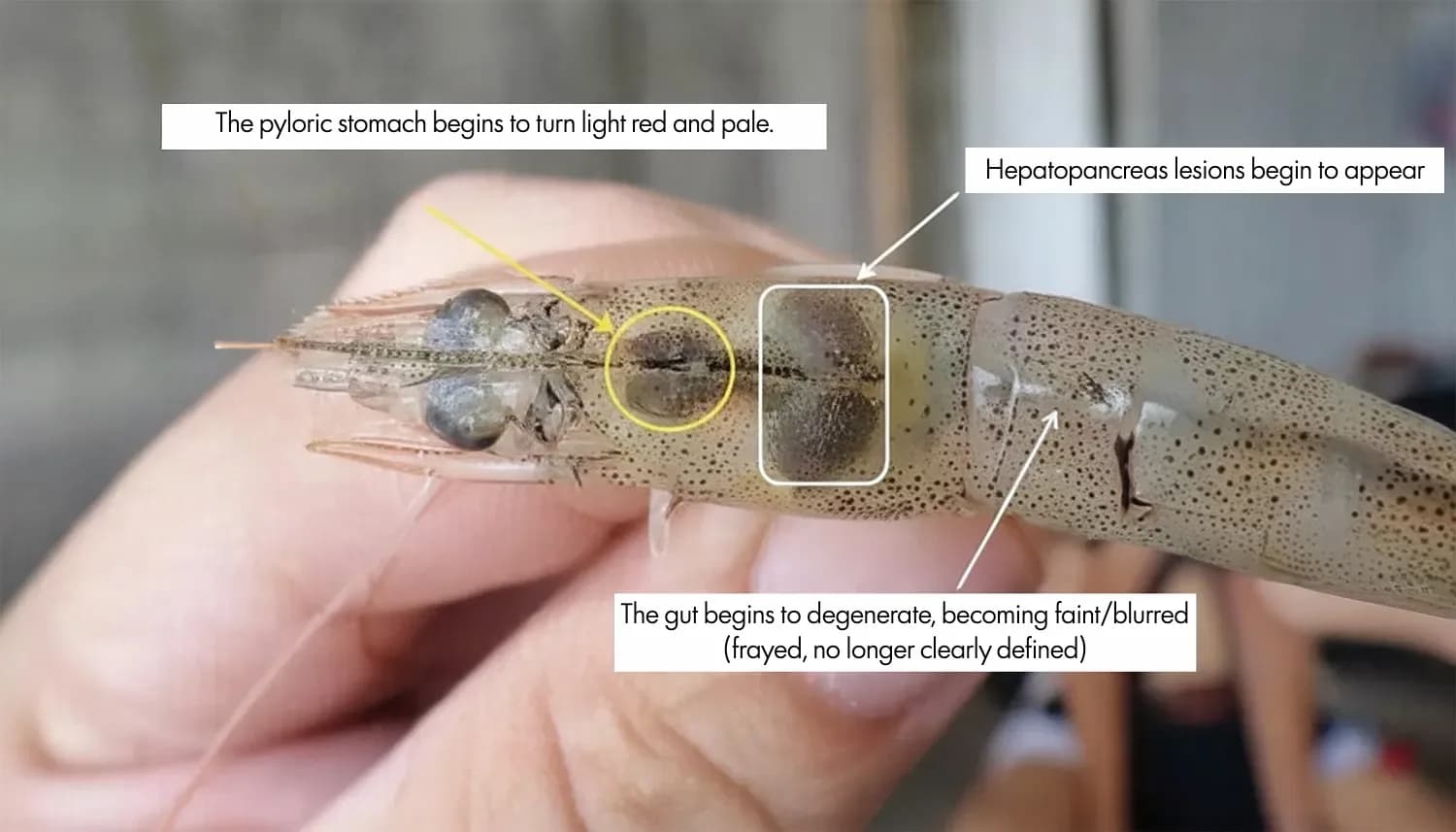
In NT2 and NT4, shrimp infected with V.paraheamolyticus showed disease signs after 24h, including lethargic swimming, reduced activity, empty or discontinuous gut contents, and pale and atrophied hepatopancreas (Figures B/b; D/d)
Histopathology

NT1, NT3 (uninfected): Hepatopancreas with normal tubules
- NT2, NT4 (infected): Shrimp hepatopancreas showed histopathological changes, including atrophied hepatopancreatic tubules, reduced numbers of B, R, F cells; degenerated and detached hepatopancreatic tubule cells falling into the lumen, and hemocytes appearing around bacterial clusters in the necrotic areas.
Cumulative Shrimp Mortality Rate

Cumulative shrimp mortality rate in treatments after 14 days of experiment
Experimental results showed that the highest shrimp mortality rate was in NT2 and the lowest in NT1.
Immune Parameters
Total Hemocyte Count
In the uninfected control treatment (NT1), THC remained unchanged between sampling times before and after infection. After 3 days of infection, THC in NT2, NT3, and NT4 all decreased compared to NT1 and remained constant until the end of the experiment for NT3 and NT4. In NT2 specifically, THC tended to recover and increase again on the sixth day post-infection. THC decreased in treatments infected with bacteria and those using antibiotics.
Phenoloxidase Activity
PO activity gradually decreased when shrimp were fed oxytetracycline-mixed feed and only increased again when antibiotic use was stopped. In this study, shrimp were fed oxytetracycline for 5 days (TN3, TN4), and PO activity decreased during antibiotic feeding and increased when oxytetracycline feeding was discontinued.
Respiratory burst
An increase in RBs activity indicates that reactive oxygen species are released by shrimp hemocytes to kill bacteria. However, in this study, RBs activity decreased after infection, indicating a reduced ability of shrimp to release reactive oxygen species, thereby affecting resistance against infecting bacteria.
Superoxide Dismutase Activity
SOD activity is one of the main protective mechanisms, helping the body combat oxidative stress caused by pollution, infectious diseases, hypoxia, etc. SOD activity in shrimp decreased in the experiment.
Analysis of immune parameters showed that feeding shrimp Oxytetracycline (at a dose of 2g/kg feed) continuously for 5 days (in the case of uninfected shrimp) would suppress immune parameters such as THC (hemocytes), PO, RBs, and SOD, negatively affecting shrimp health.
Conclusion
Immune parameters THC, PO, RBs, and SOD decreased when whiteleg shrimp were fed oxytetracycline-supplemented feed, both when infected and uninfected with V.parahaemolyticus causing acute hepatopancreatic necrosis. The results indicate that using oxytetracycline for disease prevention or treatment both suppresses immunity and can cause shrimp mortality.
Source: Can Tho University Journal of Science