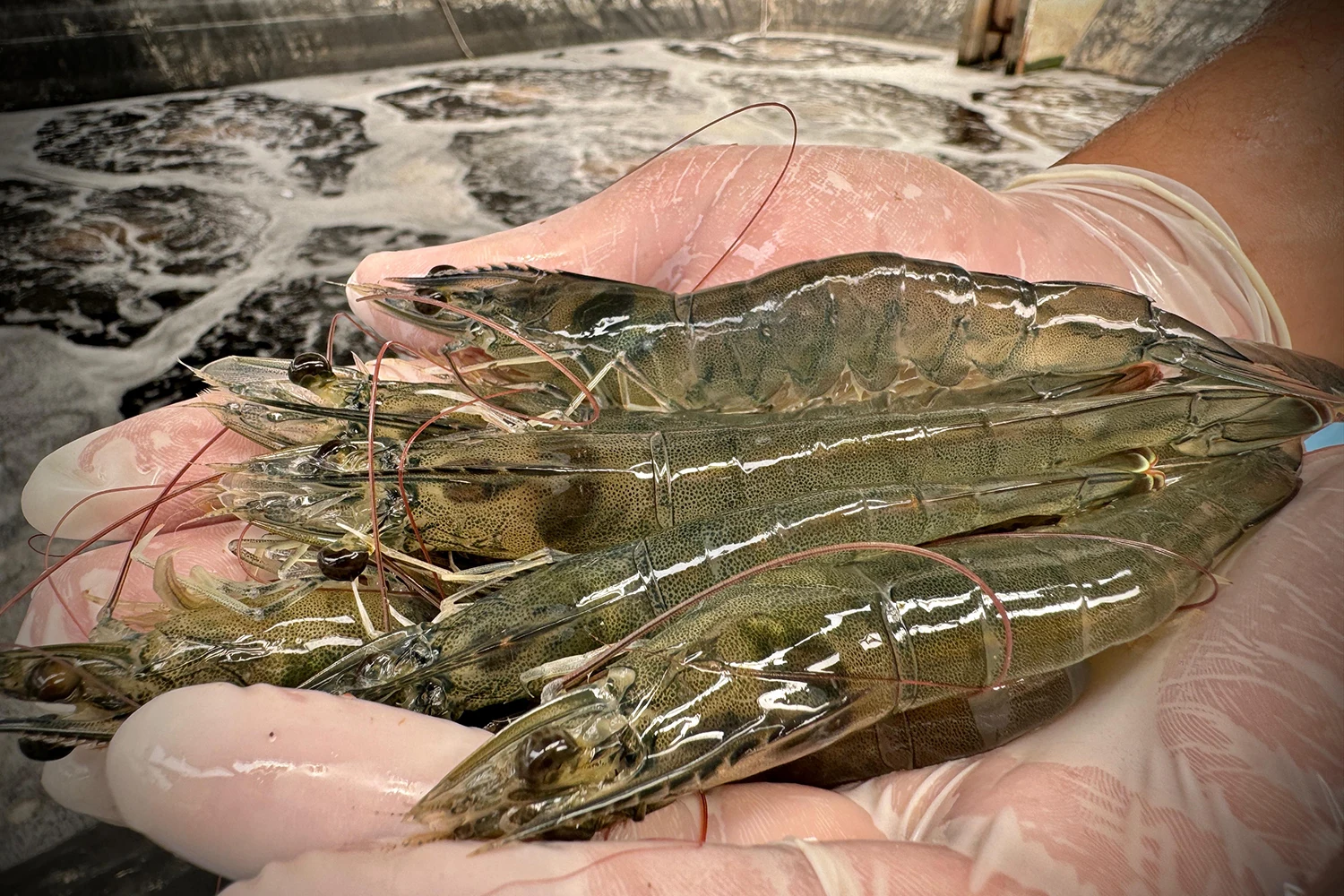
Opening photo: Pacific white shrimp. Photo: Salma Achiri; source: GSA / Responsible Seafood Advocate. View original article
Technical review and application guide • Updated 27 September 2026
From the click of a shrimp’s mandibles to feeding data
Passive acoustic monitoring (PAM) makes use of the clicks shrimp produce with their mandibles while feeding. A review by Peixoto and Soares shows that the signal is influenced by shrimp size, feed texture and pellet size. PAM is therefore useful for behavioural research and ration management, but sound has to be read within its specific biological context. [2]
Another review notes that acoustic-feedback feeding systems are already used in commercial production. Feed properties affect the sound patterns, and data from ponds and experiments are still needed to improve the algorithms. [3]
What is new in the September 2026 GSA article
Peixoto and colleagues at UFRPE, Brazil, present an AI model that recognises the feeding sounds of Pacific white shrimp, tested with recordings from the laboratory and from ponds. Video adds information on behaviour. [1]
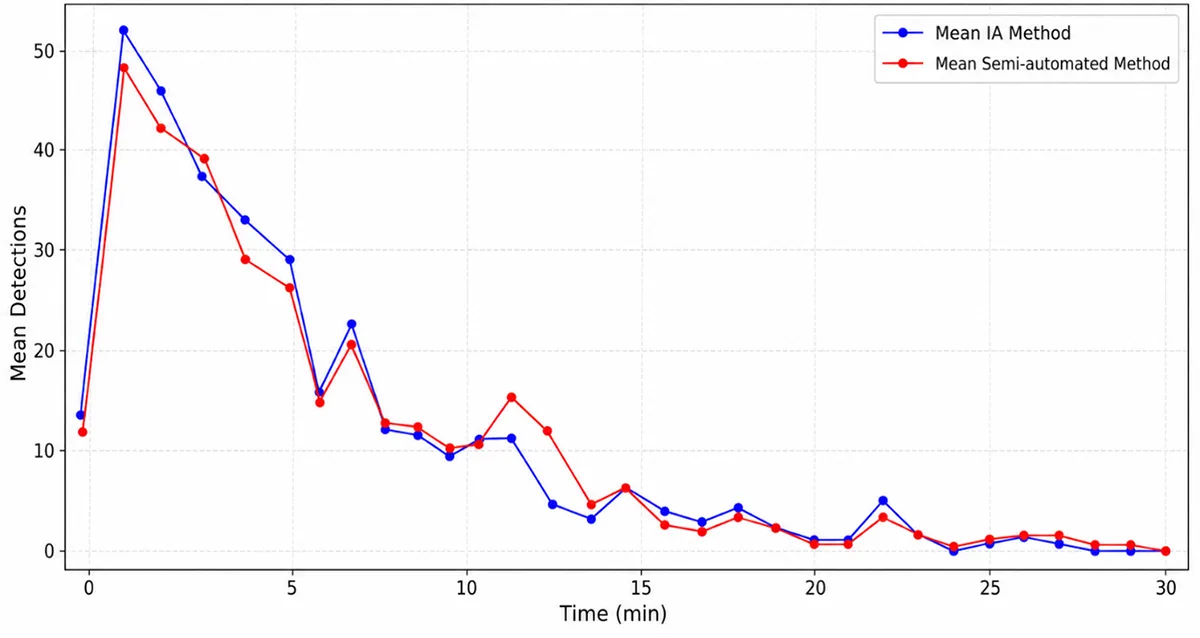
DATA BOX • Attractant trial [1]
Temperature: 24 °C. Inclusion levels: 1, 3 and 5 g/kg of feed. Observation time: 30 minutes.
The 1 g/kg level produced the highest initial acoustic response and sustained feeding activity better than the higher levels in the trial.
These are results for one specific attractant under specific research conditions; they are not a general recommended dose.
The GSA article does not report a percentage accuracy for the AI, nor an FCR reduction or feed-saving rate that can be applied in general. [1]
What to understand before reading an acoustic chart
Feed type can change the signal
The study The noisy eaters found that Pacific white shrimp produce sounds when eating many kinds of food. Soft items such as Artemia and mollusc meat produce weaker, shorter sounds; click energy and duration change with food texture. The authors also tested classifying the sounds with machine learning. [4]
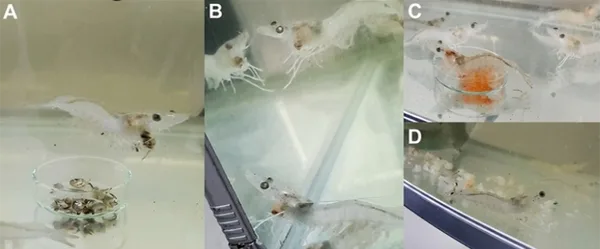
What it means for ponds: when changing the feed type or pellet size, record the time of the change and re-check the device’s response. A jump on the chart should not be read straight away as a matching change in the amount of feed consumed. This is an operational suggestion, not a conversion formula from the research.
Read temperature and oxygen together with the feeding signal
The GSA article of 27 April 2026 reports an experiment at 22.1–31.3 °C with 30-minute feeding sessions. Feeding activity and intake were higher at 27.5–31.3 °C than in the colder conditions of 22.1 and 24.1 °C. A dissolved-oxygen trial at 5, 3, 2 and 1 mg/L recorded a clear drop in feeding activity at 2 and 1 mg/L. [5]
These levels describe experiments; they do not set safe operating thresholds for every pond. When feeding sounds drop, operators should check oxygen, temperature and the equipment before changing the ration. Do not try to raise feeding sounds by adding more feed or an attractant while the cause is still unclear.
Eating more vigorously does not prove a feed is better
A study on Pacific white shrimp in a clear-water recirculating system found that acoustic activity rose with dietary protein level, while increasing the ration of a low-protein feed to balance protein intake could raise the FCR. [6]
So a trial of a new feed must track both growth and cumulative feed use. A feed that triggers a fast feeding response still has to be judged on conversion efficiency and cost. Acoustic indicators help raise questions and track responses; feed-purchasing decisions should rest on whole-cycle results.
Pond results depend on operating capacity
A trial published by GSA in 2020 used 16 ponds of 0.1 ha each, stocked at 35 shrimp/m², with four replicates per treatment. The acoustic system was combined with oxygen sensors and a feed cap of 16 kg/day/pond. The study recorded better growth, and also showed that limited night-time aeration constrained feed delivery. [7]
These design parameters are not installation standards for intensive ponds in Vietnam. Before scaling up, test the system with the farm’s actual pond area, stocking density, aerator capacity and feed distribution.
A proposed process for bringing the technology into the pond
The steps below are this review’s practical suggestions, to be adapted with technical staff and the supplier to each farm’s conditions; they are not a process validated by the GSA article.
Step 1: Define the problem to solve
Pick a specific goal: less leftover feed after each meal, earlier detection of abnormal meals, or feed delivery that tracks demand more closely. Record the current feeding practice, the actual weighed feed, growth and labour time as a baseline for comparison.
Step 2: Survey sensor placement
Ask the supplier to survey the feeding zone and sources of noise. Make test recordings while aerators, pumps and feeders run in their usual modes. Keep the sensor position and depth fixed during the comparison period, and log every time it is moved or cleaned.
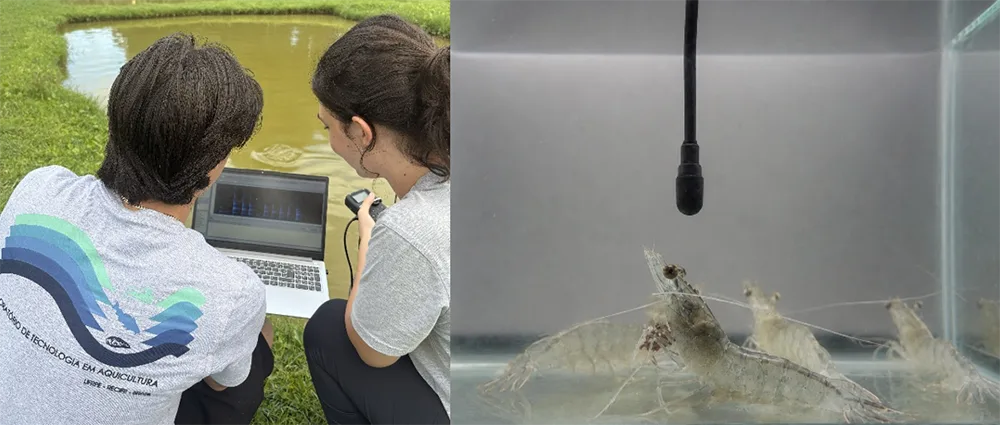
Step 3: Observe before handing over control
In the early phase, compare the acoustic chart with feeding trays, shrimp checks and the environmental log. Flag the meals where the device and actual observations disagree. Ask the supplier to explain whether the system shows click counts, an activity level or an estimated intake; these quantities are not the same thing.
Step 4: Set limits and a fallback plan
Agree on the maximum feed per meal and per day, the conditions for pausing, and who is authorised to make adjustments. When the signal is lost or the data are invalid, the system must raise a clear alert and switch to the approved fallback plan. Never use missing or faulty signals as grounds for automatically increasing feed.
Step 5: Compare before scaling up
Prefer comparisons between ponds with similar conditions, and state clearly any differences in seed, density, feed, environment and partial harvests. If the only comparison is with the previous crop, present it as a reference comparison, because weather and seed quality may differ. Scale up once the data are reliable enough and operators understand how to handle exceptions.
When the acoustic signal drops suddenly
Suggested check sequence:
- Confirm the sensor is still working.
- Check that feed is actually being delivered.
- Cross-check oxygen and temperature.
- Observe the feeding trays and the shrimp.
- Only then decide on any adjustment.
Record the cause and the action taken so that later alerts can be assessed.
If only one sensor reports a drop while the other points are normal, check the pickup range and the equipment at that point. If several indicators worsen together, deal with the pond problem according to the farm’s technical procedures, not just by changing the feeder settings.
Judge effectiveness by production results
Prepare a report for each pond, including the actual weighed feed, biomass, weight gain, estimated survival, FCR and cost per kg of shrimp. Add data downtime, the number of false alarms and maintenance labour. A system that runs well technically still has to prove its economic value on the farm.
Agree on the calculation before comparing
FCR for a period = total feed used / biomass gained over the same period. Agree on how to handle the starting biomass, partial harvests and the shrimp remaining. Do not compare FCR between two ponds if inputs or output were recorded differently.
ILLUSTRATION BOX • Not a GSA trial result
Suppose two options each produce an extra 10,000 kg of biomass, with FCRs of 1.50 and 1.40.
Difference in feed = (1.50 − 1.40) × 10,000 = 1,000 kg.
This only illustrates the calculation. Net benefit must deduct the cost of equipment, services, electricity, maintenance and other expenses.
Questions to ask the supplier
- Has the system been tested at shrimp sizes, feed types and noise levels similar to the farm’s ponds?
- Can the acoustic data, feeding schedule and alerts be exported for independent cross-checking?
- Does changing the pellet size or moving a sensor require recalibration, and who is responsible for it?
- How will the feeder operate during a power cut, a network outage or a sensor fault?
- What does the total cost per crop include, and what on-site support does the supplier provide?
A practical path for farmers
A practical approach is to start with a trial that has a clear log and agreed evaluation criteria. An acoustic signal is only valuable when it supports decisions that can be checked afterwards: which meal was adjusted, why, and with what result.
Farmers should choose systems that let them understand the data and intervene when needed. The operating goal is to supply feed that matches pond conditions and appetite, while keeping control of the cost of producing each kg of market shrimp.
References
The markers [1]–[7] in the text correspond to the sources below. Accessed 27 September 2026. For [2], [3], [4] and [6], the cross-check is based on the publisher’s public abstract or highlights.
- [1] Peixoto, S. et al. 25 September 2026. Shrimp bioacoustics: New insights into feeding behavior and precision aquaculture. Responsible Seafood Advocate, GSA. Read source
- [2] Peixoto, S. & Soares, R. (2025). Recent Advances and Applications of Passive Acoustic Monitoring in Assessing Shrimp Feeding Behaviour… Reviews in Aquaculture, 17, e12978. Published online 5 October 2024. Read source
- [3] Reis, J. et al. (2022). Passive acoustic monitoring as a tool to assess feed response and growth of shrimp in ponds and research systems. Aquaculture, 546, 737326. Read source
- [4] The noisy eaters: Acoustic characterization of clicks emitted by Penaeus vannamei fed fresh food items and pelletized diet. (2026). Aquacultural Engineering, 113, 102675. Read source
- [5] Costa Filho, F. et al. 27 April 2026. Listening to the pond bottom: How bioacoustics can transform shrimp feeding management. Responsible Seafood Advocate, GSA. Read source
- [6] Effect of protein intake on growth, protein retention, feed consumption and acoustic feeding behavior… (2026). Aquaculture, 614, 743547. Read source
- [7] Reis, J. et al. 27 April 2020. Acoustic feedback improves automated feeding systems for shrimp. Responsible Seafood Advocate, GSA. Read source