Working hours: Mon - Fri | 08:00 - 17:00HOTLINE: 0867 95 7568
Technical Article

HIGHLY VIRULENT VIBRIO ANTAGONISTIC PROBIOTIC

Max 4000 New has significantly demonstrated the ability to inhibit Vibrio TPD (Vibrio parahaemolyticus, a pathogenic strain causing white turbidity and hepatopancreatic disease in Pacific white shrimp) when used at standard concentrations.

Technical NoteShrimpNovember 26, 2025👁 326 views
Click to listen to an AI-narrated summary
AI Summary

Generate an English summary for HIGHLY VIRULENT VIBRIO ANTAGONISTIC PROBIOTIC

AI-generated summary based on the full article content below.

Editorial Framing

Why this article matters

    Full Article
    HIGHLY VIRULENT VIBRIO ANTAGONISTIC PROBIOTIC

    A probiotic that helps inhibit highly virulent Vibrio

    (Research and Development Department – Than Vuong Co., Ltd.)

    1. Samples for antibacterial testing

    The test concentrations for MAX 4000 New were 10%, 20%, 30% and 50%.

    Method

    • Vibrio spp. strains were activated in MHB medium supplemented with 1.5% NaCl and incubated at 30°C; after 24 h they were subcultured onto TCBS agar to check purity.
    • Once a pure strain was obtained, a single colony was selected and inoculated into 10 ml of MHB. 3 ml of the bacterial suspension was drawn off and its OD600nm was measured to determine absorbance.
    • The required volume of bacterial suspension was calculated and diluted to OD600nm = 0.1 (equivalent to 3.0 × 10⁸ CFU/ml)*.
    • MHA medium was poured and left to set naturally. A sterile cotton swab was dipped in the diluted bacterial suspension at the appropriate concentration and spread evenly over the MHA surface. A 1 mL pipette tip was used to punch wells for the test samples.
    • Samples at the appropriate test concentrations were prepared in falcon tubes containing diluent (MRD medium with an extra 10% Sinopol) and dissolved. 100 µL of sample was pipetted into each well.
    • After filling the wells, the test plates were incubated at 30°C. Results were read and recorded after 24 h.
    Required test concentration (%)Product weighed in (g)Diluent added (mL)
    1019
    2028
    3037
    5055

    (Each concentration was run on 2 plates, each with 3 wells.)

    2. Antibacterial results

    MAX 4000 New. Each cell gives the clear-zone sizes of the 3 wells on plate 1 and, on the next line, plate 2.

    Test concentration (%)Corresponding microbial densityClear zone at 20 h (cm)Clear zone at 24 h (cm)Average inhibition zone (cm)Result
    101.39 × 10⁸ CFU/g0 - 0 - 0
    0 - 0 - 0
    0 - 0 - 0
    0 - 0 - 0
    –No inhibition
    202.78 × 10⁸ CFU/g0 - 0 - 0
    0 - 0 - 0
    0 - 0 - 0
    0 - 0 - 0
    –No inhibition
    304.17 × 10⁸ CFU/g2.0 - 2.0 - 2.1
    2.0 - 2.0 - 1.8
    1.7 - 1.3 - 1.4
    1.3 - 1.4 - 1.4
    1.70Inhibition
    506.95 × 10⁸ CFU/g2.4 - 2.4 - 2.0
    2.4 - 2.2 - 2.8
    2.4 - 2.4 - 2.0
    2.4 - 2.2 - 2.8
    2.37Inhibition

    Conclusion: MAX 4000 New showed no antibacterial activity against Vibrio spp. at the 2 lower test concentrations (10–20%), and formed clear zones at the 30–50% test concentrations, with an average zone size of 1.7–2.37 cm.

    Plate photos

    • Figure 01: control plate (no product added), Vibrio (+) on MHA.
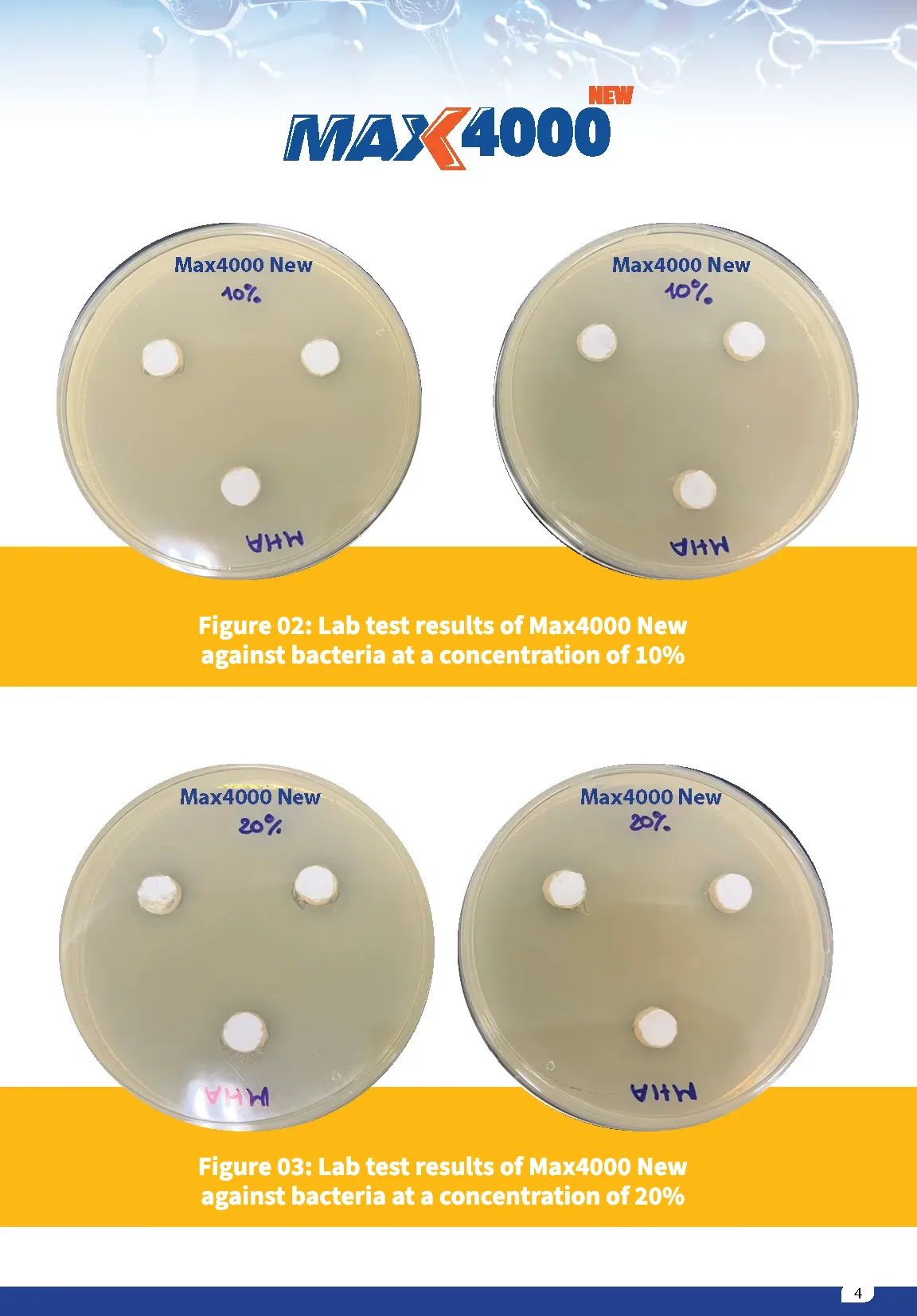
    • Figure 02: antibacterial test of MAX 4000 New at 10% (no clear zones).
    • Figure 03: antibacterial test of MAX 4000 New at 20% (no clear zones).
    • Figure 04: antibacterial test of MAX 4000 New at 30% after 20 h, marked "inhibition".
    • Figure 05: antibacterial test of MAX 4000 New at 30% after 24 h, marked "inhibition".
    • Figure 06: antibacterial test of MAX 4000 New at 50% after 20 h, marked "inhibition".

    MAX 4000 New: a probiotic that helps inhibit highly virulent Vibrio, rare on the market

    MAX 4000 New, tablet form, 227 g pack.

    • Helps reduce pressure from unfavourable bacteria at high pond densities.
    • Helps keep the pond environment stable so the shrimp maintain their immunity in the cold season.

    English text adapted from Than Vuong's original Vietnamese infographic.
    Quick Q&A

    Frequently asked questions on this topic

    What does "HIGHLY VIRULENT VIBRIO ANTAGONISTIC PROBIOTIC" cover?

    Max 4000 New has significantly demonstrated the ability to inhibit Vibrio TPD (Vibrio parahaemolyticus, a pathogenic strain causing white turbidity and hepatopancreatic disease in Pacific white shrimp) when used at standard concentrations.

    Method — what are the details?

    A probiotic that helps inhibit highly virulent Vibrio (Research and Development Department – Than Vuong Co., Ltd.) 1. Samples for antibacterial testing The test concentrations for MAX 4000 New were 10%, 20%, 30% and 50%.

    Plate photos — what are the details?

    Vibrio spp. strains were activated in MHB medium supplemented with 1.5% NaCl and incubated at 30°C; after 24 h they were subcultured onto TCBS agar to check purity. Once a pure strain was obtained, a single colony was selected and inoculated into 10 ml of MHB. 3 ml of the bacterial suspension was drawn off and its OD600nm was measured to determine absorbance. The required volume of bacterial suspension was calculated and diluted to OD600nm = 0.1

    Which species does this article apply to?

    Shrimp — Hepatopancreas, White feces, Vibrio

    Related Products

    Products linked to this topic

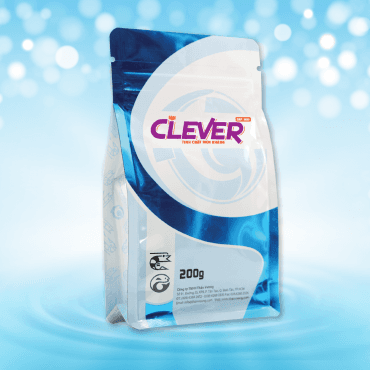
    CLEVER
    ShrimpThan Vuong Blue

    CLEVER

    Yeast-extract protein concentrate that supports shrimp gut microbiota balance and gu […]

    More Reading

    Related technical articles

    THE ROLE OF ELECTROLYTE SUPPLEMENTATION FOR SHRIMP
    Protocol•Shrimp•November 22, 2018

    THE ROLE OF ELECTROLYTE SUPPLEMENTATION FOR SHRIMP

    A recent report published in the journal Aquaculture International has provided further insight into the role of electrolyte supplem[...]

    Global Shrimp Market 2025 Overview — Shrimp Insights Bulletin February 2026
    Technical article•Shrimp•April 9, 2026

    Global Shrimp Market 2025 Overview — Shrimp Insights Bulletin February 2026

    Full-year 2025 global shrimp trade summary: Ecuador leads exports at 1.39M MT (+15%), EU imports surge 21%, US tariff shifts reshape[...]

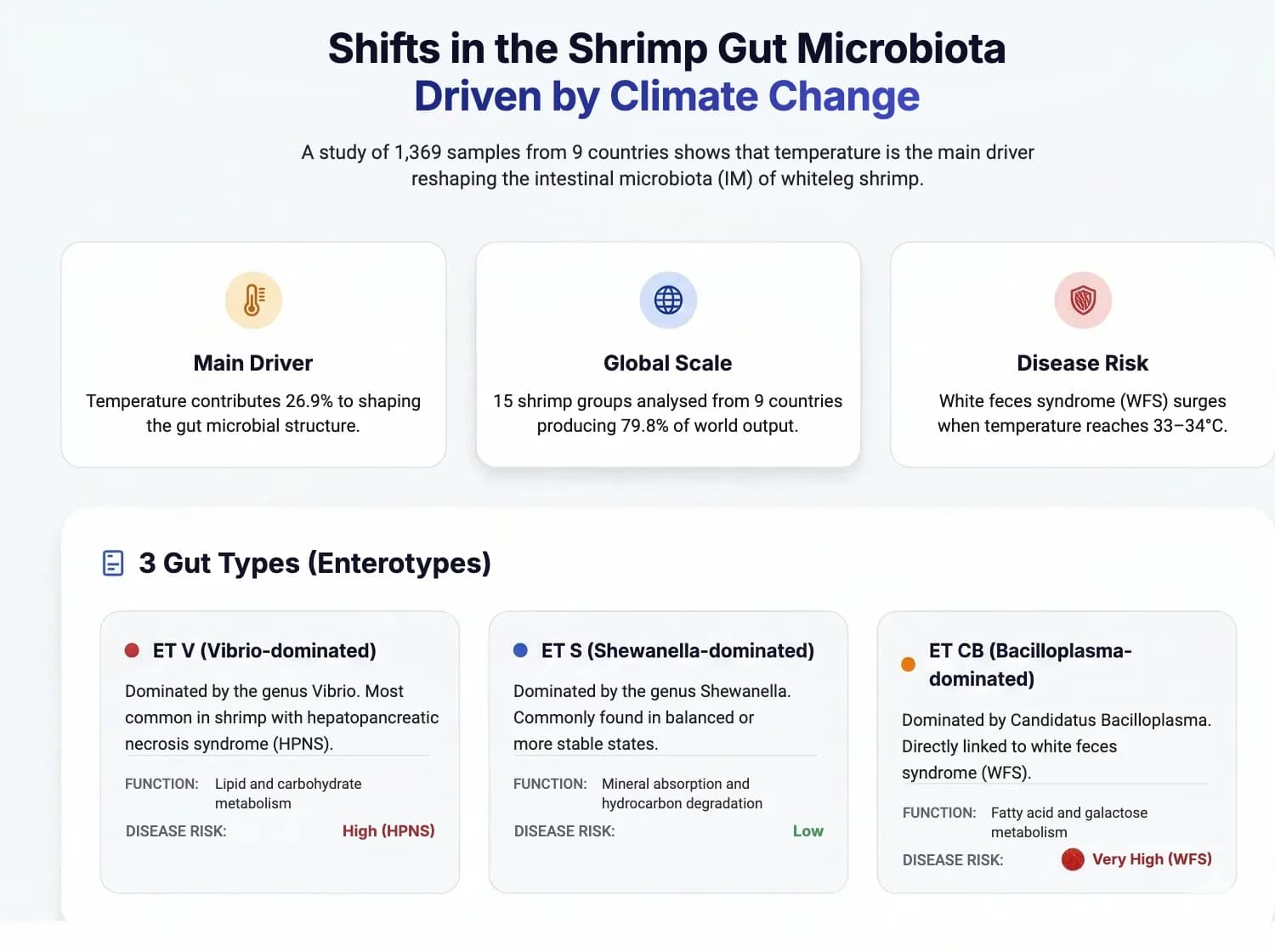
    CHANGES IN GUT MICROBIOTA DUE TO GLOBAL WARMING. REGULATING HOST HEALTH AND DISEASE STATUS IN POIKILOTHERMIC ANIMALS
    Research Insight•Shrimp•February 28, 2026

    CHANGES IN GUT MICROBIOTA DUE TO GLOBAL WARMING. REGULATING HOST HEALTH AND DISEASE STATUS IN POIKILOTHERMIC ANIMALS

    Global warming alters the gut microbiota of Pacific whiteleg shrimp by restructuring enterotypes, increasing the risk of diseases su[...]

    Ask Than Vuong

    Aquaculture technical assistant

    Hello there 👋

    Describe your pond issue or pick a question below.