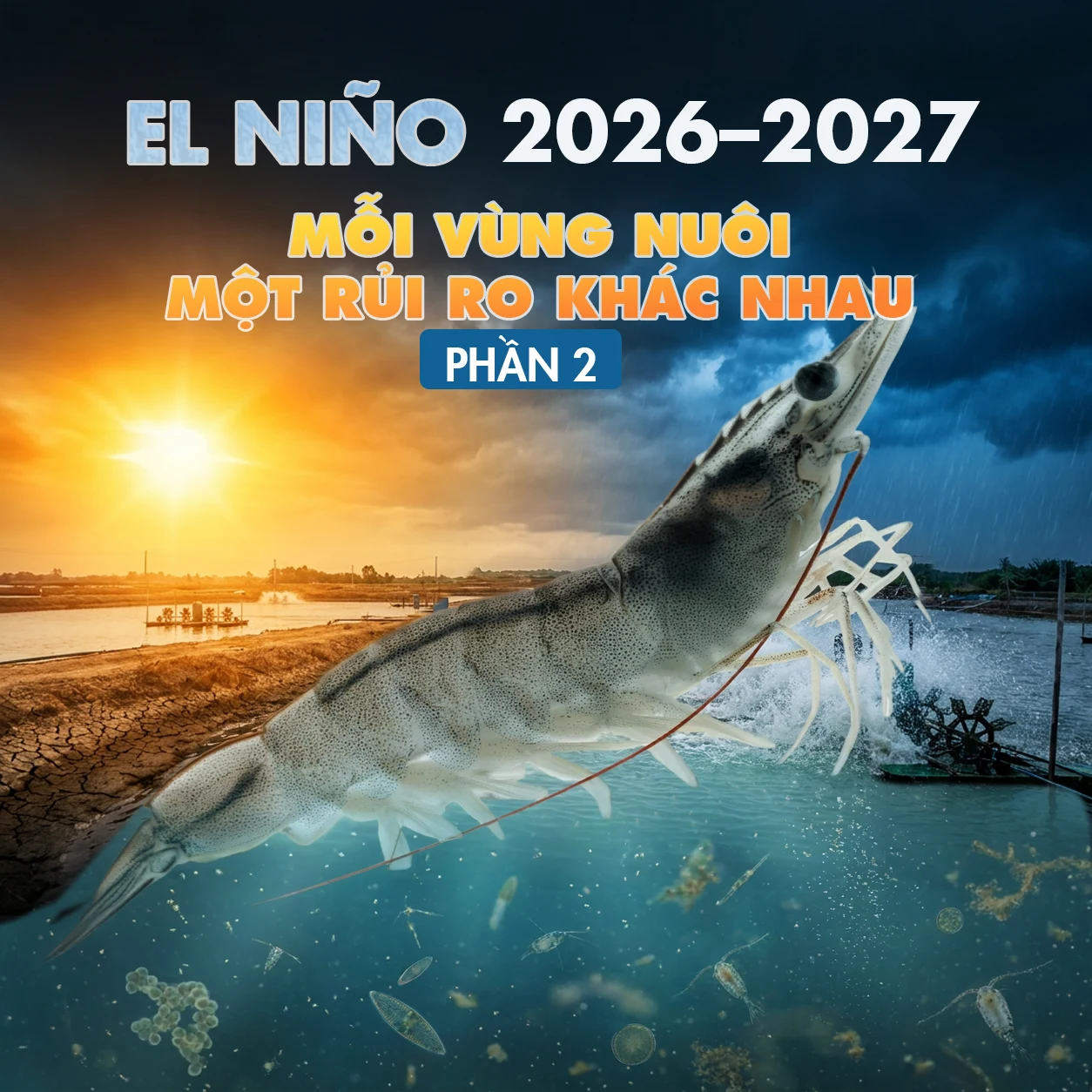
In Part 1, we saw something important: El Niño doesn't create the same kind of risk for every shrimp farming region. Some places get hotter and drier, others get wetter; some face water shortages, while others see salinity drop very quickly after heavy rain. As of September 2026, NOAA confirmed El Niño continues to strengthen, with over a 90% probability of becoming a very strong event through the autumn–winter of the Northern Hemisphere in 2026–2027. NOAA also notes that even with a very strong El Niño, the specific impact on any given region remains uncertain.
So for shrimp farmers, the important question shouldn't just be "how hot will El Niño get?" or "what do I dose once the shrimp are already stressed?" A more useful question is: if the weather changes fast, how do we make our pond's environment change more slowly? That is the mindset of building buffers into the pond before stress hits — and it's the subject of Part 2.
1. Oxygen: the first buffer to prepare
As water temperature rises, oxygen solubility falls, while shrimp metabolism and oxygen demand both increase. This is why heat is especially dangerous for ponds with high biomass, heavy algae, or organic buildup on the bottom.
FAO emphasizes that dissolved oxygen is one of the most important factors for shrimp growth and survival, and that both temperature and organic load in the pond affect DO. Literature on intensive Penaeus vannamei culture generally treats a DO of around 5 mg/L or higher as an appropriate management target; in intensive systems, keeping DO at least around 5 mg/L provides a better safety margin than operating close to the hypoxia threshold.
So ahead of a heatwave or a turn in the weather, don't wait until shrimp are gasping at the surface to think about oxygen. Aerators, paddlewheels, power lines and backup generators should be checked beforehand. More importantly, DO should be measured near dawn, when oxygen levels in the pond are typically lowest — a pond reading 7–8 mg/L at 3pm isn't necessarily safe if DO drops to 3 mg/L by 4–5am.
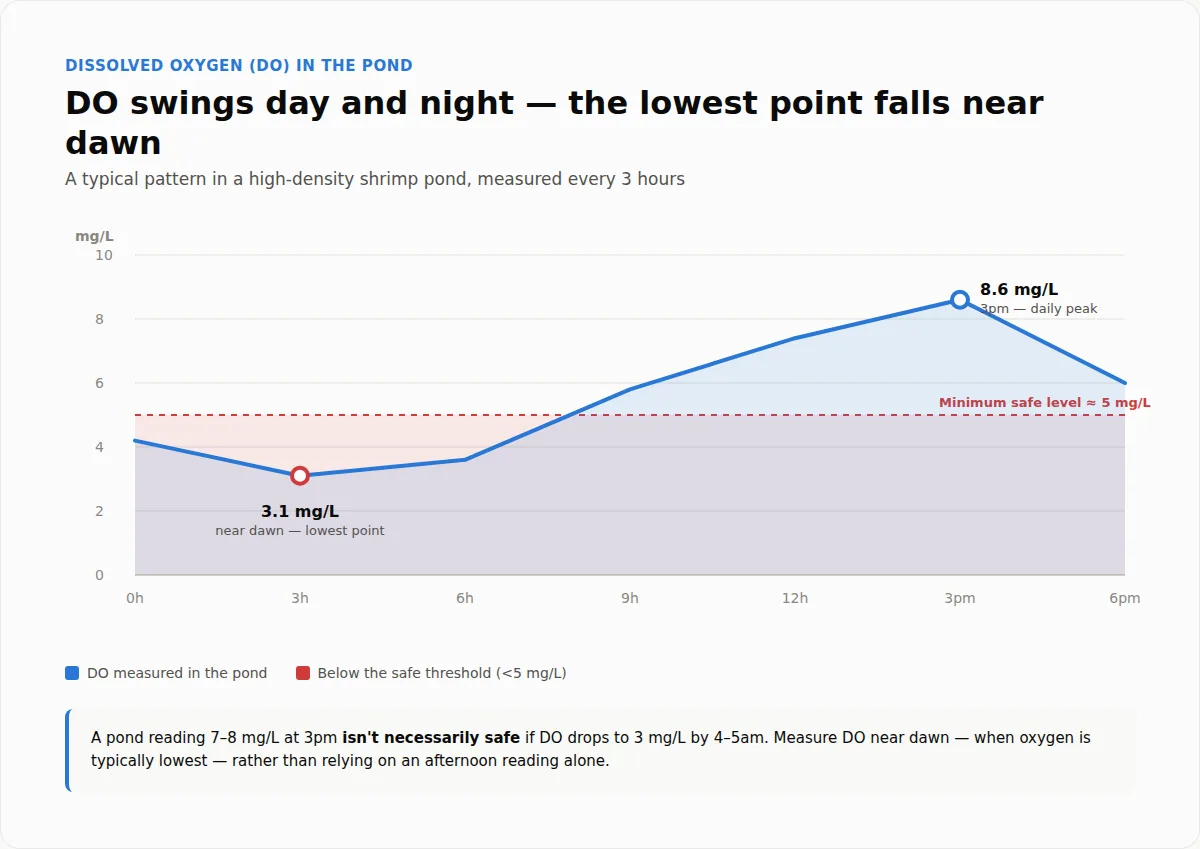
In high-density culture, what matters isn't just average DO — it's: what is the lowest DO reading of the day?
2. Don't just look at pH — look at how much it swings
Pond pH shifts with photosynthesis and respiration. During the day, algae consume CO₂ and pH rises; at night, algae, shrimp and microbes all respire, CO₂ builds up, and pH falls. FAO considers a pH range of roughly 7.5–9.0 generally suitable for shrimp culture; pH that is too high, particularly above around 9.5, can be harmful, and ponds with excessive phytoplankton density tend to show very high afternoon pH.
In practice, though, a single "good-looking" pH number doesn't tell the whole story. For example: Day 1, morning 8.0 – afternoon 8.25; Day 2, morning 7.95 – afternoon 8.35; Day 3, morning 7.80 – afternoon 8.50. None of these individual readings necessarily crosses a dangerous threshold, but the trend shows the water system swinging more and more each day — a possible sign that algae are getting too dense, that the water's buffering capacity is weakening, or that the pond ecosystem is becoming unstable.
So pH should be measured at least twice a day at fixed times — typically early morning and afternoon — and tracked as a trend rather than judged from a single reading.
3. Alkalinity: the water system's "shock absorber"
Alkalinity isn't simply a number used to "raise pH." It reflects the water's buffering capacity — its ability to resist pH changes as CO₂, photosynthesis, respiration and microbial processes shift. Research and literature on P. vannamei generally treat 100 mg CaCO₃/L or higher as necessary for many culture systems; one 2023 study of a zero-water-exchange pond operated with DO above 5 mg/L and alkalinity around 100–150 mg CaCO₃/L. In biofloc or super-intensive systems, the operating alkalinity level can run higher depending on organic load and the degree of nitrification.
The key is not to wait for alkalinity to fall → pH to swing → shrimp to become stressed before acting. If the weather is about to turn, morning pH, afternoon pH and alkalinity should be viewed together rather than managed as three separate parameters. And alkalinity or pH shouldn't be pushed up quickly with one large treatment either — the goal is stability, not a good-looking number achieved within a few hours.
4. Salinity swings aren't only a matter of "salt"
Whiteleg shrimp can adapt to a fairly wide salinity range, but that doesn't mean salinity can change abruptly without physiological stress. When salinity shifts, shrimp must adjust osmoregulation and ion balance. Studies on P. vannamei show that salinity changes clearly affect Na⁺/K⁺-ATPase activity and the status of Na, K, Ca and Mg ions.
This is a critical point in low-salinity shrimp farming: two water sources at the same 5‰ don't necessarily have the same physiological value. One source may have adequate K, Mg and Ca; another at the same 5‰ may be seriously deficient in Mg or K. Research and field experience with inland shrimp farming in Alabama show that low-salinity water sources may need K and Mg supplementation to correct ionic imbalances.
So ahead of a season with swinging rain and heat, farms operating at low salinity or on inland water sources should track salinity together with Ca, Mg, K and hardness — not salinity alone.
5. What role do dietary calcium and magnesium play?
This is where confusion easily creeps in — there are two different issues: minerals in the water, and minerals in the feed. Shrimp exchange ions directly with their environment through the gills and osmoregulatory mechanisms, so if the pond water is seriously deficient in Mg or K, supplementing minerals through feed alone cannot fully substitute for correcting the water itself. On the other hand, a well-balanced dietary mineral ration still plays an important role in growth, molting, metabolism and overall physiology.
Notably, a study published in Aquaculture and Fisheries in 2026 on P. vannamei raised in a low-salinity synbiotic system tested an organic mineral source from Lithothamnium, containing Ca, Mg and other minerals. Under that experimental condition, a diet supplemented with 2% of this mineral source produced better weight gain, biomass and FCR than the control. However, this is the result of one specific experimental condition and shouldn't be turned into a universal dosage for every farm.
The practical takeaway: there's a basis for paying attention to mineral sources in the diet, but dietary minerals and water minerals solve two different parts of the problem. During weather stress, a balanced mineral ration can be a supporting factor — but if the water itself has an ionic imbalance, the root cause in the water still has to be addressed.
6. Don't let algae get too dense before bad weather hits
A pond with dense algae can look great in the afternoon — high DO, high pH, a nice water color — but that doesn't necessarily mean the pond is stable. At night, that same algae population respires and consumes oxygen. If overcast weather persists or a large amount of algae dies off suddenly, the system can flip very quickly from algae producing oxygen to algae dying, bacteria decomposing them, and oxygen being consumed. FAO notes that ponds with excessive phytoplankton density tend to show very high afternoon pH, and that organic load in the pond is also one of the factors that directly affects oxygen.
So ahead of adverse weather, the goal shouldn't be "the darker the color, the better" — it should be a moderate, stable algae population. Caution is also needed with aggressively "crashing" algae right before a stress event: if a large amount of algae dies at once, organic load rises and so does the oxygen demand needed to decompose it.
7. Reduce the organic "burden" before stress arrives
A pond doesn't just raise shrimp — it also has to "carry" leftover feed, shrimp waste, dead algae, biofloc, bacteria and the organic matter that accumulates on the bottom. As temperature rises, biological activity and decomposition both increase, which means the system's oxygen demand rises along with them. A pond that already has a poor bottom condition will therefore have a smaller safety margin when the weather changes.
Ahead of a difficult season, regular siphoning, controlling excess feed, limiting solids buildup and monitoring NH₃/NO₂ are worth far more than waiting for these indicators to spike before acting. Especially in super-intensive or low-water-exchange systems, NH₃, NO₂, TSS, algae and pond bottom shouldn't be viewed separately — they need to be seen as connected parts of the same organic load.
8. Feed has to match the pond's carrying capacity
A common mistake during bad weather is: the shrimp are still eating, so feeding continues unchanged. But feed demand doesn't depend on shrimp weight alone — it also depends on temperature, DO, pH, molt cycle, health, plankton population and bottom condition. Feed management guidelines note that ration size should be adjusted when DO is low, temperature is extreme, pH is fluctuating, or bottom conditions are poor. A 2026 study on feeding behavior also found that when DO drops to a severely hypoxic level, feeding activity in P. vannamei declines markedly.
So growth shouldn't be forced when the pond's carrying capacity is declining. Uneaten feed doesn't disappear — it becomes organic matter, then bacteria, then oxygen consumption, then NH₃/NO₂, then pressure on the bottom. In difficult weather, cutting back feed at the right moment can sometimes help shrimp grow better in the following days, simply by preventing the system from collapsing.
9. Backup water is also an "anti-stress product"
Farmers often prepare minerals, probiotics, vitamins or other anti-stress products, but one of the most important things is easily overlooked: backup water. When the water source outside the canal changes in salinity, pH or quality too quickly, farmers with settling ponds or reservoir ponds have more options. Those without backup water sometimes have no choice but to bring poor-quality water into the pond, or to go without water for adjustment altogether.
So for farms with the means, a reservoir pond doesn't just serve water treatment — it also acts as an operational buffer for the whole farm.
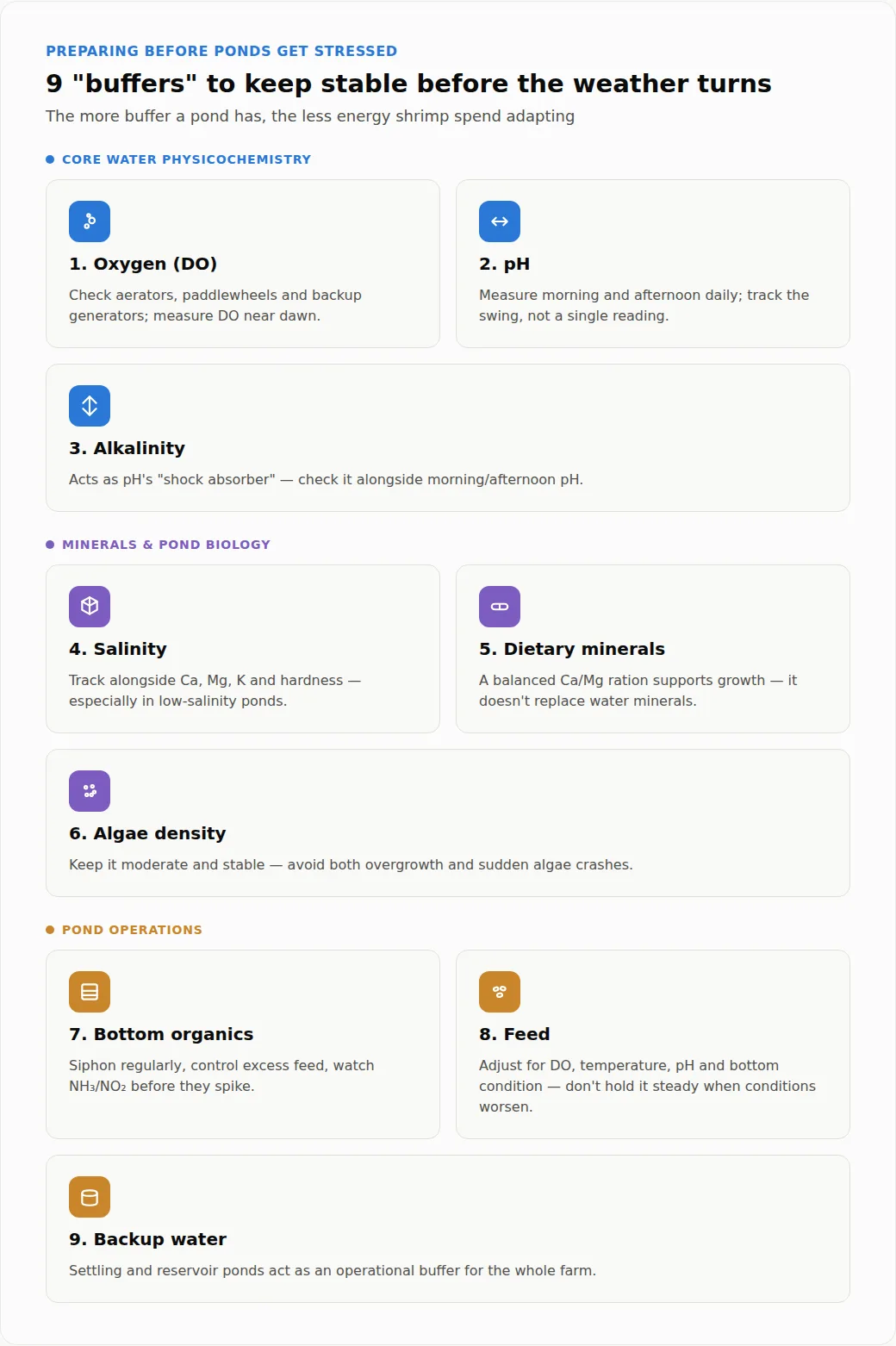
Before stress, during stress, after stress: different priorities
5–7 days before bad weather: Check the aeration system and generators; reduce bottom organics; keep algae stable; track morning/afternoon pH and alkalinity; assess salinity and Ca–Mg–K balance if farming at low salinity; prepare backup water.
24–48 hours before stress: Limit treatments that shift the environment sharply; check DO near dawn; monitor temperature, pH, alkalinity, salinity, NH₃ and NO₂; tighten feed management.
During bad weather: Prioritize oxygen first; avoid further destabilizing the environment; adjust feed to appetite and DO; monitor continuously rather than treating on a fixed schedule.
24–48 hours after stress: Re-assess algae, organics, NH₃/NO₂, pH–alkalinity and appetite; recover gradually rather than trying to force every parameter back to an "ideal" number in one treatment.
The most important mindset: don't ask "what do I dose?" too soon
When shrimp get stressed, farmers often ask "what should I treat the pond with right now?" But in many cases, the question that should have been asked a few days earlier is: "how much buffer does my pond have left?" That buffer lives in reserve oxygen, pH buffering capacity, alkalinity, ionic balance, algae density, organic load, water sources and the ability to adjust feed. If these factors are already stable before the weather changes, shrimp will need to spend less energy adapting to their environment.
Products can help shrimp get through stress. But good management has to start with reducing the causes of stress.
We can't control El Niño. We can't control rain or heat either. But we can make DO decline more slowly, pH swing less, salinity change more gradually, algae stay more stable, the bottom stay cleaner, and feed rations better matched to the pond's carrying capacity.
That's how a pond shifts from "wait for the weather, then react" to "already prepared to withstand the weather."
Sources
NOAA Climate Prediction Center
FAO – Shrimp Culture: Pond Design, Operation and Management
Southern Regional Aquaculture Center
Auburn University / Alabama Cooperative Extension
Aquaculture
Aquaculture and Fisheries
Responsible Seafood Advocate