Scientists in India have developed a genetically improved (GI) giant river prawn (Macrobrachium rosenbergii) strain with new disease resistance, helping to create a new source of income for fish farmers in Assam.

Najimuddin Ali © Gurvinder Singh
Najimuddin Ali has been farming carp Indian Major Carp (IMC) in four ponds covering four hectares in Kamrup district, Assam, northeastern India for the past nine years.
Recently, he ventured into co-culturing genetically improved (GI) giant river prawns (Macrobrachium rosenbergii) with carp and reported quickly earning a profit of approximately 50,000 Rupees ($600).“I stocked about 180 carp along with 2,000 prawns last September. I harvested them this March and sold them for approximately 1,200 Rupees ($14.37) per kg, making a decent profit. The income is definitely higher than what I earned from fish farming, and I have decided to continue with this new prawn strain,” he explained.

Sahjhan Ali © Gurvinder Singh
Sahjhan Ali tells a similar story.“I stocked 1,850 prawns along with 200 rohu (Labeo rohita) last September. The mortality rate was about 20% but I still made a decent profit, around 48,000 Rupees ($575). I am trying to procure seeds to continue prawn farming,” he noted.
This prawn strain was developed by Indian Council of Agricultural Research - Central Institute of Freshwater Aquaculture (ICAR-CIFA). Dr. Pratul Barman, District Fisheries Development Officer of Kamrup, stated that Assam has a huge demand for prawns, although production only reached about 26 tons in 2023-2024, lower than the previous year's 41 tons.“The decline in production is due to the unavailability or delays in procuring prawn seeds from coastal states like Odisha, West Bengal, and Andhra Pradesh. Larvae require 11 stages in seawater, while post-larvae can survive in freshwater. We tried to culture prawns in artificial brackish water in Assam but were unsuccessful,” he explained.“Prawns are in good demand, and we found that the genetically improved (GI) prawns reached an average size of 80 grams in ten months, whereas the conventional strain only reached 60 grams in the same period, based on individual heterogeneous growth. The new strain is not only disease-resistant but also has a lower mortality rate. The GI prawns are also ideal for both polyculture and monoculture systems, offering an excellent opportunity for farmers to earn additional income,” he added.
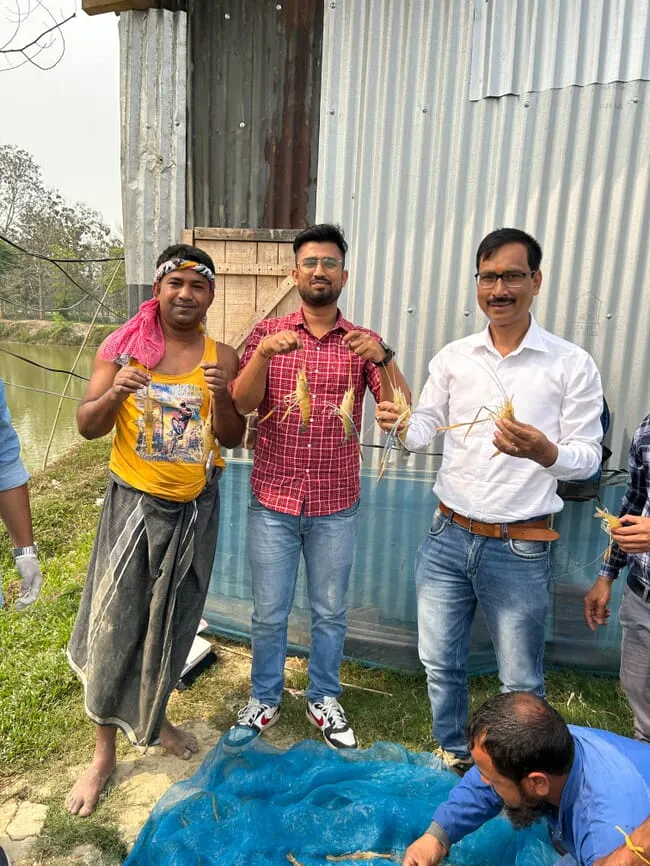
Dr. Pratul Barman (right) visiting aquaculture operators in Assam © Assam Fisheries Department
Dr. Pratul pointed out that co-culturing prawns with carp optimizes the use of resources, including water, feed, and pond space. This integration also diversifies income sources, thereby reducing financial risks for farmers. Prawns and carp occupy different ecological niches and have distinct feeding habits, which helps increase pond productivity through better nutrient cycling, he added.
Dr. Bindu Pillai, principal scientist for prawn research at ICAR-CIFA, stated that the institute developed the CIFA-GI strain in 2021.“This new strain aims to increase productivity and profitability in prawn farming. They were selected for growth rate; we do not claim any improvement in disease resistance, but on-farm trials show that CIFA-GI prawns survive well in most places,” she noted.
She agreed that Assam has good potential for freshwater prawn farming due to the state's abundant water resources.“This state is the first in Northeast India to conduct on-farm trials, and the results are very encouraging. We strongly believe that this prawn strain can increase farmers' income. We have also conducted trials in other states, mainly coastal belts,” she said.
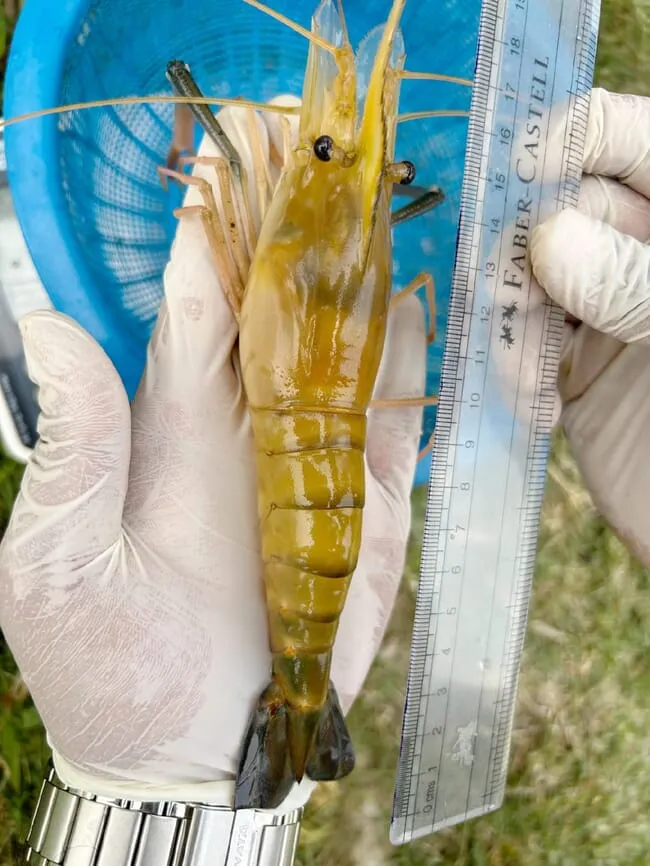
One of ICAR-CIFA's genetically improved giant river prawns. Prawns are commonly known as scampi in India © Gurvinder Singh
Dr. Farhana Hoque, co-project leader at ICAR-CIFA, stated that the selected pond areas in Assam ranged from 0.15 to 0.25 hectares.“The stocking density was 10,000 prawns/ha, and the initial stocking size was 0.02 grams. Catla and rohu carp were stocked at a ratio of 20:80, respectively, at 6,000 fish/ha. Selected farmers were provided with feed and fish seeds for the ongoing demonstration program. Prawns can also be cultured separately, with a stocking density of 30,000 prawns/ha,” she explained.
She added, “We have selected five hatcheries to serve as broodstock hatcheries to produce CIFA-GI standard prawn seeds and supply them to farmers.”
In 2023, WorldFish India, in collaboration with the Assam Fisheries Department, introduced a freshwater prawn and carp polyculture model under the World Bank-funded APART project in five districts: Kamrup, Nalbari, Morigaon, Darrang, and Goalpara. This initiative included the establishment of Farmer Producer Groups (FPGs) in each selected district. Each FPG comprises 12-25 farmer members operating over an area of 5 hectares.
A senior government official stated, “The results are remarkable, with farmers achieving an average yield of 60kg of prawns and 500kg of fish, thanks to high market demand and efficient feeding methods that significantly boost farmers' income.”
PKT CTY THẦN VƯƠNG
SOURCE: THE FISHSITE