
Working hours: Mon - Fri | 08:00 - 17:00HOTLINE: 0867 95 7568
Technical Article

TREATMENT PROTOCOL FOR YELLOW MOUTH DISEASE IN WHITELEG SHRIMP

Yellow mouth disease (often accompanied by yellow gills) is an indication that the pond environment is at low salinity (5ppt) or experiencing a fungal bloom. Below is the optimal treatment process.

ProtocolShrimpJanuary 29, 2026👁 336 views
Click to listen to an AI-narrated summary
AI Summary

Generate an English summary for TREATMENT PROTOCOL FOR YELLOW MOUTH DISEASE IN WHITELEG SHRIMP

AI-generated summary based on the full article content below.

Editorial Framing

Why this article matters

    Full Article
    TREATMENT PROTOCOL FOR YELLOW MOUTH DISEASE IN WHITELEG SHRIMP
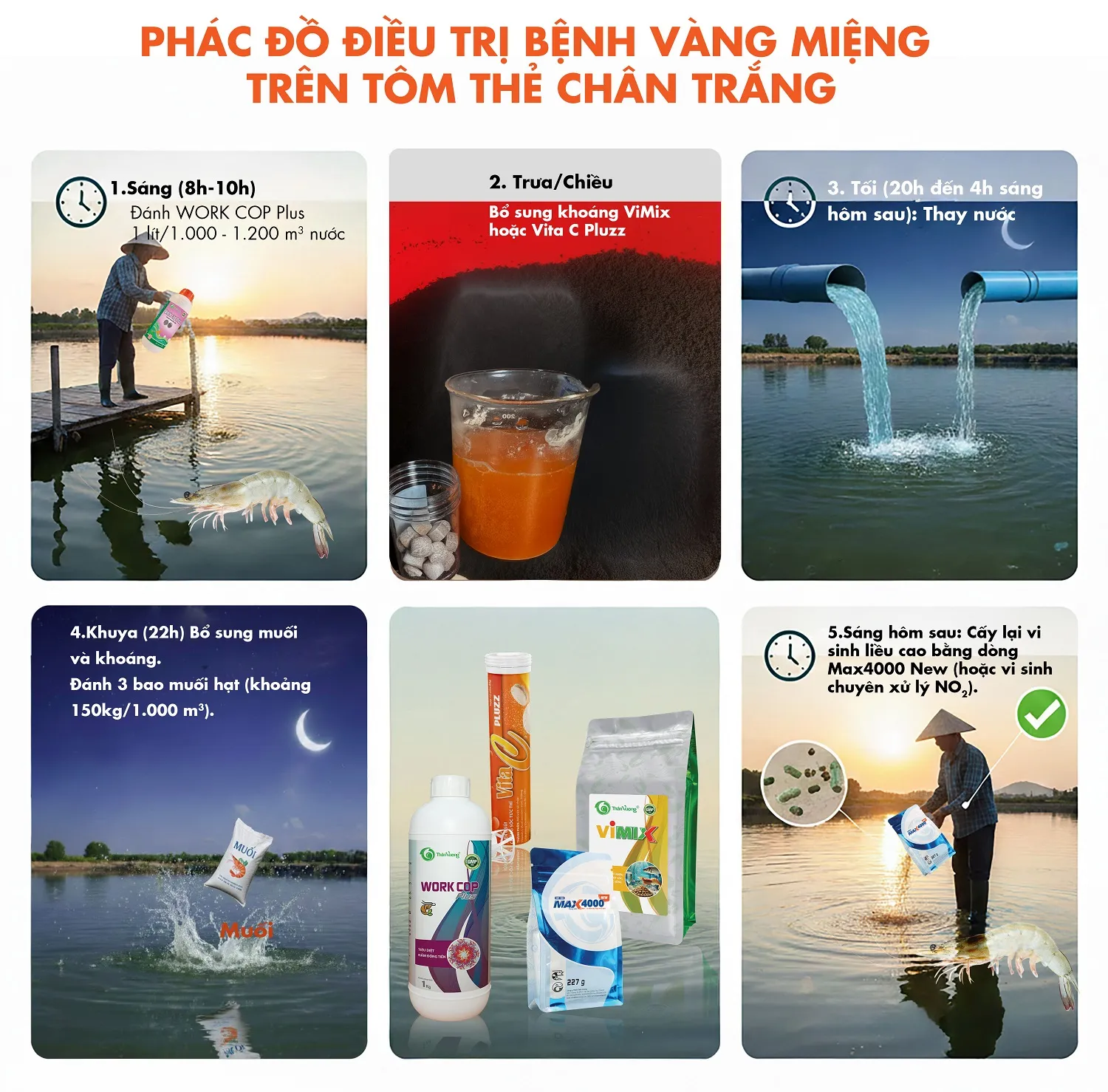
    PHAC_YY_YIYU_TRY_BYNH_VANG_MIYNG_CYp_nhYt

    I. Main Causes

    Microfungi: Fungi adhere to the shrimp's mouthparts and gills, obstructing respiration.

    Low salinity: Causes shrimp to weaken, have thin shells, and be susceptible to external parasite attacks.

    Organic pollution: Towards the end of the culture cycle, there is a large accumulation of shrimp waste and excess feed, but the microbial system cannot process it in time.

    II. Detailed Treatment Procedure

    Step 1: Inspection

    Measure toxic gas: Check NO2 concentration. If NO2 is low, proceed with treatment.

    Health check: Observe for "meat drop" (scattered dead shrimp at the bottom).

    If shrimp are healthy: Proceed with disinfection immediately.

    If shrimp are weak/dropping to the bottom: treatment is not possible.

    Step 2: Chemical and Environmental Intervention

    Morning (8 - 10 AM): Apply fungicide using Work Cop Plus.

    Dosage: 1 liter per 1,000 - 1,200 m3 of water.

    Note: Run oxygen aerators at maximum capacity to support shrimp.

    Evening (8 PM to 4 AM the next day): Gradually change water.

    Slowly drain old water and replenish with clean new water, approximately 50% of the pond's volume. This helps dilute toxins and stimulates shrimp molting.

    Late night (10 PM): Supplement with salt and minerals.

    Apply 3 bags of granular salt (approximately 150 kg/1,000 m3). Salt helps reduce the toxicity of NO2 and supports rapid shell hardening after molting.

    Combine with additional broadcast minerals to support synchronized molting.

    Step 3: Restore Microbial System

    The next morning: Re-inoculate with high-dose probiotics using Max 4000 (or specialized probiotics for environmental balance and NO2 treatment). Purpose: Decompose organic matter, clean the pond bottom, and regain control of toxic gases.

    Check: Observe if the shrimp have completely shed the yellow layer around their mouthparts. If the incidence of yellow mouthparts is still high, above 30%, repeat the procedure after 24-48 hours.

    Quick Q&A

    Frequently asked questions on this topic

    What does "TREATMENT PROTOCOL FOR YELLOW MOUTH DISEASE IN WHITELEG SHRIMP" cover?

    Yellow mouth disease (often accompanied by yellow gills) is an indication that the pond environment is at low salinity (5ppt) or experiencing a fungal bloom. Below is the optimal treatment process.

    Which species does this article apply to?

    Shrimp — Immunity & Microbiome, Ectoparasites, Water & Environment

    Related Products

    Products linked to this topic

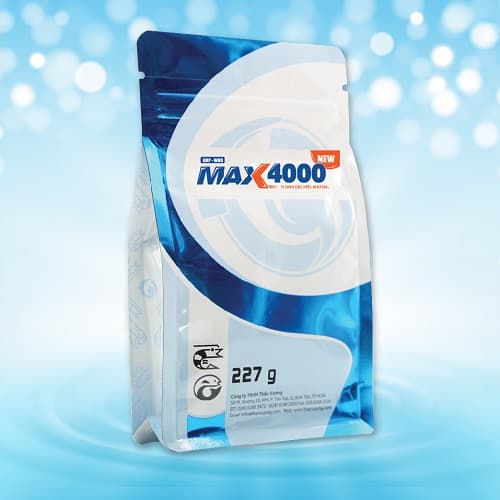
    Product reference for MAX 4000
    tom / ca / ocThần Vương Blue

    MAX 4000

    Probiotic for treating toxic gases NH3, H2S, NO2

    Product reference for LALSEA BIOREM
    allNguyên liệu

    LALSEA BIOREM

    Ammonia removal, biological organic treatment, effective at high salinity

    More Reading

    Related technical articles

    VAI TRÒ CỦA BỔ SUNG NƯỚC ĐIỆN GIẢI CHO TÔM
    Protocol•Shrimp•November 22, 2018

    THE ROLE OF ELECTROLYTE SUPPLEMENTATION FOR SHRIMP

    A recent report published in the journal Aquaculture International has provided further insight into the role of electrolyte supplem[...]

    Toàn cảnh thị trường tôm thế giới 2025 — Dữ liệu từ Shrimp Insights (Tháng 2/2026)
    Technical article•Shrimp•April 9, 2026

    Global Shrimp Market 2025 Overview — Shrimp Insights Bulletin February 2026

    Full-year 2025 global shrimp trade summary: Ecuador leads exports at 1.39M MT (+15%), EU imports surge 21%, US tariff shifts reshape[...]

    SỰ THAY ĐỔI CỦA HỆ VI SINH ĐƯỜNG RUỘT DO SỰ NÓNG LÊN TOÀN CẦU. ĐIỀU HÒA SỨC KHỎE VẬT CHỦ VÀ TÌNH TRẠNG BỆNH Ở ĐỘNG VẬT BIẾN NHIỆT
    Research Insight•Shrimp•February 28, 2026

    CHANGES IN GUT MICROBIOTA DUE TO GLOBAL WARMING. REGULATING HOST HEALTH AND DISEASE STATUS IN POIKILOTHERMIC ANIMALS

    Global warming alters the gut microbiota of Pacific whiteleg shrimp by restructuring enterotypes, increasing the risk of diseases su[...]

    Ask Than Vuong

    Aquaculture technical assistant

    Hello there 👋

    Describe your pond issue or pick a question below.


