
Working hours: Mon - Fri | 08:00 - 17:00HOTLINE: 0867 95 7568
Technical Article

PREVENTION AND TREATMENT OF BLACK SPOT DISEASE IN SHRIMP

Black spot disease in whiteleg shrimp can appear from 20–90 days old, and is particularly common when shrimp are 25–45 days old. The disease often breaks out during seasonal transitions, when abrupt weather changes cause shrimp to be easily stressed and the pond environment becomes imbalanced.

ProtocolShrimpJuly 29, 2025👁 286 views
Click to listen to an AI-narrated summary
AI Summary

Generate an English summary for PREVENTION AND TREATMENT OF BLACK SPOT DISEASE IN SHRIMP

AI-generated summary based on the full article content below.

Editorial Framing

Why this article matters

    Full Article
    PREVENTION AND TREATMENT OF BLACK SPOT DISEASE IN SHRIMP

    Causes of Black Spot Disease in Shrimp

    • Water environment: High organic matter, toxic gases, high opportunistic bacteria.
    • Vibrio and shell-fouling fungi: Attack the epidermis, causing damage and black spots.
    • Lack of trace minerals and beneficial probiotics: Poor molting in shrimp, shells are easily damaged and susceptible to disease.
    • Poor pond management: Fluctuations in pH, alkalinity, and oxygen weaken shrimp.
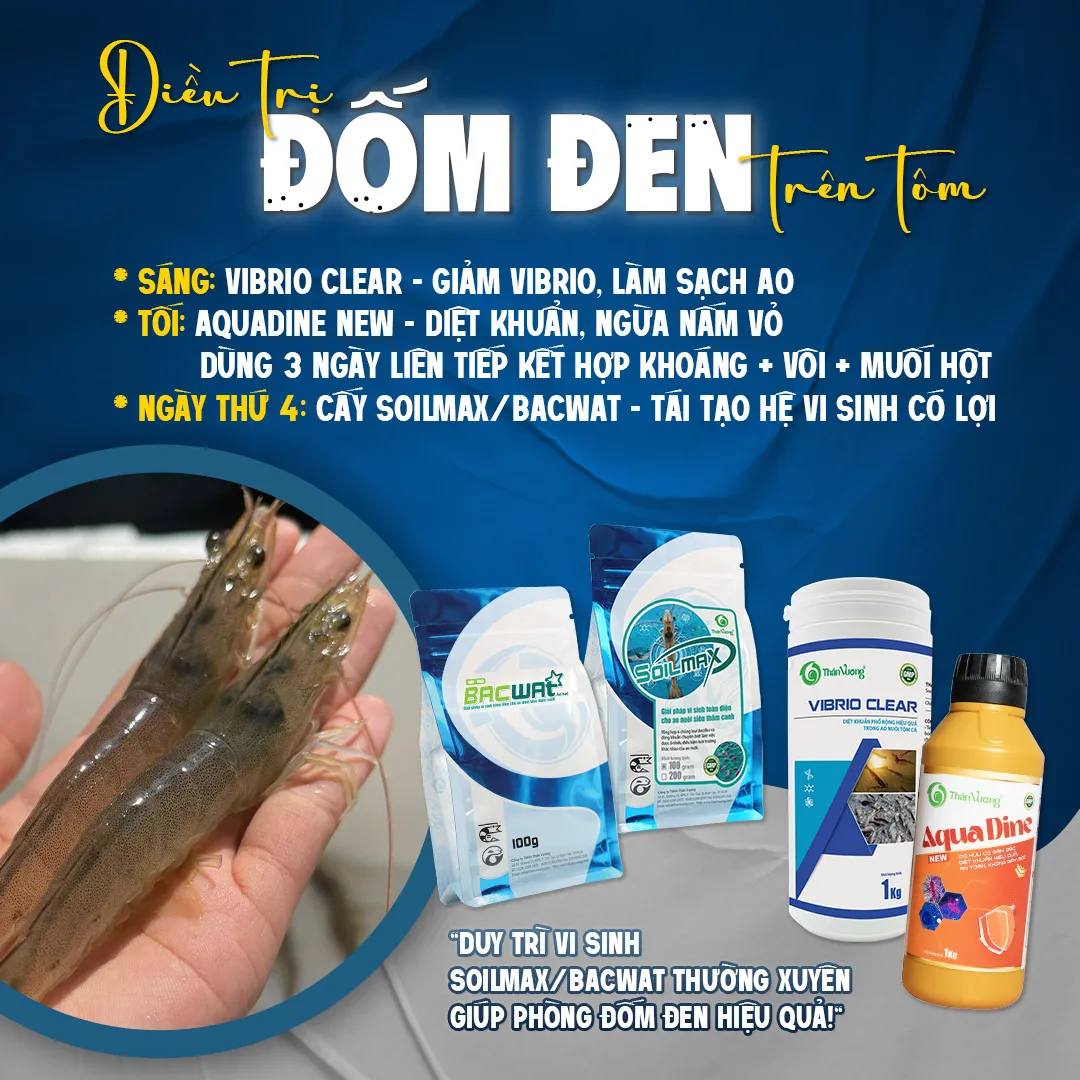
    YiYu_trY_YYm_Yen_tren_tom

    Solutions:

    • Disinfect to reduce pathogens:

    Morning: Vibrio Clear, Evening: Aquadine New.

    • Introduce beneficial probiotics:

    The next day, use SoilMax/Bacwat to restore the microbial system.

    • Maintain long-term prevention:

    Use Soilmax/Bacwat periodically to stabilize the pond bottom and prevent Vibrio outbreaks.

    • Supplement minerals and environmental management:

    Maintain stable pH, alkalinity, and oxygen to support healthy molting in shrimp.

    Quick Q&A

    Frequently asked questions on this topic

    What does "PREVENTION AND TREATMENT OF BLACK SPOT DISEASE IN SHRIMP" cover?

    Black spot disease in whiteleg shrimp can appear from 20–90 days old, and is particularly common when shrimp are 25–45 days old. The disease often breaks out during seasonal transitions, when abrupt weather changes cause shrimp to be easily stressed and the pond environment becomes imbalanced.

    Which species does this article apply to?

    Shrimp — Immunity & Microbiome, Stress, Water & Environment, Vibrio

    Related Products

    Products linked to this topic

    Product reference for LALSEA BIOREM
    allNguyên liệu

    LALSEA BIOREM

    Ammonia removal, biological organic treatment, effective at high salinity

    Product reference for HERB GUARD
    shrimpThần Vương Blue

    HERB GUARD

    Enhance liver function, improve color of hepatopancreas

    More Reading

    Related technical articles

    VAI TRÒ CỦA BỔ SUNG NƯỚC ĐIỆN GIẢI CHO TÔM
    Protocol•Shrimp•November 22, 2018

    THE ROLE OF ELECTROLYTE SUPPLEMENTATION FOR SHRIMP

    A recent report published in the journal Aquaculture International has provided further insight into the role of electrolyte supplem[...]

    Toàn cảnh thị trường tôm thế giới 2025 — Dữ liệu từ Shrimp Insights (Tháng 2/2026)
    Technical article•Shrimp•April 9, 2026

    Global Shrimp Market 2025 Overview — Shrimp Insights Bulletin February 2026

    Full-year 2025 global shrimp trade summary: Ecuador leads exports at 1.39M MT (+15%), EU imports surge 21%, US tariff shifts reshape[...]

    SỰ THAY ĐỔI CỦA HỆ VI SINH ĐƯỜNG RUỘT DO SỰ NÓNG LÊN TOÀN CẦU. ĐIỀU HÒA SỨC KHỎE VẬT CHỦ VÀ TÌNH TRẠNG BỆNH Ở ĐỘNG VẬT BIẾN NHIỆT
    Research Insight•Shrimp•February 28, 2026

    CHANGES IN GUT MICROBIOTA DUE TO GLOBAL WARMING. REGULATING HOST HEALTH AND DISEASE STATUS IN POIKILOTHERMIC ANIMALS

    Global warming alters the gut microbiota of Pacific whiteleg shrimp by restructuring enterotypes, increasing the risk of diseases su[...]

    Ask Than Vuong

    Aquaculture technical assistant

    Hello there 👋

    Describe your pond issue or pick a question below.


