EFFECTS OF ALKALINITY ON GROWTH AND SURVIVAL RATE OF MARINE SHRIMP LARVAE AND POSTLARVAE
Alkalinity affects the buffering system in the water environment, mitigating pH fluctuations and helping to stabilize water pH. When water alkalinity changes, it will affect physicochemical parameters, survival rate, and shrimp growth.
Research InsightShrimpMarch 10, 2020👁 264 views
Click to listen to an AI-narrated summary
AI Summary
Generate an English summary for EFFECTS OF ALKALINITY ON GROWTH AND SURVIVAL RATE OF MARINE SHRIMP LARVAE AND POSTLARVAE
AI-generated summary based on the full article content below.
Editorial Framing
Why this article matters
Full Article
This article is a study by Dr. Chau Tai Tao (Faculty of Fisheries - Can Tho University) on the effect of alkalinity on the growth and survival rate of black tiger shrimp and whiteleg shrimp larvae and postlarvae.
What is alkalinity?
Total alkalinity indicates the acid-neutralizing capacity of water.
Alkalinity in water is created by 3 ions: OH-, CO32-, HCO3-. Among these, HCO3- is the main form.
Effects of alkalinity:
Alkalinity affects the buffering system in the aquatic environment.
It maintains pH fluctuations and helps stabilize water pH.
Changes in water alkalinity will affect physical and chemical factors, as well as the survival rate and growth of shrimp.
In marine shrimp larval rearing, lower alkalinity makes it difficult for shrimp to harden their shells after molting. If alkalinity is too high, shrimp larvae and postlarvae grow slowly, have difficulty molting, or fail to molt, leading to death.
Experiment evaluating the effect of alkalinity on the growth and survival rate of black tiger shrimp and whiteleg shrimp larvae:
Experimental setup:
Shrimp rearing water salinity 30‰.
Soda (NaHCO3) was used to adjust alkalinity to suit each treatment before larval stocking.
The experiment included the following treatments:
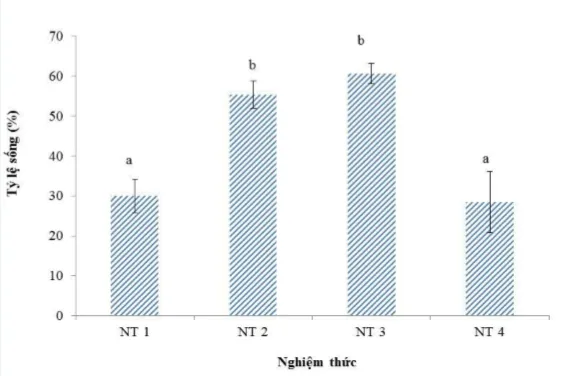
For the black tiger shrimp experiment: Larval rearing water alkalinity of 80, 100, 120, 140 mg CaCO3/L corresponding to treatments 1, 2, 3, 4.
For the whiteleg shrimp experiment: Larval rearing water alkalinity of 100, 120, 140, 160, 180 mg CaCO3/L corresponding to treatments 1, 2, 3, 4, 5.
Total length of larvae and postlarvae was measured at stages Z3, M2, PL1, PL5, PL10, PL15 (for black tiger shrimp) and Z1, M1, PL1, PL6, PL12 (for whiteleg shrimp).
Survival rate was determined at PL15 (for black tiger shrimp) and M1, PL1, PL12 (for whiteleg shrimp).
Results:
Table 1. Environmental parameters in the black tiger shrimp experiment
Parameter
Treatment
80 mg CaCO3/L
100 mg CaCO3/L
120 mg CaCO3/L
140 mg CaCO3/L
Temperature (°C)
Morning
29.6 ± 0.21
29.2 ± 0.22
29.2 ± 0.12
29.3 ± 0.24
Afternoon
30.6 ± 0.52
30.6 ± 0.59
30.5 ± 0.58
30.6 ± 0.6
pH
Morning
7.9 ± 0.03
7.8 ± 0.0
7.9 ± 0.02
Quick Q&A
Frequently asked questions on this topic
What does "EFFECTS OF ALKALINITY ON GROWTH AND SURVIVAL RATE OF MARINE SHRIMP LARVAE AND POSTLARVAE" cover?
Alkalinity affects the buffering system in the water environment, mitigating pH fluctuations and helping to stabilize water pH. When water alkalinity changes, it will affect physicochemical parameters, survival rate, and shrimp growth.
Which species does this article apply to?
Shrimp — Water & Environment
Related Products
Products linked to this topic
shrimpThần Vương Blue
PRO GUT
Premium digestive probiotics specifically for shrimp farming in lined ponds
tom / ca / ocThần Vương Blue
MAX 4000
Probiotic for treating toxic gases NH3, H2S, NO2
allNguyên liệu
LALSEA BIOREM
Ammonia removal, biological organic treatment, effective at high salinity
shrimpThần Vương Blue
HERB GUARD
Enhance liver function, improve color of hepatopancreas
More Reading
Related technical articles
Protocol•Shrimp•November 22, 2018
THE ROLE OF ELECTROLYTE SUPPLEMENTATION FOR SHRIMP
A recent report published in the journal Aquaculture International has provided further insight into the role of electrolyte supplem[...]
Technical article•Shrimp•April 9, 2026
Global Shrimp Market 2025 Overview — Shrimp Insights Bulletin February 2026
Full-year 2025 global shrimp trade summary: Ecuador leads exports at 1.39M MT (+15%), EU imports surge 21%, US tariff shifts reshape[...]
Research Insight•Shrimp•February 28, 2026
CHANGES IN GUT MICROBIOTA DUE TO GLOBAL WARMING. REGULATING HOST HEALTH AND DISEASE STATUS IN POIKILOTHERMIC ANIMALS
Global warming alters the gut microbiota of Pacific whiteleg shrimp by restructuring enterotypes, increasing the risk of diseases su[...]
Ask Than Vuong
Aquaculture technical assistant
Hello there 👋
Describe your pond issue or pick a question below.