How is a BAP standard made — and who checks the standard setter?
A very practical question that companies often ask before committing to a certification program: who writes these standards, and what guarantees that they are not rules an interest group has written for itself? The next part of CEO Mike Kocsis's presentation answers this question head-on — and it is perhaps the part most worth reading closely for anyone who still sees certification as "a label you can buy".
01Six steps to issue a standard
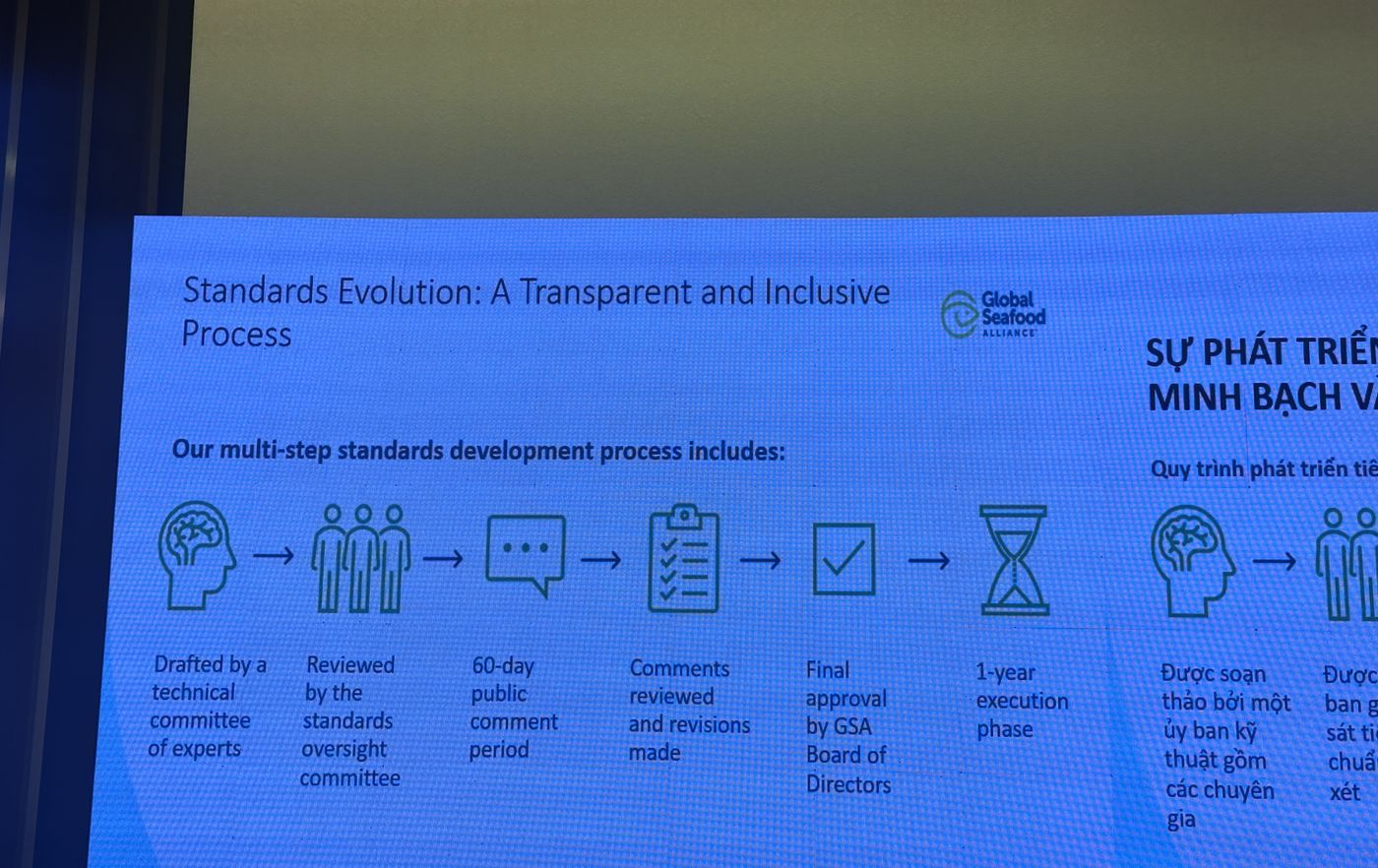
Mr. Kocsis described GSA's standards development process as "transparent and inclusive", with six consecutive steps. First, a draft is written by a technical committee of experts. That draft must then be reviewed by the standards oversight committee — a level independent of the drafting group. Next comes a step that few organizations dare to take: a 60-day public comment period, meaning that anyone — farmers, factories, scientists, non-governmental organizations — has the right to comment on the content of the standard. All comments are then reviewed and the standard is revised accordingly, and only then is it submitted to the GSA Board of Directors for final approval. And even after approval, the standard has a one-year implementation phase, so that companies can adapt before they are audited against the new standard.
is the public comment window for each standard — a BAP standard does not "fall from the sky": it opens the door for people in the industry to speak up before it becomes the rules of the game.
Technical committee drafts
Industry experts write the draft
Oversight committee reviews
Independent of the drafting group
60-day public comment period
Farmers, factories and scientists can all comment
Review & revision
Every comment is reviewed and answered
GSA Board approves
Final decision
1-year transition
Companies have time to adapt
02The standard setter gets graded too
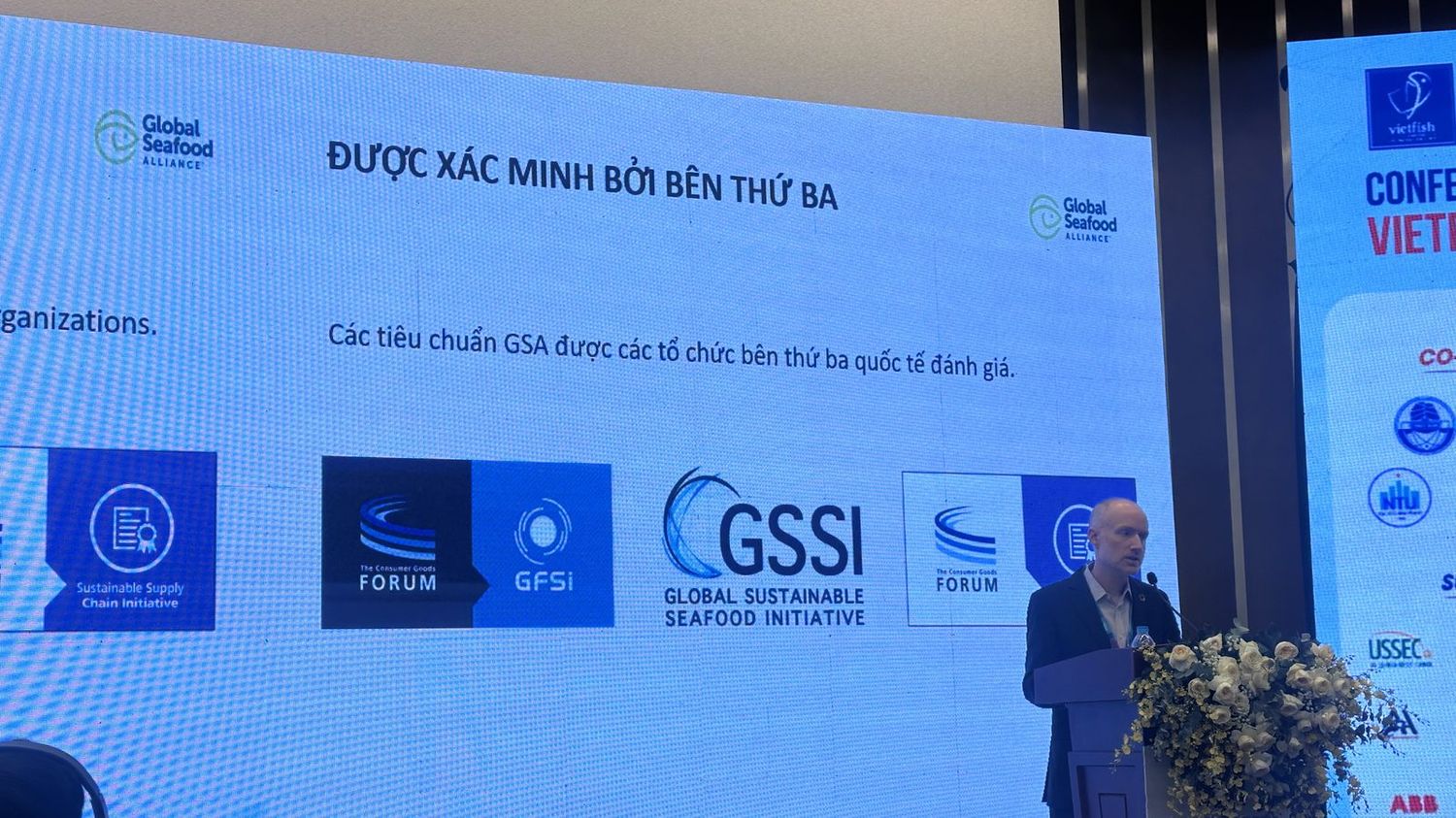
The second point Mr. Kocsis stressed: GSA standards are benchmarked by international third-party organizations — in other words, GSA does not grade its own work. The slide shows three endorsing names: GFSI (Global Food Safety Initiative) and SSCI (Sustainable Supply Chain Initiative) — both part of The Consumer Goods Forum, which brings together the world's largest retailers and food brands — along with GSSI (Global Sustainable Seafood Initiative).
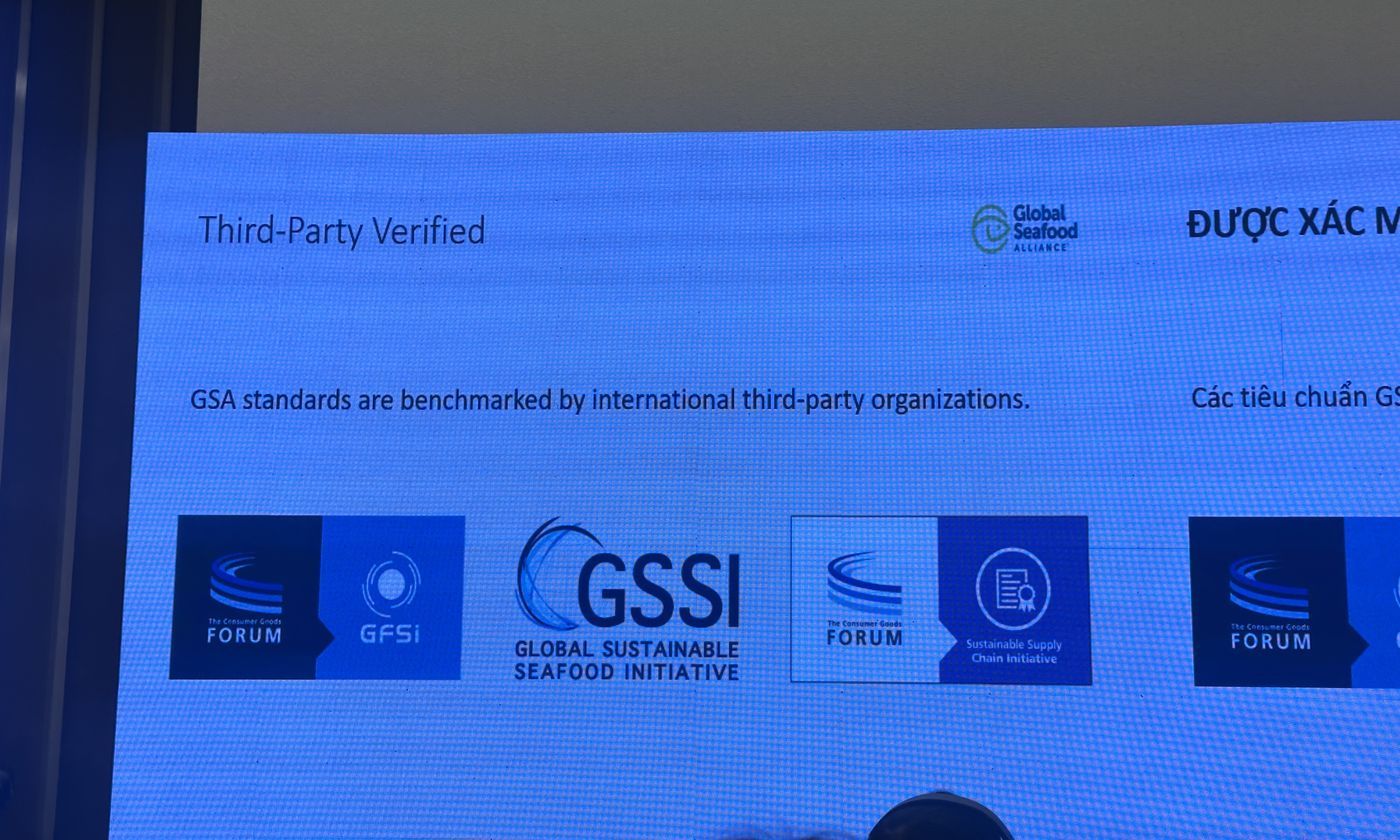
Global Food Safety Initiative
Part of The Consumer Goods Forum — the forum of the world's largest retailers
Global Sustainable Seafood Initiative
Benchmarks seafood certification programs
Sustainable Supply Chain Initiative
Part of The Consumer Goods Forum — the social responsibility pillar
That is why the certification network reviewed in Part 1 — 3,223 farms, 563 processing plants, 364 hatcheries, 158 feed mills and 16 vessels — is worth as much as a "passport" through many markets: behind the label is a process that both industry insiders and third parties can scrutinize.
03Recognized by the world's largest marketplace itself
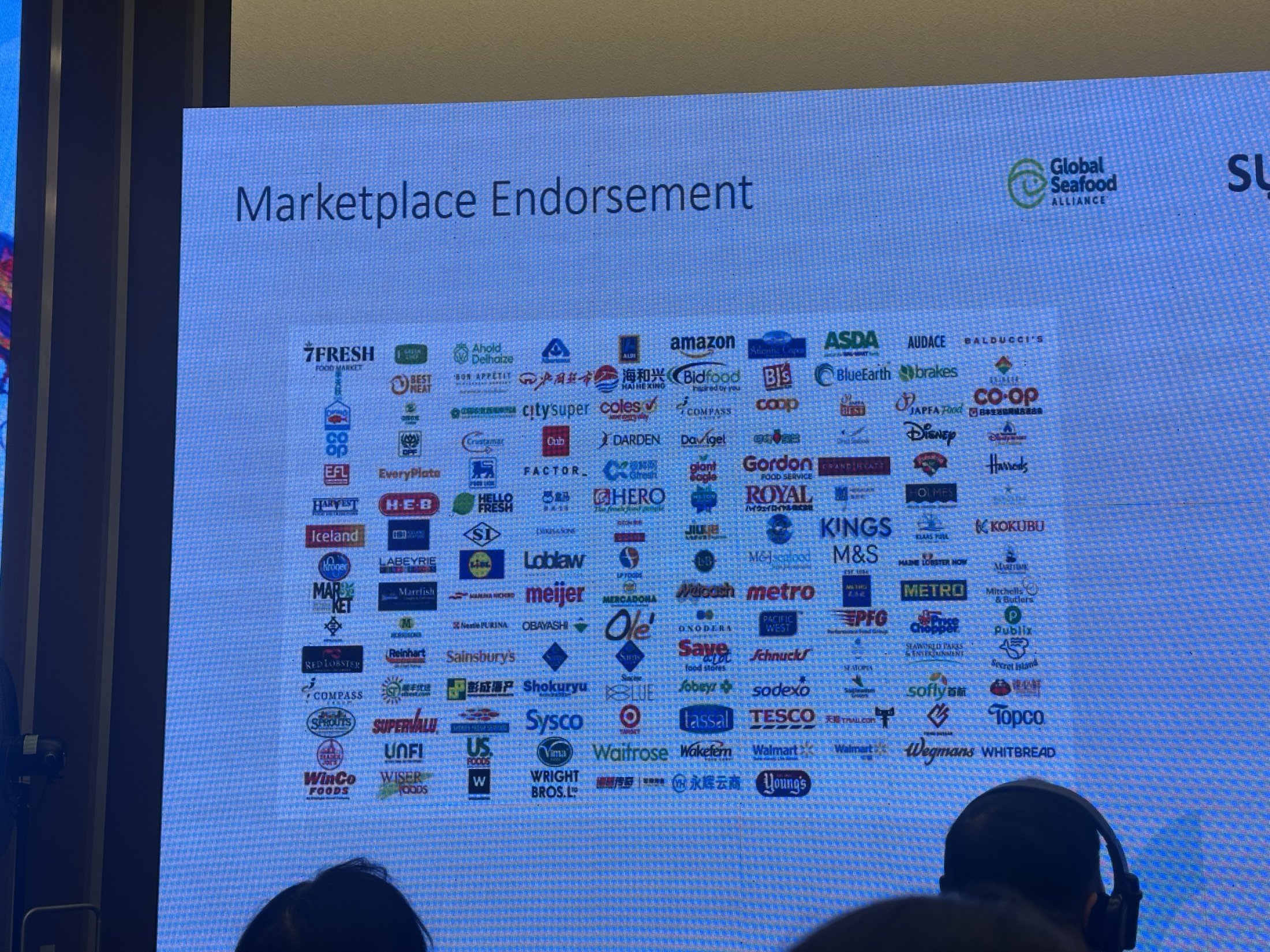
If GFSI, GSSI and SSCI are the three technical "judges", the next slide Mr. Kocsis showed — "Marketplace Endorsement" — is the evidence that buyers actually see every day. It is a board packed with the logos of hundreds of global retailers, supermarket chains, food service companies and trading platforms that publicly recognize GSA certification when sourcing seafood. At a glance, you can spot names familiar to anyone who has ever handled export orders: Amazon, Walmart, Tesco, ASDA, ALDI, Ahold Delhaize, Sainsbury's, Waitrose, Kroger, Publix, Target, Meijer, Mercadona, Metro, Sysco, US Foods, Gordon Food Service, Bidfood, Sodexo, Compass Group, HelloFresh, Red Lobster — along with China's e-commerce platform Tmall (天猫).
04On the same stage as Walmart, ALDI and Red Lobster — a Vietnamese name
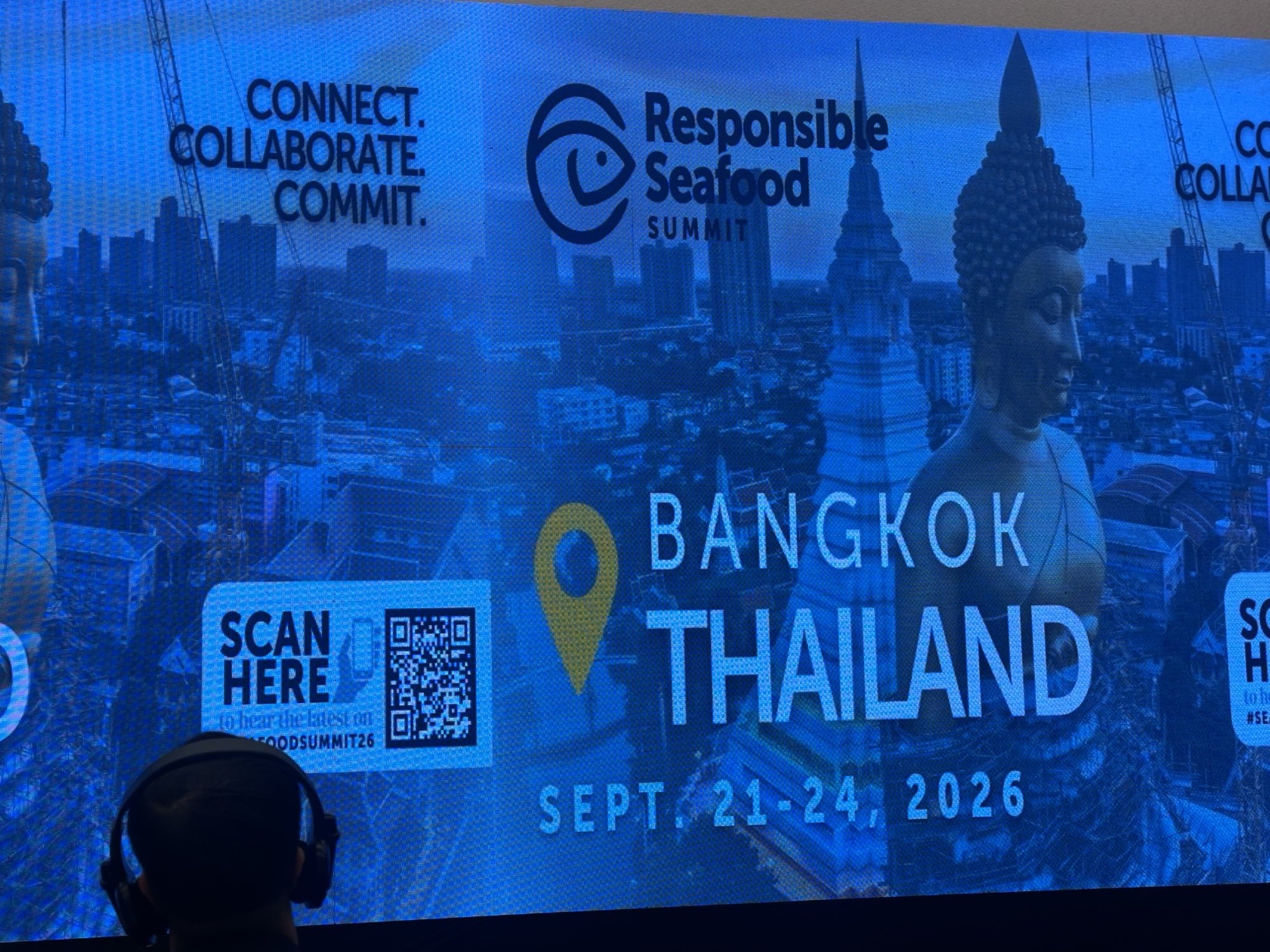
Mr. Kocsis closed his presentation with an invitation to GSA's largest annual event: the Responsible Seafood Summit, held in Bangkok, Thailand, September 21–24, 2026, under the message "Connect. Collaborate. Commit." — the very conference of the training arm mentioned in Part 1.
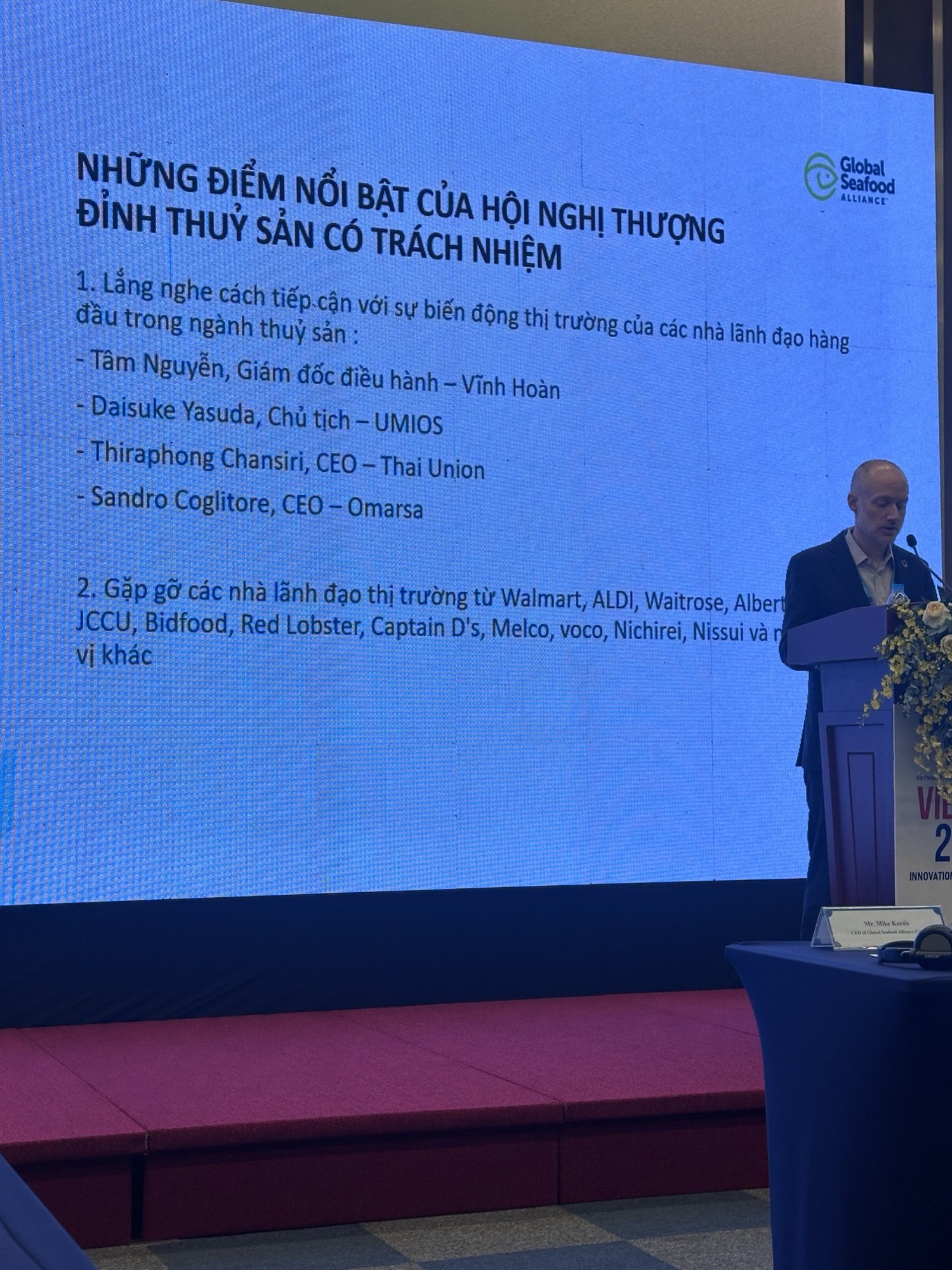
The program slide shows two notable things. First, among the seafood industry leaders taking the stage to share how they respond to market volatility is Tâm Nguyễn — CEO of Vĩnh Hoàn — alongside the CEO of Thai Union (Thiraphong Chansiri), the CEO of Omarsa (Sandro Coglitore) and the Chairman of UMIOS (Daisuke Yasuda). Second, the "meet the market leaders" session names a long list of major buyers: Walmart, ALDI, Waitrose, JCCU, Bidfood, Red Lobster, Captain D's, Melco, voco, Nichirei, Nissui and many others.
05A lesson not just for exporters
GSA's six-step process offers a benchmark worth following for anyone who writes standards or procedures in Vietnam's seafood industry — from a cooperative's farming protocol to a company's internal standard: written by people with expertise, reviewed at an independent level, open to comments from practitioners, and with a transition period long enough for ponds to adjust. Transparency does not weaken a standard — it is what makes people trust it and follow it willingly.

Digitize your farm records with Nuôi Lời
Log feed, water quality, cast-net sampling, medicines and costs right at the pond; export multi-sheet Excel reports that support traceability records in line with ASC and GMP — exactly what standards such as BAP require. Free, sign in with your phone number, no email needed.
Try Nuôi Lời →